01 / Morfologi

Ciri dan struktur

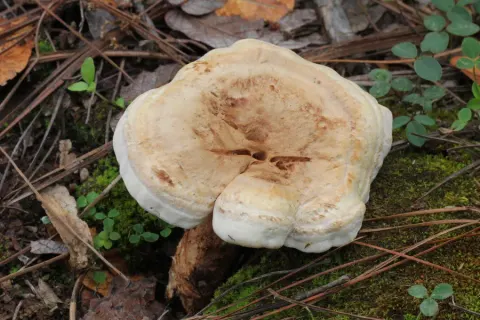
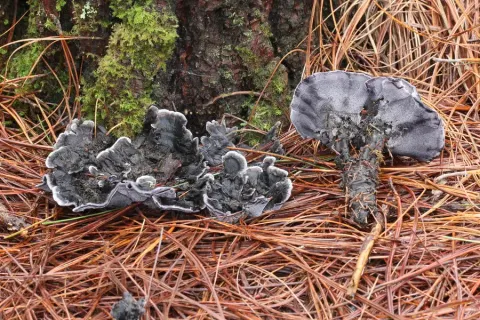
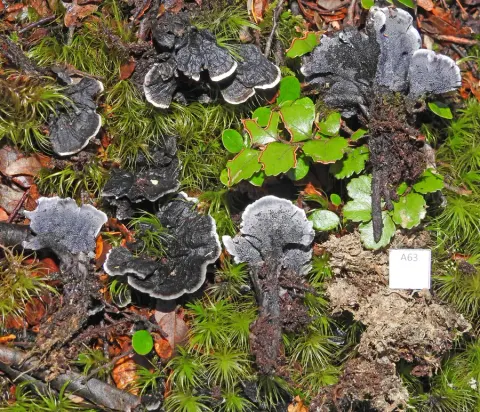
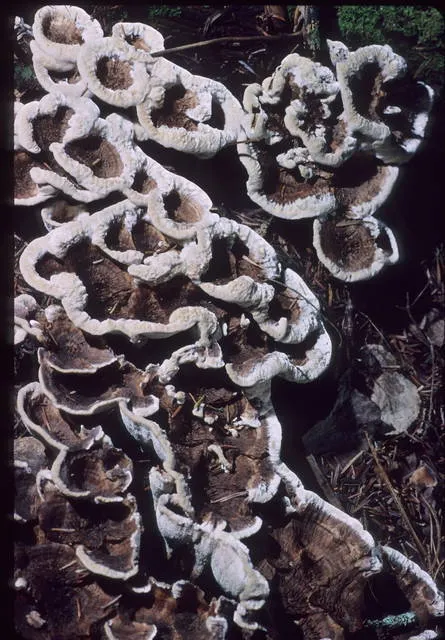
Phellodon confluens produces fruit bodies (or basidiocarps) with a firm, corky texture. The cap (or pileus) is round to irregular in outline and varies from 3–9 cm in diameter, often fusing with adjacent caps to form clusters. Young caps are whitish grey and smooth (glabrous) but darken to brown or almost black as they age. The cap surface may be slightly depressed or pitted and frequently gives rise to new, smaller pilei at its margin. On the underside, the hymenophore (the fertile, spore-bearing surface) is densely "toothed" (hydnoid) rather than gilled or pored, with individual spines up to 3 mm long that are white to pale grey. The flesh (context) is organised in two layers (duplex), especially noticeable in the stalk, and ranges from pinkish brown to dark brown. When tasted, the flesh has a faintly spicy note. The stalk (stipe) measures 10–40 by 10–20 mm, is covered in a fine, woolly (tomentose) grey to dark brown surface and firmly supports the cap. Microscopically, the fungus has a monomitic hyphal system—containing only generative hyphae—that are simple-septate (each cell divided by a single cross-wall), translucent (hyaline) and 3–6 μm wide. Its spores are roughly elliptic, 3.5–4 by 3–4 μm in size, hyaline and adorned with minute spines.

Sebagian uraian ditampilkan dalam bahasa sumber; terjemahannya belum tersedia atau belum lolos pemeriksaan.

Rujukan: [1]

Pengukuran mengikuti objek, spesimen atau kultur, dan metode yang disebutkan sumber. Baca uraian asli untuk konteks lengkap.

02 / Kehidupan

Habitat dan peran ekologis

The fungus has a northern hemisphere distribution and is found in Asia, Europe, and North America. It is considered vulnerable in Switzerland. In northern Europe, the fungus follows the distribution of its host tree (Quercus), extending to central Sweden and to southern Finland.

Sebagian uraian ditampilkan dalam bahasa sumber; terjemahannya belum tersedia atau belum lolos pemeriksaan.

Rujukan: [1]

Habitat atau konteks temuan
Informasi belum tersedia pada sumber rilis ini.
Substrat
Informasi belum tersedia pada sumber rilis ini.
Peran atau konteks
Belum dikategorikan pada rilis ini.
Temukan hubungan serupa
03 / Siklus hidup

Reproduksi

Phellodon confluens produces fruit bodies (or basidiocarps) with a firm, corky texture. The cap (or pileus) is round to irregular in outline and varies from 3–9 cm in diameter, often fusing with adjacent caps to form clusters. Young caps are whitish grey and smooth (glabrous) but darken to brown or almost black as they age. The cap surface may be slightly depressed or pitted and frequently gives rise to new, smaller pilei at its margin. On the underside, the hymenophore (the fertile, spore-bearing surface) is densely "toothed" (hydnoid) rather than gilled or pored, with individual spines up to 3 mm long that are white to pale grey. The flesh (context) is organised in two layers (duplex), especially noticeable in the stalk, and ranges from pinkish brown to dark brown.

Sebagian uraian ditampilkan dalam bahasa sumber; terjemahannya belum tersedia atau belum lolos pemeriksaan.

Rujukan: [1]

Sinonim menurut acuan taksonomi rilis: Calodon amicus; Hydnellum amicum; Hydnum amicum; Hydnum confluens; Hydnum vellereum; Phellodon amicus; Phellodon confluens var. corrugatus; Phellodon vellereus; Sarcodon amicus
04 / Batas informasi

Catatan identitas dan cakupan

  • Nama diterima mengikuti Catalogue of Life Base2026-09-11; uraian mempertahankan konsep dan nama sumber aslinya.
  • Original geographic, specimen and life-cycle scope retained; source import awaits individual editorial review.
  • Impor dan terjemahan otomatis belum diperiksa editorial per profil. Struktur reproduktif yang disebutkan tidak membuktikan seluruh siklus hidup diketahui.
  • Pengukuran pada uraian mengikuti spesimen, kultur, dan metode sumber; angka tidak diperluas ke semua populasi.

Catatan distribusi dalam narasi mengikuti sumbernya. Dokumentasi spesimen atau foto mengikuti catatan sumber. Bukti wilayah Indonesia dan penilaian konservasi tidak disimpulkan dari gambar.

05 / Dokumentasi

Melihat dengan konteks

Dokumentasi Phellodon confluens menurut asosiasi foto pada record takson iNaturalist. Kredit: walt sturgeon. Identitas mengikuti sumber; bukan penentuan spesimen independen.

Jenis
Fotografi
Kredit
(c) walt sturgeon, some rights reserved (CC BY-SA)
Sumber media
Buka entri sumber

Gambar menunjukkan objek menurut identifikasi sumber, bukan verifikasi independen spesimen oleh Fungi. Tidak ada skala baru yang ditambahkan.

06 / Rujukan

Sumber profil

  1. [1] Phellodon confluens — Wikipedia (en)Bagian sumber: Frozen revision 1366987840
    Tanggal penghimpunan sumber: 2026-10-12
    Teks sumber: CC BY-SA4.0 · Wikipedia contributors
  2. [2] Catalogue of Life Base2026-09-11 — Phellodon confluensBagian sumber: ColDP NameUsage.tsv ID 4FZM6; accepted species; source 2073
    Tanggal penghimpunan sumber: 2026-10-12
  3. [3] Dokumentasi visual — Phellodon confluensBagian sumber: Individual media record; identification follows the source, not independent determination
    Tanggal penghimpunan sumber: 2026-10-12
    Media sumber: CC BY-SA 4.0 · (c) walt sturgeon, some rights reserved (CC BY-SA)

Adaptasi teks: CC BY-SA 4.0. Wikipedia contributors — Phellodon confluens — Wikipedia (en)

Uraian asli dan riwayat sumber

Riwayat atau halaman sumber

Ringkasan sumber

Phellodon confluens, commonly known as the fused cork hydnum, is a species of tooth fungus in the family Bankeraceae. The fungus produces firm, corky fruit bodies with caps that are initially whitish grey before darkening to brown or black with age, and these caps often fuse together to form clusters. Its underside features small tooth-like spines rather than gills or pores, which are white to pale grey in colour. The species has a northern hemisphere distribution, found in forested areas of Asia, Europe, and North America, typically associated with oak trees.

Revisi sumber

Morfologi sumber

Phellodon confluens produces fruit bodies (or basidiocarps) with a firm, corky texture. The cap (or pileus) is round to irregular in outline and varies from 3–9 cm in diameter, often fusing with adjacent caps to form clusters. Young caps are whitish grey and smooth (glabrous) but darken to brown or almost black as they age. The cap surface may be slightly depressed or pitted and frequently gives rise to new, smaller pilei at its margin. On the underside, the hymenophore (the fertile, spore-bearing surface) is densely "toothed" (hydnoid) rather than gilled or pored, with individual spines up to 3 mm long that are white to pale grey. The flesh (context) is organised in two layers (duplex), especially noticeable in the stalk, and ranges from pinkish brown to dark brown. When tasted, the flesh has a faintly spicy note. The stalk (stipe) measures 10–40 by 10–20 mm, is covered in a fine, woolly (tomentose) grey to dark brown surface and firmly supports the cap. Microscopically, the fungus has a monomitic hyphal system—containing only generative hyphae—that are simple-septate (each cell divided by a single cross-wall), translucent (hyaline) and 3–6 μm wide. Its spores are roughly elliptic, 3.5–4 by 3–4 μm in size, hyaline and adorned with minute spines.

Revisi sumber

Ekologi sumber

The fungus has a northern hemisphere distribution and is found in Asia, Europe, and North America. It is considered vulnerable in Switzerland. In northern Europe, the fungus follows the distribution of its host tree (Quercus), extending to central Sweden and to southern Finland.

Revisi sumber

Struktur reproduksi sumber

Phellodon confluens produces fruit bodies (or basidiocarps) with a firm, corky texture. The cap (or pileus) is round to irregular in outline and varies from 3–9 cm in diameter, often fusing with adjacent caps to form clusters. Young caps are whitish grey and smooth (glabrous) but darken to brown or almost black as they age. The cap surface may be slightly depressed or pitted and frequently gives rise to new, smaller pilei at its margin. On the underside, the hymenophore (the fertile, spore-bearing surface) is densely "toothed" (hydnoid) rather than gilled or pored, with individual spines up to 3 mm long that are white to pale grey. The flesh (context) is organised in two layers (duplex), especially noticeable in the stalk, and ranges from pinkish brown to dark brown.

Revisi sumber

Rujukan halaman ini

Fungi. Phellodon confluens. Rilis data fungi-2026-10-12-expansion-2. https://fungi-atlas.mgadib.chatgpt.site/jamur/phellodon-confluens/.

Status: impor sumber; pemeriksaan editorial per profil belum selesai. Untuk klaim biologis, gunakan rujukan pada bagian terkait dan periksa konteks sumber aslinya.