01 / Morfologi

Ciri dan struktur

The cap (pileus) of Phlegmacium ochribubalinum measures 5–8 cm across and begins convex, soon flattening to a slight dome (plano‑convex), occasionally bearing a broad central bump (umbo). Its surface is very finely fibrillose—covered in delicate fibres—and has an ochre‑yellow centre that grades to whitish at the margin. Beneath the cap, the gills (lamellae) are moderately spaced and notched where they attach to the stipe (emarginate). They start a very pale brownish‑grey and deepen to pale brown as the mushroom matures. The stipe stands 6–10 cm tall, narrowing from 1.5–2 cm at the base to 0.8–1.3 cm at the apex. It is club‑shaped (clavate), initially white, and gradually acquires a pale brown‑yellow hue with age. A thin white universal veil may persist as a delicate film on the cap margin and as narrow belts encircling the stipe. The flesh (context) is uniformly white, and the mushroom emits a pleasantly mild odour. When dried and deposited as specimens (Latin: specimina exsiccata) in herbaria, the cap centre becomes warm yellow‑brown, fading to a pale leather colour or nearly white toward the edge; the stipe matches the cap's paler tones. Under the microscope, spores measured in Melzer's reagent average 12.5–14.3 by 7.5–8.2 μm (length–middle value–width). They are almond‑shaped (amygdaloid), densely warted (verrucose), especially near the tip, and show a moderate dextrinoid reaction (reddish‑brown staining). The four‑spored basidia are 39–48 by 9–12 μm and contain granules from large to minute. The inner gill tissue (trama) is formed of hyphae bearing dark, almost black granules, while hyphae at the stipe apex are yellow with clear droplets (guttules) but lack granules.

Sebagian uraian ditampilkan dalam bahasa sumber; terjemahannya belum tersedia atau belum lolos pemeriksaan.

Rujukan: [1]

Pengukuran mengikuti objek, spesimen atau kultur, dan metode yang disebutkan sumber. Baca uraian asli untuk konteks lengkap.

02 / Kehidupan

Habitat dan peran ekologis

Phlegmacium ochribubalinum is found in South Finland, where it grows on the ground with deciduous trees.

Sebagian uraian ditampilkan dalam bahasa sumber; terjemahannya belum tersedia atau belum lolos pemeriksaan.

Rujukan: [1]

Habitat atau konteks temuan
Informasi belum tersedia pada sumber rilis ini.
Substrat
tanah
Peran atau konteks
Belum dikategorikan pada rilis ini.
Temukan hubungan serupa
03 / Siklus hidup

Reproduksi

Under the microscope, spores measured in Melzer's reagent average 12.5–14.3 by 7.5–8.2 μm (length–middle value–width). They are almond‑shaped (amygdaloid), densely warted (verrucose), especially near the tip, and show a moderate dextrinoid reaction (reddish‑brown staining). The four‑spored basidia are 39–48 by 9–12 μm and contain granules from large to minute. The inner gill tissue (trama) is formed of hyphae bearing dark, almost black granules, while hyphae at the stipe apex are yellow with clear droplets (guttules) but lack granules. Veil (cortina) hyphae are sand‑brown to slightly reddish with scattered red granules.

Sebagian uraian ditampilkan dalam bahasa sumber; terjemahannya belum tersedia atau belum lolos pemeriksaan.

Rujukan: [1]

Sinonim menurut acuan taksonomi rilis: Cortinarius ochribubalinus
04 / Batas informasi

Catatan identitas dan cakupan

  • Nama diterima mengikuti Catalogue of Life Base2026-09-11; uraian mempertahankan konsep dan nama sumber aslinya.
  • Original geographic, specimen and life-cycle scope retained; source import awaits individual editorial review.
  • Impor dan terjemahan otomatis belum diperiksa editorial per profil. Struktur reproduktif yang disebutkan tidak membuktikan seluruh siklus hidup diketahui.
  • Pengukuran pada uraian mengikuti spesimen, kultur, dan metode sumber; angka tidak diperluas ke semua populasi.

Catatan distribusi dalam narasi mengikuti sumbernya. Dokumentasi spesimen atau foto mengikuti catatan sumber. Bukti wilayah Indonesia dan penilaian konservasi tidak disimpulkan dari gambar.

05 / Dokumentasi

Melihat dengan konteks

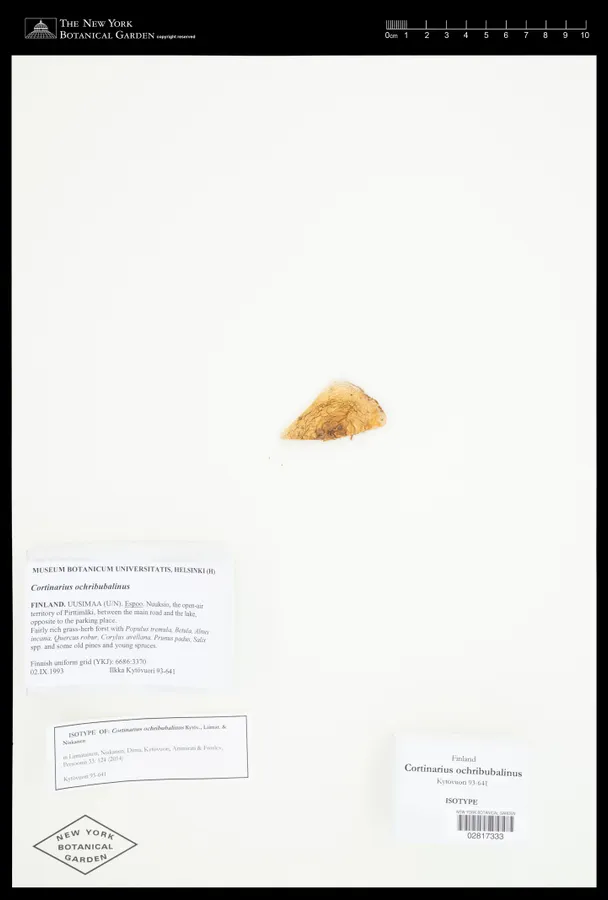
Voucher herbarium Cortinarius ochribubalinus (02817333), The New York Botanical Garden. Identifikasi mengikuti record spesimen sumber. Foto bahan, kemasan, atau label herbarium sebagaimana tersedia pada record institusi; bukan foto lapangan atau penentuan spesimen independen.

Jenis
Voucher herbarium
Kredit
The New York Botanical Garden
Lisensi
CC BY 4.0
Sumber media
Buka entri sumber

Gambar menunjukkan objek menurut identifikasi sumber, bukan verifikasi independen spesimen oleh Fungi. Tidak ada skala baru yang ditambahkan.

06 / Rujukan

Sumber profil

  1. [1] Phlegmacium ochribubalinum — Wikipedia (en)Bagian sumber: Frozen revision 1312572195
    Tanggal penghimpunan sumber: 2026-10-12
    Teks sumber: CC BY-SA4.0 · Wikipedia contributors
  2. [2] Catalogue of Life Base2026-09-11 — Phlegmacium ochribubalinumBagian sumber: ColDP NameUsage.tsv ID B2NJB; accepted species; source 2073
    Tanggal penghimpunan sumber: 2026-10-12
  3. [3] Dokumentasi visual — Cortinarius ochribubalinusBagian sumber: Individual media record; identification follows the source, not independent determination
    Tanggal penghimpunan sumber: 2026-10-12
    Media sumber: CC BY 4.0 · The New York Botanical Garden

Adaptasi teks: CC BY-SA 4.0. Wikipedia contributors — Phlegmacium ochribubalinum — Wikipedia (en)

Uraian asli dan riwayat sumber

Riwayat atau halaman sumber

Ringkasan sumber

Phlegmacium ochribubalinum is a species of mushroom-forming fungus in the family Cortinariaceae, originally described in 2014 as Cortinarius ochribubalinus before being reclassified in 2022 based on molecular data. The mushroom features a 5–8 centimetre cap with an ochre-yellow centre fading to whitish at the margins, moderately spaced pale brownish-grey gills, and a club-shaped white stipe that gradually turns pale brown-yellow with age. It grows on the ground among deciduous trees in South Finland, particularly in species-rich woodlands dominated by aspen, birch, alder, oak, hazel and other broad-leaved trees.

Revisi sumber

Morfologi sumber

The cap (pileus) of Phlegmacium ochribubalinum measures 5–8 cm across and begins convex, soon flattening to a slight dome (plano‑convex), occasionally bearing a broad central bump (umbo). Its surface is very finely fibrillose—covered in delicate fibres—and has an ochre‑yellow centre that grades to whitish at the margin. Beneath the cap, the gills (lamellae) are moderately spaced and notched where they attach to the stipe (emarginate). They start a very pale brownish‑grey and deepen to pale brown as the mushroom matures. The stipe stands 6–10 cm tall, narrowing from 1.5–2 cm at the base to 0.8–1.3 cm at the apex. It is club‑shaped (clavate), initially white, and gradually acquires a pale brown‑yellow hue with age. A thin white universal veil may persist as a delicate film on the cap margin and as narrow belts encircling the stipe. The flesh (context) is uniformly white, and the mushroom emits a pleasantly mild odour. When dried and deposited as specimens (Latin: specimina exsiccata) in herbaria, the cap centre becomes warm yellow‑brown, fading to a pale leather colour or nearly white toward the edge; the stipe matches the cap's paler tones. Under the microscope, spores measured in Melzer's reagent average 12.5–14.3 by 7.5–8.2 μm (length–middle value–width). They are almond‑shaped (amygdaloid), densely warted (verrucose), especially near the tip, and show a moderate dextrinoid reaction (reddish‑brown staining). The four‑spored basidia are 39–48 by 9–12 μm and contain granules from large to minute. The inner gill tissue (trama) is formed of hyphae bearing dark, almost black granules, while hyphae at the stipe apex are yellow with clear droplets (guttules) but lack granules.

Revisi sumber

Ekologi sumber

Phlegmacium ochribubalinum is found in South Finland, where it grows on the ground with deciduous trees.

Revisi sumber

Struktur reproduksi sumber

Under the microscope, spores measured in Melzer's reagent average 12.5–14.3 by 7.5–8.2 μm (length–middle value–width). They are almond‑shaped (amygdaloid), densely warted (verrucose), especially near the tip, and show a moderate dextrinoid reaction (reddish‑brown staining). The four‑spored basidia are 39–48 by 9–12 μm and contain granules from large to minute. The inner gill tissue (trama) is formed of hyphae bearing dark, almost black granules, while hyphae at the stipe apex are yellow with clear droplets (guttules) but lack granules. Veil (cortina) hyphae are sand‑brown to slightly reddish with scattered red granules.

Revisi sumber

Rujukan halaman ini

Fungi. Phlegmacium ochribubalinum. Rilis data fungi-2026-10-12-expansion-2. https://fungi-atlas.mgadib.chatgpt.site/jamur/phlegmacium-ochribubalinum/.

Status: impor sumber; pemeriksaan editorial per profil belum selesai. Untuk klaim biologis, gunakan rujukan pada bagian terkait dan periksa konteks sumber aslinya.