01 / Morfologi

Ciri dan struktur

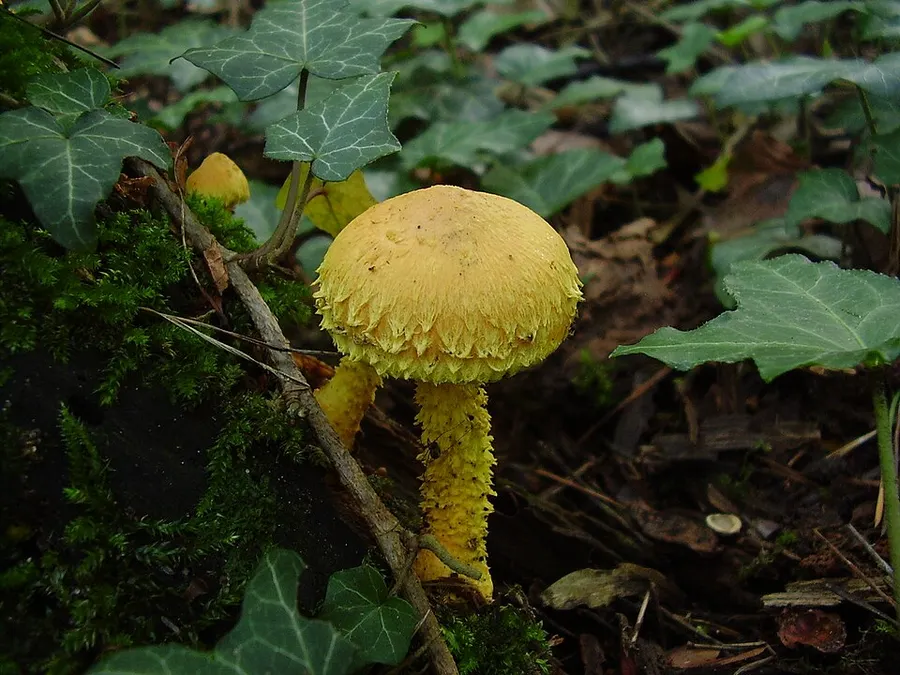
Pholiota flammans often has a striking appearance. The cap is initially round, then convex and finally flattening with age. Its surface is bright yellow to orange, and covered with triangular scales (squamules) arranged in concentric rings. The cap surface is dry, matt and felt-like, and in wet conditions may lose scales. The cap margin remain curved slightly inwards. The yellow gills are crowded together, attached to the stem, and have a notch where the gill attaches to the stem. As the fruit body matures, the gills darken to cinnamon brown following spore release. The spore print is brown to rust. Under a light microscope, the spores are seen to be smooth, elliptical to oblong in shape, with dimensions of 3–5 by 2–3 μm. The basidia (the spore-bearing cells) are 4-spored, and have a narrow club-shape with dimension of 18–22 by 3.5–4.5 μm. The gill cystidia are seen to stain blue when cotton blue dye and lactate are applied. The gelatinous hyphae are only present on the cap surface, not the surface of the stem; these local differences in cell structure explain the ease with which the scales are sloughed off the cap, but not the stems of the fruit bodies. The macroscopic and microscopic characteristics of the mycelia of this species grown in culture have been described in detail.

Sebagian uraian ditampilkan dalam bahasa sumber; terjemahannya belum tersedia atau belum lolos pemeriksaan.

Rujukan: [1]

Pengukuran mengikuti objek, spesimen atau kultur, dan metode yang disebutkan sumber. Baca uraian asli untuk konteks lengkap.

02 / Kehidupan

Habitat dan peran ekologis

Being saprobic, P. flammans ditemukan secara eksklusif pada batang dan batang pohon konifer yang mati dan membusuk, dengan tubuh buah muncul dalam tuft atau tunggal, dari musim panas hingga musim gugur. dan China.

Rujukan: [1]

Habitat atau konteks temuan
Informasi belum tersedia pada sumber rilis ini.
Substrat
Informasi belum tersedia pada sumber rilis ini.
Peran atau konteks
Pengurai
Temukan hubungan serupa
03 / Siklus hidup

Reproduksi

Pholiota flammans often has a striking appearance. The cap is initially round, then convex and finally flattening with age. Its surface is bright yellow to orange, and covered with triangular scales (squamules) arranged in concentric rings. The cap surface is dry, matt and felt-like, and in wet conditions may lose scales. The cap margin remain curved slightly inwards. The yellow gills are crowded together, attached to the stem, and have a notch where the gill attaches to the stem. As the fruit body matures, the gills darken to cinnamon brown following spore release. The spore print is brown to rust. Under a light microscope, the spores are seen to be smooth, elliptical to oblong in shape, with dimensions of 3–5 by 2–3 μm.

Sebagian uraian ditampilkan dalam bahasa sumber; terjemahannya belum tersedia atau belum lolos pemeriksaan.

Rujukan: [1]

Sinonim menurut acuan taksonomi rilis: Dryophila flammans; Hypodendrum flammans
04 / Batas informasi

Catatan identitas dan cakupan

  • Nama diterima mengikuti Catalogue of Life Base2026-09-11; uraian mempertahankan konsep dan nama sumber aslinya.
  • Original geographic, specimen and life-cycle scope retained; source import awaits individual editorial review.
  • Impor dan terjemahan otomatis belum diperiksa editorial per profil. Struktur reproduktif yang disebutkan tidak membuktikan seluruh siklus hidup diketahui.
  • Pengukuran pada uraian mengikuti spesimen, kultur, dan metode sumber; angka tidak diperluas ke semua populasi.

Catatan distribusi dalam narasi mengikuti sumbernya. Dokumentasi spesimen atau foto mengikuti catatan sumber. Bukti wilayah Indonesia dan penilaian konservasi tidak disimpulkan dari gambar.

05 / Dokumentasi

Melihat dengan konteks

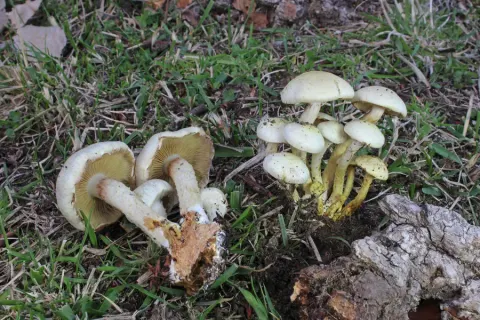
Dokumentasi Pholiota flammans dari Wikimedia Commons. Pholiota flammans. Sofia, Bulgaria. Identifikasi mengikuti record berkas sumber.

Jenis
Fotografi
Kredit
Paffka
Sumber media
Buka entri sumber

Gambar menunjukkan objek menurut identifikasi sumber, bukan verifikasi independen spesimen oleh Fungi. Tidak ada skala baru yang ditambahkan.

06 / Rujukan

Sumber profil

  1. [1] Pholiota flammans — Wikipedia (en)Bagian sumber: Frozen revision 1350417606
    Tanggal penghimpunan sumber: 2026-10-12
    Teks sumber: CC BY-SA4.0 · Wikipedia contributors
  2. [2] Catalogue of Life Base2026-09-11 — Pholiota flammansBagian sumber: ColDP NameUsage.tsv ID 4GM32; accepted species; source 2073
    Tanggal penghimpunan sumber: 2026-10-12
  3. [3] Dokumentasi visual — Pholiota flammansBagian sumber: Individual media record; identification follows the source, not independent determination
    Tanggal penghimpunan sumber: 2026-10-12
    Media sumber: CC BY-SA 3.0 · Paffka

Adaptasi teks: CC BY-SA 4.0. Wikipedia contributors — Pholiota flammans — Wikipedia (en)

Uraian asli dan riwayat sumber

Riwayat atau halaman sumber

Ringkasan sumber

Pholiota flammans, commonly known as the yellow pholiota, the flaming Pholiota, or the flame scalecap, is a basidiomycete agaric mushroom of the genus Pholiota. Its fruit body is golden-yellow in color throughout, while its cap and stem are covered in sharp scales. As it is a saprobic fungus, the fruit bodies typically appear in clusters on the stumps of dead coniferous trees. P. flammans is distributed throughout Europe, North America, and Asia in boreal and temperate regions. Its edibility has not been clarified.

Revisi sumber

Morfologi sumber

Pholiota flammans often has a striking appearance. The cap is initially round, then convex and finally flattening with age. Its surface is bright yellow to orange, and covered with triangular scales (squamules) arranged in concentric rings. The cap surface is dry, matt and felt-like, and in wet conditions may lose scales. The cap margin remain curved slightly inwards. The yellow gills are crowded together, attached to the stem, and have a notch where the gill attaches to the stem. As the fruit body matures, the gills darken to cinnamon brown following spore release. The spore print is brown to rust. Under a light microscope, the spores are seen to be smooth, elliptical to oblong in shape, with dimensions of 3–5 by 2–3 μm. The basidia (the spore-bearing cells) are 4-spored, and have a narrow club-shape with dimension of 18–22 by 3.5–4.5 μm. The gill cystidia are seen to stain blue when cotton blue dye and lactate are applied. The gelatinous hyphae are only present on the cap surface, not the surface of the stem; these local differences in cell structure explain the ease with which the scales are sloughed off the cap, but not the stems of the fruit bodies. The macroscopic and microscopic characteristics of the mycelia of this species grown in culture have been described in detail.

Revisi sumber

Ekologi sumber

Being saprobic, P. flammans is found exclusively on dead and decaying stumps and trunks of coniferous trees, with fruit bodies appearing in tufts or singly, from summer to autumn. and China.

Revisi sumber

Struktur reproduksi sumber

Pholiota flammans often has a striking appearance. The cap is initially round, then convex and finally flattening with age. Its surface is bright yellow to orange, and covered with triangular scales (squamules) arranged in concentric rings. The cap surface is dry, matt and felt-like, and in wet conditions may lose scales. The cap margin remain curved slightly inwards. The yellow gills are crowded together, attached to the stem, and have a notch where the gill attaches to the stem. As the fruit body matures, the gills darken to cinnamon brown following spore release. The spore print is brown to rust. Under a light microscope, the spores are seen to be smooth, elliptical to oblong in shape, with dimensions of 3–5 by 2–3 μm.

Revisi sumber

Rujukan halaman ini

Fungi. Pholiota flammans. Rilis data fungi-2026-10-12-expansion-2. https://fungi-atlas.mgadib.chatgpt.site/jamur/pholiota-flammans/.

Status: impor sumber; pemeriksaan editorial per profil belum selesai. Untuk klaim biologis, gunakan rujukan pada bagian terkait dan periksa konteks sumber aslinya.