Ciri dan struktur
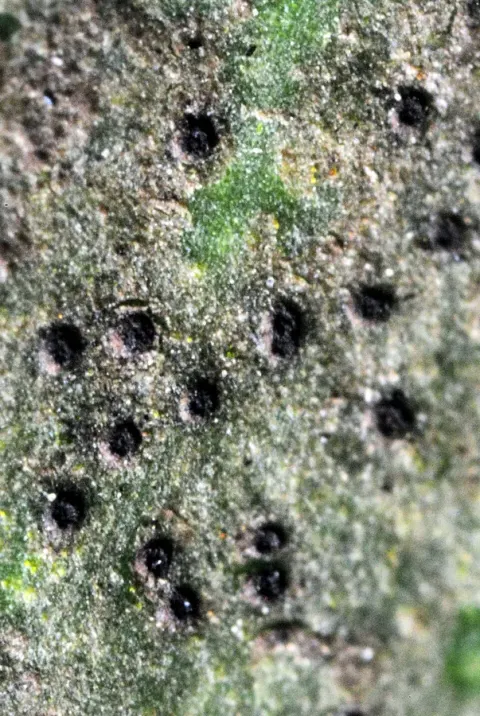
The thallus (the main body of the lichen) of Phylloblastia fortuita appears scattered across leaf surfaces, forming a thin, diffuse, cobweb-like structure with a greenish-grey colouration. The thallus develops more prominently around reproductive structures and consists of clear (hyaline), interwoven fungal threads (hyphae) measuring 3-4 micrometers in thickness. The (the algal partner in the lichen symbiosis) is , with algal cells 6–10 micrometres in diameter that form irregular to rounded clusters surrounded by fungal hyphae. The reproductive structures (perithecia) are (attached directly to the surface without stalks), more or less spherical to hemispherical in shape, with flattened or depressed tops. These measure 0.1–0.2 mm in diameter (occasionally reaching 0.24 mm) and up to 0.1 mm in height, with colouration ranging from greyish brown to dark brown and featuring a felt-like outer surface texture. The perithecia lack an (a protective covering structure). The (the protective layer surrounding the reproductive tissues) measures 18–32 micrometers thick, with two distinct layers. The outer layer resembles a textura globularis (a tissue of spherical cells) with an olivaceous-brown colour, while the inner layer consists of compressed, elongated cells in a arrangement forming a textura angularis (angular tissue). While paraphyses (sterile filaments) are absent, (sterile hair-like structures) are consistently present, appearing colourless with a basal layer of roughly equal-diameter cells and 1–2 oblong apical cells. The asci (spore-producing structures) are club to egg-shaped, each containing 8 spores, measuring 40–60 by 15–20 (sometimes 25) μm, with slightly thickened tips that do not react with iodine stain (I-).
Habitat dan peran ekologis
Phylloblastia fortuita is a species of foliicolous (leaf-dwelling) lichen in the family Verrucariaceae. Found in Western Europe and North America, it was formally described as a new species in 2009 by Esteve Llop and Antonio Gómez-Bolea. The type specimen was collected from Sant Medir (Sant Cugat del Vallès, Barcelona) at an altitude of 220 m, where it was found growing on the leaves of Ilex aquifolium. The lichen, originally documented as occurring in the Mediterranean climate of the Iberian Peninsula, was reported from Marin County, California, in 2016. Other plants from which it has been documented include Buxus sempervirens, Hedera helix, Quercus ilex, and, in North America, Sequoia sempervirens.
- Habitat atau konteks temuan
- Informasi belum tersedia pada sumber rilis ini.
- Substrat
- Informasi belum tersedia pada sumber rilis ini.
- Peran atau konteks
- Pembentuk liken
Reproduksi
The thallus (the main body of the lichen) of Phylloblastia fortuita appears scattered across leaf surfaces, forming a thin, diffuse, cobweb-like structure with a greenish-grey colouration. The thallus develops more prominently around reproductive structures and consists of clear (hyaline), interwoven fungal threads (hyphae) measuring 3-4 micrometers in thickness. The (the algal partner in the lichen symbiosis) is , with algal cells 6–10 micrometres in diameter that form irregular to rounded clusters surrounded by fungal hyphae. The reproductive structures (perithecia) are (attached directly to the surface without stalks), more or less spherical to hemispherical in shape, with flattened or depressed tops.
Catatan identitas dan cakupan
- Nama diterima mengikuti Catalogue of Life Base2026-09-11; uraian mempertahankan konsep dan nama sumber aslinya.
- Original geographic, specimen and life-cycle scope retained; source import awaits individual editorial review.
- Impor dan terjemahan otomatis belum diperiksa editorial per profil. Struktur reproduktif yang disebutkan tidak membuktikan seluruh siklus hidup diketahui.
- Pengukuran pada uraian mengikuti spesimen, kultur, dan metode sumber; angka tidak diperluas ke semua populasi.
Catatan distribusi dalam narasi mengikuti sumbernya. Dokumentasi spesimen atau foto mengikuti catatan sumber. Bukti wilayah Indonesia dan penilaian konservasi tidak disimpulkan dari gambar.
Melihat dengan konteks
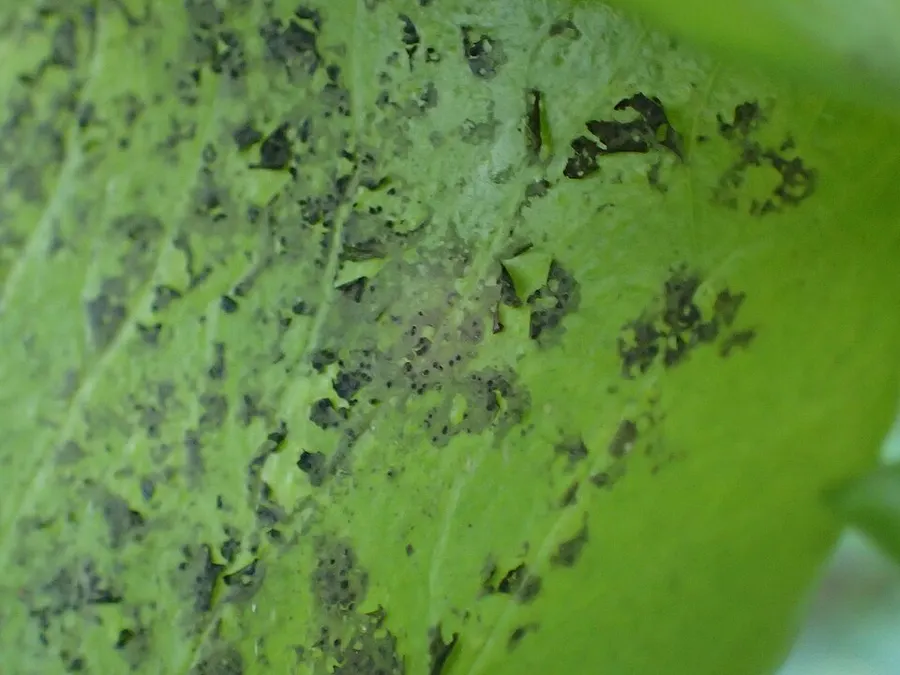
Dokumentasi Phylloblastia fortuita dari Wikimedia Commons. Phylloblastia fortuita, a species of fungus, epiphyllous on Hedera helix. Identifikasi mengikuti record berkas sumber.
- Jenis
- Fotografi
- Kredit
- George Greiff
- Lisensi
- CC BY 4.0
- Sumber media
- Buka entri sumber
Sumber profil
- [1] Phylloblastia fortuita — Wikipedia (en)
- [2] Catalogue of Life Base2026-09-11 — Phylloblastia fortuita
- [3] Dokumentasi visual — Phylloblastia fortuita
Rujukan halaman ini
Fungi. Phylloblastia fortuita. Rilis data fungi-2026-10-12-expansion-2. https://fungi-atlas.mgadib.chatgpt.site/jamur/phylloblastia-fortuita/.
Status: impor sumber; pemeriksaan editorial per profil belum selesai. Untuk klaim biologis, gunakan rujukan pada bagian terkait dan periksa konteks sumber aslinya.