01 / Morfologi

Ciri dan struktur

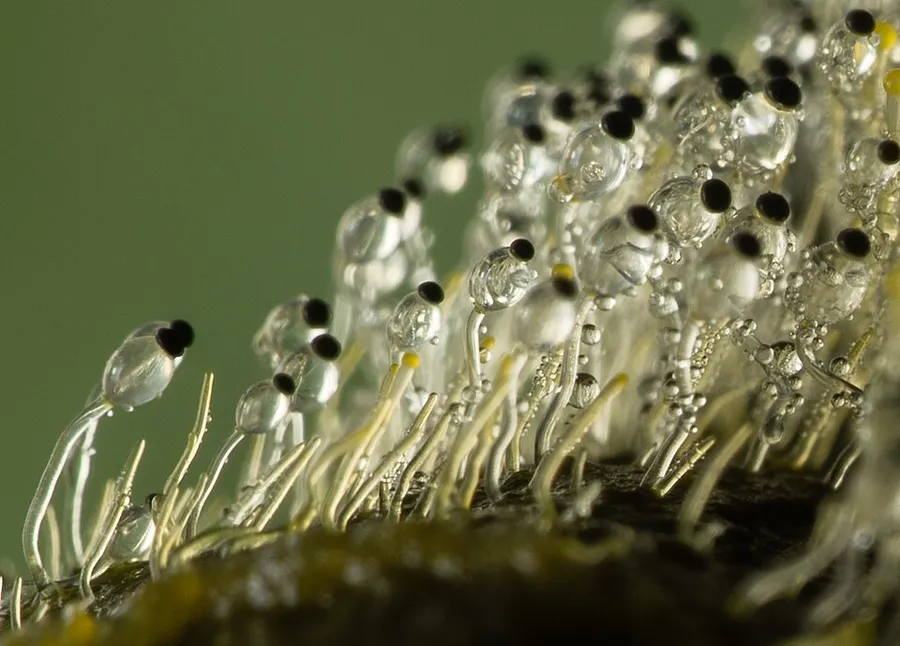
This fungus normally grows beneath the surface – a sensitivity to oxygen inhibits radial growth at the hyphae. According to McVickar (1942), and later amended by Ootaki et al. (1993), the development of P. crystallinus may be divided into six stages: In stage I, the sporangiophore initially elongates at the apex, but does not rotate. In stage II, the sporangiophore develops a sporangium. In stage III, after the development of the sporangium, there is a temporary cessation of growth. In stage IV, a subsporangial vesicle expands beneath the sporangium. This is followed by stage V, where the spore matures, and the region of hypha directly below the subsporangial vesicle continues elongating. Finally, in stage VI, the subsporangial vesicle bursts and throws the sporangium into the air. Scanning and transmission electron microscopy has shown that the surface of the sporangium is covered with crystals of two distinct sizes. The larger crystals enclose spines having a central pore.

Sebagian uraian ditampilkan dalam bahasa sumber; terjemahannya belum tersedia atau belum lolos pemeriksaan.

Rujukan: [1]

Pengukuran mengikuti objek, spesimen atau kultur, dan metode yang disebutkan sumber. Baca uraian asli untuk konteks lengkap.

02 / Kehidupan

Habitat dan peran ekologis

Pilobolus crystallinus, yang biasa dikenal sebagai "kanon dung" atau "penyebar topi", adalah spesies jamur yang termasuk dalam Mucorales order. Ini unik karena ia menempelkan spora-spora ke tumbuhan, sehingga dimakan oleh hewan yang berdaging. Kemudian, ia melewati sistem pencernaan hewan dan tumbuh di kotoran mereka. Although these fungi only grow to be 2 – 4 cm tall, they can shoot their sporangium, containing their spores, up to 2 m away. Due to peningkatan tekanan di vesikel, sporangium dapat mempercepat 0–45 mph dalam milimeter pertama penerbangan, yang sesuai dengan percepatan 20000 g. Dengan menggunakan zat seperti lendir yang ditemukan di vesikel jamur, sporangium dapat menempel pada apapun yang ia kenakan, sehingga menyelesaikan siklus hidupnya. Pilobolus crystallinus telah dilaporkan tumbuh pada pupuk sapi.

Sebagian uraian ditampilkan dalam bahasa sumber; terjemahannya belum tersedia atau belum lolos pemeriksaan.

Rujukan: [1]

Habitat atau konteks temuan
Informasi belum tersedia pada sumber rilis ini.
Substrat
Informasi belum tersedia pada sumber rilis ini.
Peran atau konteks
Belum dikategorikan pada rilis ini.
Temukan hubungan serupa
03 / Siklus hidup

Reproduksi

This fungus normally grows beneath the surface – a sensitivity to oxygen inhibits radial growth at the hyphae. According to McVickar (1942), and later amended by Ootaki et al. (1993), the development of P. crystallinus may be divided into six stages: In stage I, the sporangiophore initially elongates at the apex, but does not rotate. In stage II, the sporangiophore develops a sporangium. In stage III, after the development of the sporangium, there is a temporary cessation of growth. In stage IV, a subsporangial vesicle expands beneath the sporangium. This is followed by stage V, where the spore matures, and the region of hypha directly below the subsporangial vesicle continues elongating. Finally, in stage VI, the subsporangial vesicle bursts and throws the sporangium into the air.

Sebagian uraian ditampilkan dalam bahasa sumber; terjemahannya belum tersedia atau belum lolos pemeriksaan.

Rujukan: [1]

Sinonim menurut acuan taksonomi rilis: Hydrogera crystallina; Hydrogera oblique; Mucor obliquus; Mucor urceolatus; Pilobolus crystallinus var. hyalosporus; Pilobolus hyalosporus; Pilobolus ramosus; Pilobolus schmidtii; Pilobolus simplex; Pilobolus urceolatus
04 / Batas informasi

Catatan identitas dan cakupan

  • Nama diterima mengikuti Catalogue of Life Base2026-09-11; uraian mempertahankan konsep dan nama sumber aslinya.
  • Original geographic, specimen and life-cycle scope retained; source import awaits individual editorial review.
  • Impor dan terjemahan otomatis belum diperiksa editorial per profil. Struktur reproduktif yang disebutkan tidak membuktikan seluruh siklus hidup diketahui.
  • Pengukuran pada uraian mengikuti spesimen, kultur, dan metode sumber; angka tidak diperluas ke semua populasi.

Catatan distribusi dalam narasi mengikuti sumbernya. Dokumentasi spesimen atau foto mengikuti catatan sumber. Bukti wilayah Indonesia dan penilaian konservasi tidak disimpulkan dari gambar.

05 / Dokumentasi

Melihat dengan konteks

Dokumentasi Pilobolus crystallinus dari Wikimedia Commons. For more information about this, see the observation page at Mushroom Observer. Identifikasi mengikuti record berkas sumber.

Jenis
Fotografi
Kredit
This image was created by user Sava Krstic (sava) at Mushroom Observer , a source for mycological images. You can contact this user here .
Sumber media
Buka entri sumber

Gambar menunjukkan objek menurut identifikasi sumber, bukan verifikasi independen spesimen oleh Fungi. Tidak ada skala baru yang ditambahkan.

06 / Rujukan

Sumber profil

  1. [1] Pilobolus crystallinus — Wikipedia (en)Bagian sumber: Frozen revision 1311721038
    Tanggal penghimpunan sumber: 2026-10-12
    Teks sumber: CC BY-SA4.0 · Wikipedia contributors
  2. [2] Catalogue of Life Base2026-09-11 — Pilobolus crystallinusBagian sumber: ColDP NameUsage.tsv ID 4HTV4; accepted species; source 2073
    Tanggal penghimpunan sumber: 2026-10-12
  3. [3] Dokumentasi visual — Pilobolus crystallinusBagian sumber: Individual media record; identification follows the source, not independent determination
    Tanggal penghimpunan sumber: 2026-10-12
    Media sumber: CC BY-SA 3.0 · This image was created by user Sava Krstic (sava) at Mushroom Observer , a source for mycological images. You can contact this user here .

Adaptasi teks: CC BY-SA 4.0. Wikipedia contributors — Pilobolus crystallinus — Wikipedia (en)

Uraian asli dan riwayat sumber

Riwayat atau halaman sumber

Ringkasan sumber

Pilobolus crystallinus, commonly known as the "dung cannon" or "hat thrower", is a species of fungus belonging to the Mucorales order. It is unique in that it adheres its spores to vegetation, so as to be eaten by grazing animals. It then passes through the animals' digestive systems and grows in their feces. Although these fungi only grow to be 2 – 4 cm tall, they can shoot their sporangium, containing their spores, up to 2 m away. Due to an increase of pressure in the vesicle, the sporangium can accelerate 0–45 mph in the first millimeter of its flight, which corresponds to an acceleration of 20000 g.

Revisi sumber

Morfologi sumber

This fungus normally grows beneath the surface – a sensitivity to oxygen inhibits radial growth at the hyphae. According to McVickar (1942), and later amended by Ootaki et al. (1993), the development of P. crystallinus may be divided into six stages: In stage I, the sporangiophore initially elongates at the apex, but does not rotate. In stage II, the sporangiophore develops a sporangium. In stage III, after the development of the sporangium, there is a temporary cessation of growth. In stage IV, a subsporangial vesicle expands beneath the sporangium. This is followed by stage V, where the spore matures, and the region of hypha directly below the subsporangial vesicle continues elongating. Finally, in stage VI, the subsporangial vesicle bursts and throws the sporangium into the air. Scanning and transmission electron microscopy has shown that the surface of the sporangium is covered with crystals of two distinct sizes. The larger crystals enclose spines having a central pore.

Revisi sumber

Ekologi sumber

Pilobolus crystallinus, commonly known as the "dung cannon" or "hat thrower", is a species of fungus belonging to the Mucorales order. It is unique in that it adheres its spores to vegetation, so as to be eaten by grazing animals. It then passes through the animals' digestive systems and grows in their feces. Although these fungi only grow to be 2 – 4 cm tall, they can shoot their sporangium, containing their spores, up to 2 m away. Due to an increase of pressure in the vesicle, the sporangium can accelerate 0–45 mph in the first millimeter of its flight, which corresponds to an acceleration of 20000 g. Using a mucus-like substance found in the vesicle of the fungus, the sporangium can adhere itself onto whatever it lands, thus completing its life cycle. Pilobolus crystallinus has been reported to grow on the dung of cattle.

Revisi sumber

Struktur reproduksi sumber

This fungus normally grows beneath the surface – a sensitivity to oxygen inhibits radial growth at the hyphae. According to McVickar (1942), and later amended by Ootaki et al. (1993), the development of P. crystallinus may be divided into six stages: In stage I, the sporangiophore initially elongates at the apex, but does not rotate. In stage II, the sporangiophore develops a sporangium. In stage III, after the development of the sporangium, there is a temporary cessation of growth. In stage IV, a subsporangial vesicle expands beneath the sporangium. This is followed by stage V, where the spore matures, and the region of hypha directly below the subsporangial vesicle continues elongating. Finally, in stage VI, the subsporangial vesicle bursts and throws the sporangium into the air.

Revisi sumber

Rujukan halaman ini

Fungi. Pilobolus crystallinus. Rilis data fungi-2026-10-12-expansion-2. https://fungi-atlas.mgadib.chatgpt.site/jamur/pilobolus-crystallinus/.

Status: impor sumber; pemeriksaan editorial per profil belum selesai. Untuk klaim biologis, gunakan rujukan pada bagian terkait dan periksa konteks sumber aslinya.
