01 / Morfologi

Ciri dan struktur

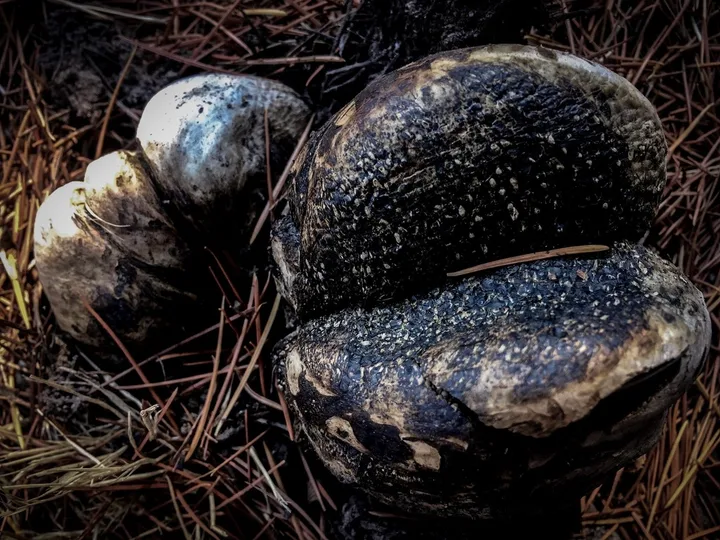
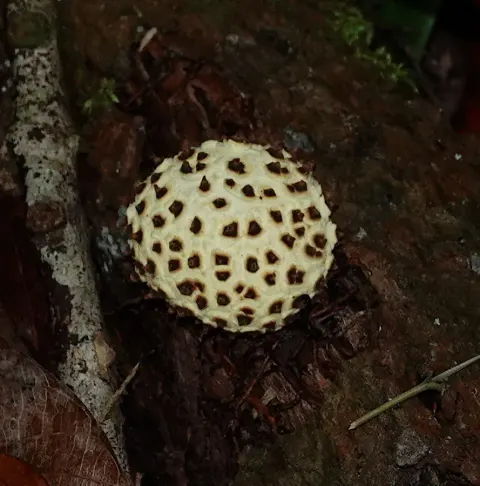
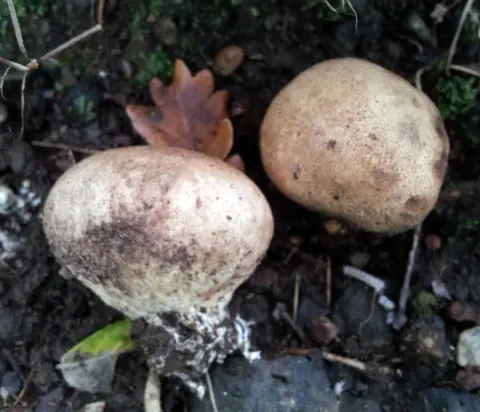
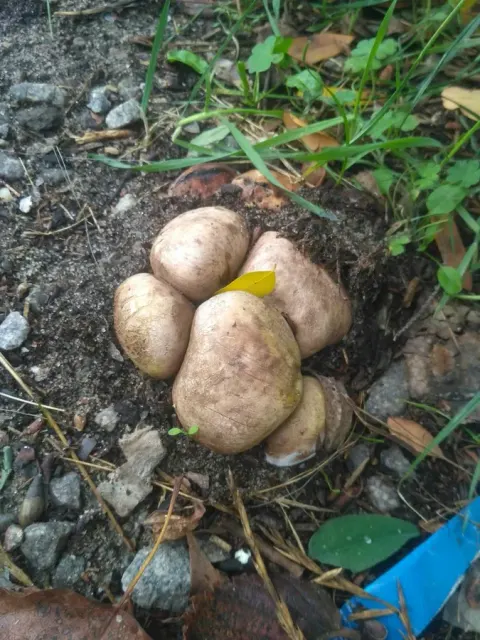
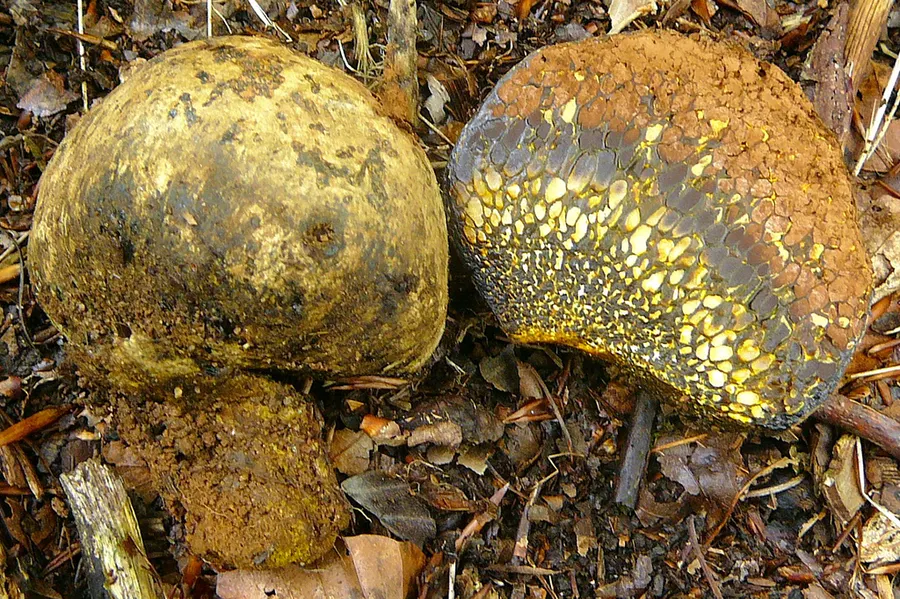
The fruiting body is varying in size, and can be 5–30 cm tall and 4–20 cm. Immatures have been described to be oblong, somewhat resembling the shape of a rugby ball. There is some variation in coloration, and mature Pisolithus Arhizus feature a shiny gray/brown shell with darker and lighter/whitish/yellowish patches depending on the specimen. As it ages, the fungus can develop a rudimentary stipe or stem, although not all will do this. It also tends to open up, exposing "cracks and fissures, and eventually breaking up to expose the interior." This outer peridium is roughly 1mm thick and within it can be found a mass of pea-sized "pseudoperidioles" which are structures that contain and produce spores, and are fixed in a dark gel. As a reproductive strategy, P.arhizus will release spores to the wind as the peridium turns dry and crumbly/powdery with time. The fungus has non-ornamental spores that are described as "khaki" or "cinnamon" brown, and measure roughly 5-8µm in size.

Sebagian uraian ditampilkan dalam bahasa sumber; terjemahannya belum tersedia atau belum lolos pemeriksaan.

Rujukan: [1]

Pengukuran mengikuti objek, spesimen atau kultur, dan metode yang disebutkan sumber. Baca uraian asli untuk konteks lengkap.

02 / Kehidupan

Habitat dan peran ekologis

Pisolithus arhizus is known to be quite durable; it is found in some unlikely places, tolerating intense soil conditions such as low ph and water concentration, or high temperatures and levels of metal contamination. Specifically, it is often found in soils with gravel and sand as well as in spots like ditches or lawns. They often work to accomplish mineral weathering in order to breakdown harsh rocks and soils, and reallocate these and other nutrients to their host plants. In return, plants supply fungi with carbon, and some estimates suggest some ECM relationships could even account for roughly a fifth of a tree's net carbon budget. P.arhizus specifically is shown to have positive performances on photosynthesis, biomass, and nutrient uptake. Numerous scientific studies on the complex symbiotic relationships of P. arhizus have proved its positive ECM effects on a variety of host plants. In Quercus ilex oaks, the fungus neutralizes harmful compounds from the tree's own leaf litter and transfer the nutrients back to the tree through the roots - an essential step for making certain growing conditions possible for these oaks. Another study shows that P.arhizus aided White Cover (Trifolium repens) growth in contaminated mining soils, and improved the growth as well as the mercury tolerance in these flowers by substantial amounts.

Sebagian uraian ditampilkan dalam bahasa sumber; terjemahannya belum tersedia atau belum lolos pemeriksaan.

Rujukan: [1]

Habitat atau konteks temuan
Informasi belum tersedia pada sumber rilis ini.
Substrat
Informasi belum tersedia pada sumber rilis ini.
Peran atau konteks
Belum dikategorikan pada rilis ini.
Temukan hubungan serupa
03 / Siklus hidup

Reproduksi

The fruiting body is varying in size, and can be 5–30 cm tall and 4–20 cm. Immatures have been described to be oblong, somewhat resembling the shape of a rugby ball. There is some variation in coloration, and mature Pisolithus Arhizus feature a shiny gray/brown shell with darker and lighter/whitish/yellowish patches depending on the specimen. As it ages, the fungus can develop a rudimentary stipe or stem, although not all will do this. It also tends to open up, exposing "cracks and fissures, and eventually breaking up to expose the interior." This outer peridium is roughly 1mm thick and within it can be found a mass of pea-sized "pseudoperidioles" which are structures that contain and produce spores, and are fixed in a dark gel.

Sebagian uraian ditampilkan dalam bahasa sumber; terjemahannya belum tersedia atau belum lolos pemeriksaan.

Rujukan: [1]

Sinonim menurut acuan taksonomi rilis: Cauloglossum novozelandicum; Endacinus tinctorius; Lycoperdodes arhizon; Lycoperdodes australe; Lycoperdodes conglomeratum; Lycoperdodes crassipes; Lycoperdodes tinctorium; Lycoperdodes tuberosum; Lycoperdodes turgidum; Melanogaster tuberosum; Pisocarpium arhizum; Pisocarpium clavatum; Pisocarpium crassipes; Pisolithus arenarius var. novozeelandicus; Pisolithus australis; Pisolithus crassipes; Pisolithus tinctorius f. clavatus; Pisolithus tinctorius f. conglomeratus; Pisolithus tinctorius f. olivaceus; Pisolithus tinctorius f. pisocarpium; Pisolithus tinctorius f. tuberosus; Pisolithus tinctorius f. turgidus; Pisolithus tuberosus; Pisolithus turgidus; Polysaccum acaule; Polysaccum arenarium; Polysaccum arenarium var. acaule; Polysaccum arhizum; Polysaccum australe; Polysaccum conglomeratum; Polysaccum crassipes; Polysaccum crassipes var. clavatum; Polysaccum olivaceum; Polysaccum pisocarpium; Polysaccum pisocarpium var. acaule; Polysaccum pisocarpium var. crassipes; Polysaccum pisocarpium var. novozeelandicum; Polysaccum pisocarpium var. rafinesquii; Polysaccum pisocarpium var. tuberosum; Polysaccum subarrhizum; Polysaccum tuberosum; Polysaccum turgidum; Scleroderma arhizum; Scleroderma tinctorium
04 / Batas informasi

Catatan identitas dan cakupan

  • Nama diterima mengikuti Catalogue of Life Base2026-09-11; uraian mempertahankan konsep dan nama sumber aslinya.
  • Original geographic, specimen and life-cycle scope retained; source import awaits individual editorial review.
  • Impor dan terjemahan otomatis belum diperiksa editorial per profil. Struktur reproduktif yang disebutkan tidak membuktikan seluruh siklus hidup diketahui.
  • Pengukuran pada uraian mengikuti spesimen, kultur, dan metode sumber; angka tidak diperluas ke semua populasi.

Catatan distribusi dalam narasi mengikuti sumbernya. Dokumentasi spesimen atau foto mengikuti catatan sumber. Bukti wilayah Indonesia dan penilaian konservasi tidak disimpulkan dari gambar.

05 / Dokumentasi

Melihat dengan konteks

Dokumentasi Pisolithus arhizus menurut asosiasi foto pada record takson iNaturalist. Kredit: Pisolithus_arrhizus_CZ.jpg. Identitas mengikuti sumber; bukan penentuan spesimen independen.

Jenis
Fotografi
Kredit
(c) Pisolithus_arrhizus_CZ.jpg, some rights reserved (CC BY-SA)
Sumber media
Buka entri sumber

Gambar menunjukkan objek menurut identifikasi sumber, bukan verifikasi independen spesimen oleh Fungi. Tidak ada skala baru yang ditambahkan.

Dokumentasi tambahan

06 / Rujukan

Sumber profil

  1. [1] Pisolithus arhizus — Wikipedia (en)Bagian sumber: Frozen revision 1379519181
    Tanggal penghimpunan sumber: 2026-10-12
    Teks sumber: CC BY-SA4.0 · Wikipedia contributors
  2. [2] Catalogue of Life Base2026-09-11 — Pisolithus arhizusBagian sumber: ColDP NameUsage.tsv ID 4J8Y4; accepted species; source 2073
    Tanggal penghimpunan sumber: 2026-10-12
  3. [3] Dokumentasi visual — Pisolithus arhizusBagian sumber: Identitas mengikuti sumber dokumentasi; bukan penentuan spesimen independen.
    Tanggal penghimpunan sumber: 2026-10-17
    Media sumber: CC BY-SA 4.0 · (c) Pisolithus_arrhizus_CZ.jpg, some rights reserved (CC BY-SA)
  4. [4] Dokumentasi visual — Pisolithus arhizusBagian sumber: Identitas mengikuti sumber dokumentasi; bukan penentuan spesimen independen.
    Tanggal penghimpunan sumber: 2026-10-17
    Teks sumber: CC BY-SA 4.0 · (c) Chael Thomas, some rights reserved (CC BY-SA), uploaded by Chael Thomas

Adaptasi teks: CC BY-SA 4.0. Wikipedia contributors — Pisolithus arhizus — Wikipedia (en)

Uraian asli dan riwayat sumber

Riwayat atau halaman sumber

Ringkasan sumber

The fruiting body is varying in size, and can be 5–30 cm tall and 4–20 cm. Immatures have been described to be oblong, somewhat resembling the shape of a rugby ball. There is some variation in coloration, and mature Pisolithus Arhizus feature a shiny gray/brown shell with darker and lighter/whitish/yellowish patches depending on the specimen. As it ages, the fungus can develop a rudimentary stipe or stem, although not all will do this. It also tends to open up, exposing "cracks and fissures, and eventually breaking up to expose the interior." This outer peridium is roughly 1mm thick and within it can be found a mass of pea-sized "pseudoperidioles" which are structures that contain and produce spores, and are fixed in a dark gel.

Revisi sumber

Morfologi sumber

The fruiting body is varying in size, and can be 5–30 cm tall and 4–20 cm. Immatures have been described to be oblong, somewhat resembling the shape of a rugby ball. There is some variation in coloration, and mature Pisolithus Arhizus feature a shiny gray/brown shell with darker and lighter/whitish/yellowish patches depending on the specimen. As it ages, the fungus can develop a rudimentary stipe or stem, although not all will do this. It also tends to open up, exposing "cracks and fissures, and eventually breaking up to expose the interior." This outer peridium is roughly 1mm thick and within it can be found a mass of pea-sized "pseudoperidioles" which are structures that contain and produce spores, and are fixed in a dark gel. As a reproductive strategy, P.arhizus will release spores to the wind as the peridium turns dry and crumbly/powdery with time. The fungus has non-ornamental spores that are described as "khaki" or "cinnamon" brown, and measure roughly 5-8µm in size.

Revisi sumber

Ekologi sumber

Pisolithus arhizus is known to be quite durable; it is found in some unlikely places, tolerating intense soil conditions such as low ph and water concentration, or high temperatures and levels of metal contamination. Specifically, it is often found in soils with gravel and sand as well as in spots like ditches or lawns. They often work to accomplish mineral weathering in order to breakdown harsh rocks and soils, and reallocate these and other nutrients to their host plants. In return, plants supply fungi with carbon, and some estimates suggest some ECM relationships could even account for roughly a fifth of a tree's net carbon budget. P.arhizus specifically is shown to have positive performances on photosynthesis, biomass, and nutrient uptake. Numerous scientific studies on the complex symbiotic relationships of P. arhizus have proved its positive ECM effects on a variety of host plants. In Quercus ilex oaks, the fungus neutralizes harmful compounds from the tree's own leaf litter and transfer the nutrients back to the tree through the roots - an essential step for making certain growing conditions possible for these oaks. Another study shows that P.arhizus aided White Cover (Trifolium repens) growth in contaminated mining soils, and improved the growth as well as the mercury tolerance in these flowers by substantial amounts.

Revisi sumber

Struktur reproduksi sumber

The fruiting body is varying in size, and can be 5–30 cm tall and 4–20 cm. Immatures have been described to be oblong, somewhat resembling the shape of a rugby ball. There is some variation in coloration, and mature Pisolithus Arhizus feature a shiny gray/brown shell with darker and lighter/whitish/yellowish patches depending on the specimen. As it ages, the fungus can develop a rudimentary stipe or stem, although not all will do this. It also tends to open up, exposing "cracks and fissures, and eventually breaking up to expose the interior." This outer peridium is roughly 1mm thick and within it can be found a mass of pea-sized "pseudoperidioles" which are structures that contain and produce spores, and are fixed in a dark gel.

Revisi sumber

Rujukan halaman ini

Fungi. Pisolithus arhizus. Rilis data fungi-2026-10-12-expansion-2. https://fungi-atlas.mgadib.chatgpt.site/jamur/pisolithus-arhizus/.

Status: impor sumber; pemeriksaan editorial per profil belum selesai. Untuk klaim biologis, gunakan rujukan pada bagian terkait dan periksa konteks sumber aslinya.