01 / Morfologi

Ciri dan struktur

Placopsis cribellans is a crust-forming lichen that typically makes small, tidy rosettes or irregular, closely appressed patches on rock, without a distinct marginal border (a projecting ). The thallus is made up of convex, fairly narrow that are contiguous or only slightly separated from the edge towards the centre. When wet, the upper surface is pale green to green-brown; when dry, it shifts to grey-white, fawnish, or grey-brown, often darkening towards the lobe tips. Under a hand lens it may show scattered white (spots), and the surface ranges from smooth and glossy to dull, often becoming pitted or with tiny scars where isidia have been rubbed away. It lacks soredia and usually lacks . The isidia are spherical and small (up to about 0.1 mm across), scattered to densely crowded; they abrade readily, leaving whitish to dark grey-green or blackened pits. Apothecia are mostly central; when crowded they can become misshapen where they press against one another. Their rim is thick and swollen (about 0.1–0.2 mm), glossy, and smooth to slightly scalloped, and it is the same colour as the surrounding thallus. The is pale to dark red-brown, flat to concave, and not . Microscopically, the spore-bearing layer (the hymenium) is tall, about 130–300 micrometres (μm). The ascospores are colourless and broadly ellipsoid, about 17.5–22.5 × 9–12.5 μm, and the asexual propagules (conidia) are thread-like, about 18–21 × 0.5–1 μm.

Sebagian uraian ditampilkan dalam bahasa sumber; terjemahannya belum tersedia atau belum lolos pemeriksaan.

Rujukan: [1]

Pengukuran mengikuti objek, spesimen atau kultur, dan metode yang disebutkan sumber. Baca uraian asli untuk konteks lengkap.

02 / Kehidupan

Habitat dan peran ekologis

Placopsis cribellans has been treated as a widespread, cosmopolitan species, with records reported from East Asia (Japan, Korea, Taiwan), the Pacific (including Hawaii and Papua New Guinea), Australia, the Galápagos Islands, and Tristan da Cunha, as well as the Aleutian Islands, British Columbia, and the far south of South America; it is also reported from New Zealand. In southern South America, the source reports collections from Chile's Juan Fernández Archipelago, including Más Afuera at about 1,000 m in grassland with scattered plants of Lophosoria, and an older specimen from Más a Tierra (Tres Puntas, about 200 m) that had been filed under another name before being recognised as including Placopsis material. It is also reported from mainland Chile (Brunswick Peninsula, at Puerto Cutter along the shore north of a copper mine) and from Argentina in Tierra del Fuego (Isla Grande, in Parque Nacional de Tierra del Fuego), where it was collected in open meadow and scrub on low hills near Bahía Lapataia, close to the Chilean frontier.

Sebagian uraian ditampilkan dalam bahasa sumber; terjemahannya belum tersedia atau belum lolos pemeriksaan.

Rujukan: [1]

Habitat atau konteks temuan
padang rumput
Substrat
Informasi belum tersedia pada sumber rilis ini.
Peran atau konteks
Pembentuk liken
Temukan hubungan serupa
03 / Siklus hidup

Reproduksi

Placopsis cribellans is a crust-forming lichen that typically makes small, tidy rosettes or irregular, closely appressed patches on rock, without a distinct marginal border (a projecting ). The thallus is made up of convex, fairly narrow that are contiguous or only slightly separated from the edge towards the centre. When wet, the upper surface is pale green to green-brown; when dry, it shifts to grey-white, fawnish, or grey-brown, often darkening towards the lobe tips. Under a hand lens it may show scattered white (spots), and the surface ranges from smooth and glossy to dull, often becoming pitted or with tiny scars where isidia have been rubbed away. It lacks soredia and usually lacks . The isidia are spherical and small (up to about 0.1 mm across), scattered to densely crowded; they abrade readily, leaving whitish to dark grey-green or blackened pits.

Sebagian uraian ditampilkan dalam bahasa sumber; terjemahannya belum tersedia atau belum lolos pemeriksaan.

Rujukan: [1]

Sinonim menurut acuan taksonomi rilis: Lecanora cribellans
04 / Batas informasi

Catatan identitas dan cakupan

  • Nama diterima mengikuti Catalogue of Life Base2026-09-11; uraian mempertahankan konsep dan nama sumber aslinya.
  • Original geographic, specimen and life-cycle scope retained; source import awaits individual editorial review.
  • Impor dan terjemahan otomatis belum diperiksa editorial per profil. Struktur reproduktif yang disebutkan tidak membuktikan seluruh siklus hidup diketahui.
  • Pengukuran pada uraian mengikuti spesimen, kultur, dan metode sumber; angka tidak diperluas ke semua populasi.

Catatan distribusi dalam narasi mengikuti sumbernya. Dokumentasi spesimen atau foto mengikuti catatan sumber. Bukti wilayah Indonesia dan penilaian konservasi tidak disimpulkan dari gambar.

05 / Dokumentasi

Melihat dengan konteks

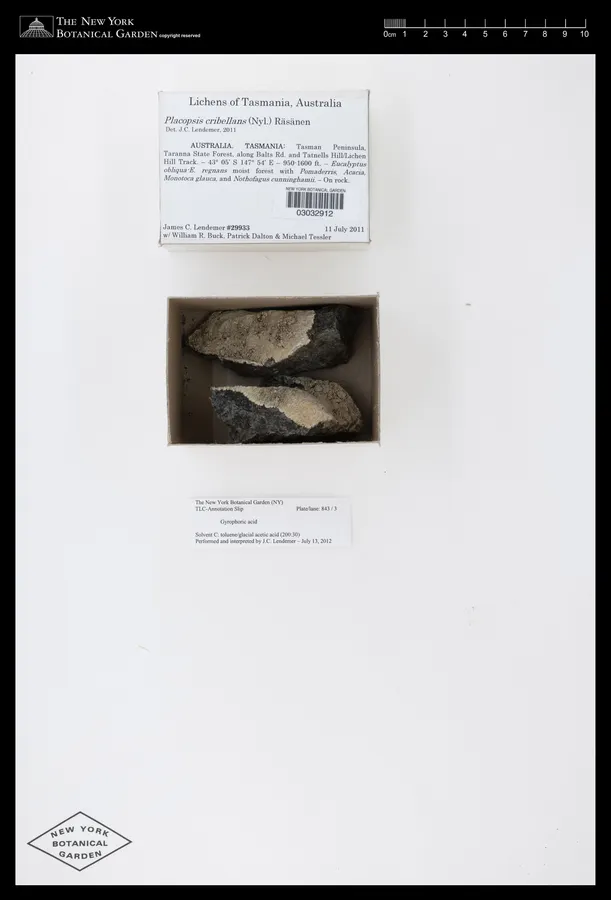
Voucher herbarium Placopsis cribellans (03032912), The New York Botanical Garden. Identifikasi mengikuti record spesimen sumber. Foto bahan, kemasan, atau label herbarium sebagaimana tersedia pada record institusi; bukan foto lapangan atau penentuan spesimen independen.

Jenis
Voucher herbarium
Kredit
The New York Botanical Garden
Lisensi
CC BY 4.0
Sumber media
Buka entri sumber

Gambar menunjukkan objek menurut identifikasi sumber, bukan verifikasi independen spesimen oleh Fungi. Tidak ada skala baru yang ditambahkan.

06 / Rujukan

Sumber profil

  1. [1] Placopsis cribellans — Wikipedia (en)Bagian sumber: Frozen revision 1335923216
    Tanggal penghimpunan sumber: 2026-10-12
    Teks sumber: CC BY-SA4.0 · Wikipedia contributors
  2. [2] Catalogue of Life Base2026-09-11 — Placopsis cribellansBagian sumber: ColDP NameUsage.tsv ID 77NNJ; accepted species; source 2073
    Tanggal penghimpunan sumber: 2026-10-12
  3. [3] Dokumentasi visual — Placopsis cribellansBagian sumber: Individual media record; identification follows the source, not independent determination
    Tanggal penghimpunan sumber: 2026-10-12
    Media sumber: CC BY 4.0 · The New York Botanical Garden

Adaptasi teks: CC BY-SA 4.0. Wikipedia contributors — Placopsis cribellans — Wikipedia (en)

Uraian asli dan riwayat sumber

Riwayat atau halaman sumber

Ringkasan sumber

Placopsis cribellans is a species of crustose lichen in the family Trapeliaceae. It forms small, neat rosettes or irregular patches on rock, with a surface that appears pale green when wet and shifts to grey-white or fawnish when dry. The thallus bears tiny spherical isidia that break off easily, leaving characteristic pits, and produces reddish-brown disc-shaped fruiting bodies. The species has a wide distribution, with records from East Asia, the Pacific islands, Australia, and both North and South America.

Revisi sumber

Morfologi sumber

Placopsis cribellans is a crust-forming lichen that typically makes small, tidy rosettes or irregular, closely appressed patches on rock, without a distinct marginal border (a projecting ). The thallus is made up of convex, fairly narrow that are contiguous or only slightly separated from the edge towards the centre. When wet, the upper surface is pale green to green-brown; when dry, it shifts to grey-white, fawnish, or grey-brown, often darkening towards the lobe tips. Under a hand lens it may show scattered white (spots), and the surface ranges from smooth and glossy to dull, often becoming pitted or with tiny scars where isidia have been rubbed away. It lacks soredia and usually lacks . The isidia are spherical and small (up to about 0.1 mm across), scattered to densely crowded; they abrade readily, leaving whitish to dark grey-green or blackened pits. Apothecia are mostly central; when crowded they can become misshapen where they press against one another. Their rim is thick and swollen (about 0.1–0.2 mm), glossy, and smooth to slightly scalloped, and it is the same colour as the surrounding thallus. The is pale to dark red-brown, flat to concave, and not . Microscopically, the spore-bearing layer (the hymenium) is tall, about 130–300 micrometres (μm). The ascospores are colourless and broadly ellipsoid, about 17.5–22.5 × 9–12.5 μm, and the asexual propagules (conidia) are thread-like, about 18–21 × 0.5–1 μm.

Revisi sumber

Ekologi sumber

Placopsis cribellans has been treated as a widespread, cosmopolitan species, with records reported from East Asia (Japan, Korea, Taiwan), the Pacific (including Hawaii and Papua New Guinea), Australia, the Galápagos Islands, and Tristan da Cunha, as well as the Aleutian Islands, British Columbia, and the far south of South America; it is also reported from New Zealand. In southern South America, the source reports collections from Chile's Juan Fernández Archipelago, including Más Afuera at about 1,000 m in grassland with scattered plants of Lophosoria, and an older specimen from Más a Tierra (Tres Puntas, about 200 m) that had been filed under another name before being recognised as including Placopsis material. It is also reported from mainland Chile (Brunswick Peninsula, at Puerto Cutter along the shore north of a copper mine) and from Argentina in Tierra del Fuego (Isla Grande, in Parque Nacional de Tierra del Fuego), where it was collected in open meadow and scrub on low hills near Bahía Lapataia, close to the Chilean frontier.

Revisi sumber

Struktur reproduksi sumber

Placopsis cribellans is a crust-forming lichen that typically makes small, tidy rosettes or irregular, closely appressed patches on rock, without a distinct marginal border (a projecting ). The thallus is made up of convex, fairly narrow that are contiguous or only slightly separated from the edge towards the centre. When wet, the upper surface is pale green to green-brown; when dry, it shifts to grey-white, fawnish, or grey-brown, often darkening towards the lobe tips. Under a hand lens it may show scattered white (spots), and the surface ranges from smooth and glossy to dull, often becoming pitted or with tiny scars where isidia have been rubbed away. It lacks soredia and usually lacks . The isidia are spherical and small (up to about 0.1 mm across), scattered to densely crowded; they abrade readily, leaving whitish to dark grey-green or blackened pits.

Revisi sumber

Rujukan halaman ini

Fungi. Placopsis cribellans. Rilis data fungi-2026-10-12-expansion-2. https://fungi-atlas.mgadib.chatgpt.site/jamur/placopsis-cribellans/.

Status: impor sumber; pemeriksaan editorial per profil belum selesai. Untuk klaim biologis, gunakan rujukan pada bagian terkait dan periksa konteks sumber aslinya.