Ciri dan struktur
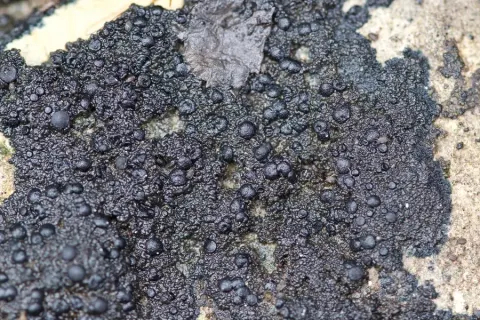
Placynthium glaciale forms a thin, crust-like thallus that clings tightly to its substrate and breaks along fine cracks (). A single patch is rarely wider than about 3.5 cm and averages 0.2 mm thick. The surface is olive-brown and densely studded with minute, cactus-like —technically described as or —that are only 30–150 micrometers (μm) across. Each lobe rises from the crust as a tiny round or finger-shaped projection, giving the lichen a roughened texture under a hand lens. In vertical section the outer skin () is a continuous mosaic () of rounded cells 4–6 μm wide. A bluish marginal growth zone () may be present; it turns mauve in potassium hydroxide solution (KOH) but does not extend beyond the thallus edge. The photosynthetic partner is an unidentified cyanobacterium whose 6–7 μm cells sometimes link into short chains and can be easily dislodged when the thallus is sectioned. The spore-bearing bodies (apothecia) are scattered over the surface as round 0.3–0.8 mm in diameter. Their centers are dark brown to jet black, flat to slightly sunken, and entirely dull. A shiny black rim persists as the apothecia age and may curve inward enough to shade part of the . Microscopic sections show a wall () about 50 μm thick at the sides and up to 90 μm at the base; its inner layers are purplish, grading to blue-black toward the edge, and consist of radiating fungal threads whose end cells can reach 10 μm wide. The spore layer (hymenium) is 65–90 μm tall and carries streaks of deep blue-black pigment that intensify toward the top; it stains blue in iodine before any alkali treatment.
Habitat dan peran ekologis
Placynthium glaciale is only known to occur in Alaska, where it has been documented from Glacier Bay National Park, Petersburg Borough, Patterson Glacier, and Muir Glacier. It is one of ten Placynthium species that is found in Alaska.
- Habitat atau konteks temuan
- Informasi belum tersedia pada sumber rilis ini.
- Substrat
- Informasi belum tersedia pada sumber rilis ini.
- Peran atau konteks
- Pembentuk liken
Reproduksi
The spore-bearing bodies (apothecia) are scattered over the surface as round 0.3–0.8 mm in diameter. Their centers are dark brown to jet black, flat to slightly sunken, and entirely dull. A shiny black rim persists as the apothecia age and may curve inward enough to shade part of the . Microscopic sections show a wall () about 50 μm thick at the sides and up to 90 μm at the base; its inner layers are purplish, grading to blue-black toward the edge, and consist of radiating fungal threads whose end cells can reach 10 μm wide. The spore layer (hymenium) is 65–90 μm tall and carries streaks of deep blue-black pigment that intensify toward the top; it stains blue in iodine before any alkali treatment.
Catatan identitas dan cakupan
- Nama diterima mengikuti Catalogue of Life Base2026-09-11; uraian mempertahankan konsep dan nama sumber aslinya.
- Original geographic, specimen and life-cycle scope retained; source import awaits individual editorial review.
- Impor dan terjemahan otomatis belum diperiksa editorial per profil. Struktur reproduktif yang disebutkan tidak membuktikan seluruh siklus hidup diketahui.
- Pengukuran pada uraian mengikuti spesimen, kultur, dan metode sumber; angka tidak diperluas ke semua populasi.
Catatan distribusi dalam narasi mengikuti sumbernya. Dokumentasi spesimen atau foto mengikuti catatan sumber. Bukti wilayah Indonesia dan penilaian konservasi tidak disimpulkan dari gambar.
Melihat dengan konteks
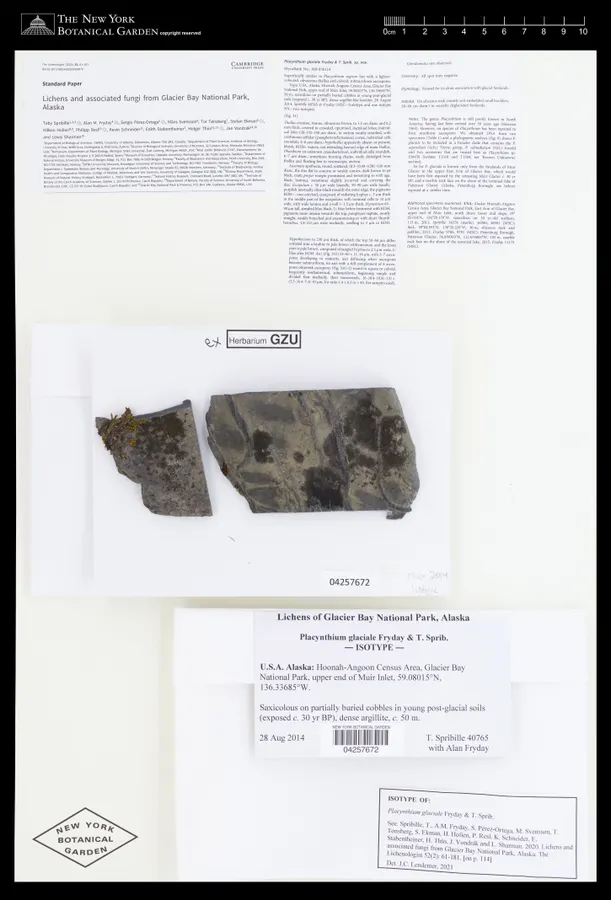
Voucher herbarium Placynthium glaciale (04257672), The New York Botanical Garden. Identifikasi mengikuti record spesimen sumber. Foto bahan, kemasan, atau label herbarium sebagaimana tersedia pada record institusi; bukan foto lapangan atau penentuan spesimen independen.
- Jenis
- Voucher herbarium
- Kredit
- The New York Botanical Garden
- Lisensi
- CC BY 4.0
- Sumber media
- Buka entri sumber
Sumber profil
- [1] Placynthium glaciale — Wikipedia (en)
- [2] Catalogue of Life Base2026-09-11 — Placynthium glaciale
- [3] Dokumentasi visual — Placynthium glaciale
Rujukan halaman ini
Fungi. Placynthium glaciale. Rilis data fungi-2026-10-12-expansion-2. https://fungi-atlas.mgadib.chatgpt.site/jamur/placynthium-glaciale/.
Status: impor sumber; pemeriksaan editorial per profil belum selesai. Untuk klaim biologis, gunakan rujukan pada bagian terkait dan periksa konteks sumber aslinya.