Ciri dan struktur
Mycelial colonial morphotype: Colonies on PCA 6–8 mm in diameter in 3 mo, circular, convex, appearing woolly, margin entire, aerial mycelium abundant, densest at the centre, cobwebby towards the margin, white to grey with a pale brown zone at the margin, colony surface with a dark brown hue formed by substrate mycelium and released pigment; reverse brown. Compact colonial morphotype: Colonies on PCA 5–6 mm in diameter in 8 mo, irregular, pulvinate, deeply furrowed, appearing mucoid-waxy to faintly floccose, of a “cartilage” consistency, become hollow upon aging, margin lobate, aerial mycelium scant, hyaline to pale brown, colony surface dark brown; reverse dark brown. Compact colonies, which are formed in vitro on sterilised roots of P. oceanica, become irregular in shape, folded and furrowed in an almost cerebriform pattern, cacao brown, ca. 5–6 mm long on the longest side after several months of cultivation. Hyphae hyaline to pale brown, septate, smooth-walled and 2–3(–3.5) µm wide, often with terminal, intercalary, rarely with lateral, one-celled, thick-walled globose, subglobose to ellipsoidal swellings 10–14 µm wide; hyphae frequently protrude from these swellings and continue growing. Surface of the compact colonies covered by hyaline to subhyaline, smooth-walled hyphae with terminal, capitate swellings. Chlamydospores, conidiogenous cells or conidia, ascomatal initials and ascomata not observed. In vivo hyphae pigmented, septate, smooth-walled and (2–)3–4(–5) µm wide, colonising root cells of the host and/or forming an extraradical hyphal sheath, i.e. a finger-like pseudoparenchymatous net on the root surface.
Habitat dan peran ekologis
Root mycobiont of the dominant and endemic Mediterranean seagrass Posidonia oceanica. So far known only from the NW Mediterranean Sea.
- Habitat atau konteks temuan
- Informasi belum tersedia pada sumber rilis ini.
- Substrat
- Informasi belum tersedia pada sumber rilis ini.
- Peran atau konteks
- Belum dikategorikan pada rilis ini.
Reproduksi
Mycelial colonial morphotype: Colonies on PCA 6–8 mm in diameter in 3 mo, circular, convex, appearing woolly, margin entire, aerial mycelium abundant, densest at the centre, cobwebby towards the margin, white to grey with a pale brown zone at the margin, colony surface with a dark brown hue formed by substrate mycelium and released pigment; reverse brown. Compact colonial morphotype: Colonies on PCA 5–6 mm in diameter in 8 mo, irregular, pulvinate, deeply furrowed, appearing mucoid-waxy to faintly floccose, of a “cartilage” consistency, become hollow upon aging, margin lobate, aerial mycelium scant, hyaline to pale brown, colony surface dark brown; reverse dark brown. Compact colonies, which are formed in vitro on sterilised roots of P. oceanica, become irregular in shape, folded and furrowed in an almost cerebriform pattern, cacao brown, ca. 5–6 mm long on the longest side after several months of cultivation.
Catatan identitas dan cakupan
- Nama diterima mengikuti Catalogue of Life Base2026-09-11; uraian mempertahankan konsep dan nama sumber aslinya.
- Preserve original treatment localities, hosts and substrate scope. Materials examined describe documented specimens, not the full global range.
- Impor dan terjemahan otomatis belum diperiksa editorial per profil. Struktur reproduktif yang disebutkan tidak membuktikan seluruh siklus hidup diketahui.
- Pengukuran pada uraian mengikuti spesimen, kultur, dan metode sumber; angka tidak diperluas ke semua populasi.
Catatan distribusi dalam narasi mengikuti sumbernya. Dokumentasi spesimen atau foto mengikuti catatan sumber. Bukti wilayah Indonesia dan penilaian konservasi tidak disimpulkan dari gambar.
Melihat dengan konteks
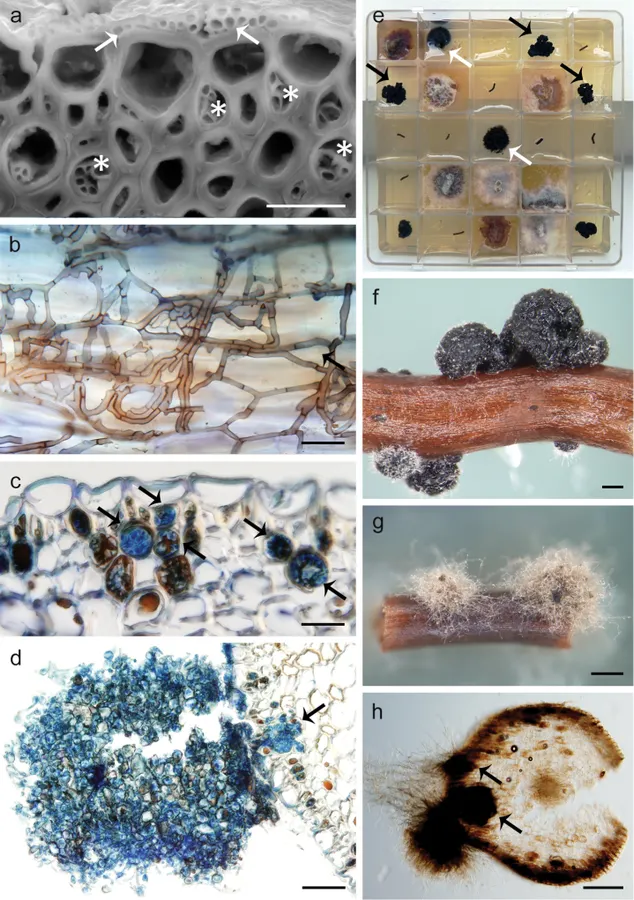
In vivo root colonisation pattern and in vitro cultural aspects of Posidoniomyces atricolor. a In vivo colonisation on the root surface (arrows) and in the hypodermis (asterisks) of P. oceanica b DSE colonisation on the root surface c germinating microsclerotia stained with trypan blue (arrows) d compact colony developed from microsclerotia (arrow) e surface-sterilised root segments yielding P. atricolor compact colonies (black arrows), sometimes with substrate mycelium (white arrows) f compact colonial morphotype g mycelial colonial morphotype h mycelial morphotype developing from microsclerotia (arrows) in transversal section. Scale bars: 20 μm (a, b), 50 μm (c), 100 μm (d), 200 μm (f, h), 500 μm (g).
- Jenis
- Pelat ilmiah
- Kredit
- Martin Vohník, Ondřej Borovec, Zuzana Kolaříková, Radka Sudová, Martina Réblová
- Lisensi
- CC BY 4.0
- Sumber media
- Buka entri sumber
Dokumentasi tambahan
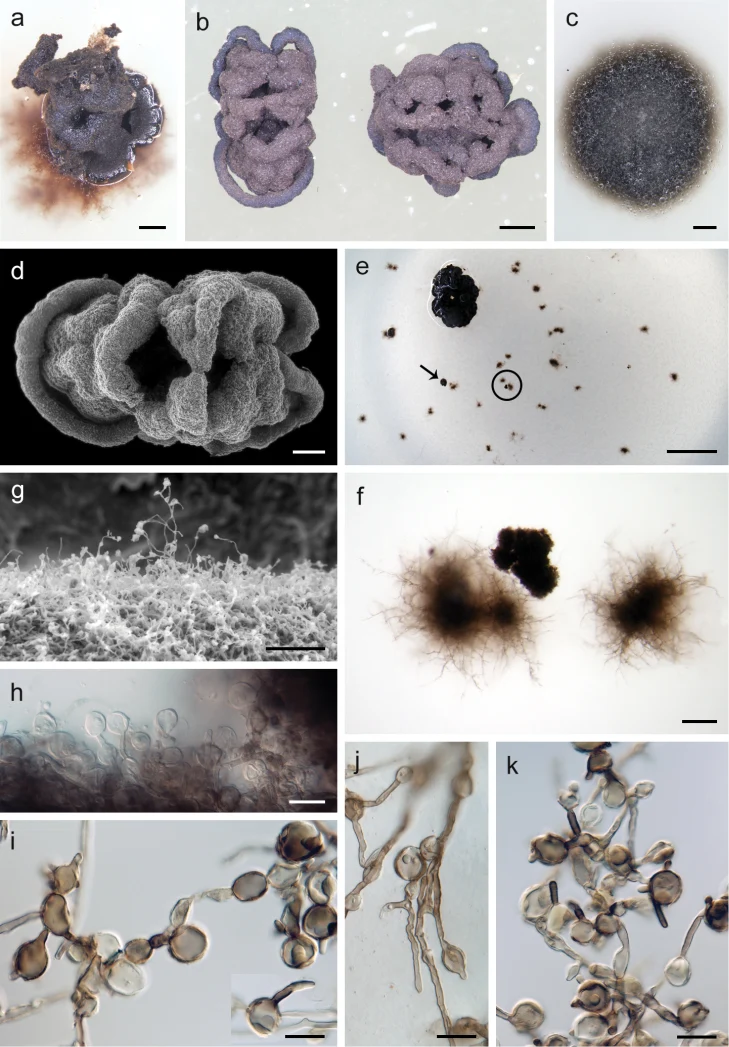
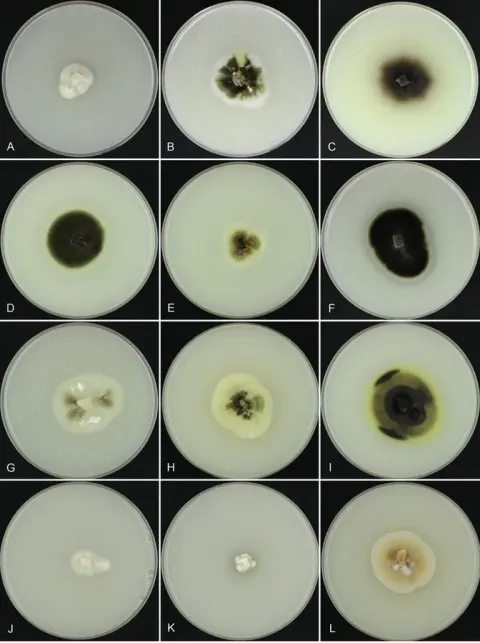
Colonial morphotypes of Posidoniomyces atricolor in vitro (type isolate BRK-21). a Compact morphotype with substrate mycelium b, d compact colonies with a cerebriform pattern c colony of P. atricolor on PCA e rhizoidal and compact (arrow) daughter colonies on PCA washed with sterile tap water f detail of the colonies encircled in e; g, h terminal capitate swellings on the surface of compact colonies i–k conspicuous swellings on aerial mycelium. Scale bars: 500 μm (a, d), 1000 μm (b, c), 5 mm (e), 200 μm (f), 100 μm (g), 20 μm (h).
Kredit dan penggunaan
Martin Vohník, Ondřej Borovec, Zuzana Kolaříková, Radka Sudová, Martina Réblová
Ukuran dan format gambar disesuaikan tanpa pemotongan, retus, atau penambahan skala. Lisensi sumber dipertahankan.
Sumber profil
- [1] Extensive sampling and high-throughput sequencing reveal Posidoniomyces atricolor gen. et sp. nov. (Aigialaceae, Pleosporales) as the dominant root mycobiont of the dominant Mediterranean seagrass Posidonia oceanica — Posidoniomyces atricolor
- [2] Catalogue of Life Base2026-09-11 — Posidoniomyces atricolor
- [3] Dokumentasi visual — Posidoniomyces atricolor
- [4] Dokumentasi visual — Posidoniomyces atricolor
Rujukan halaman ini
Fungi. Posidoniomyces atricolor. Rilis data fungi-2026-10-12-expansion-2. https://fungi-atlas.mgadib.chatgpt.site/jamur/posidoniomyces-atricolor/.
Status: impor sumber; pemeriksaan editorial per profil belum selesai. Untuk klaim biologis, gunakan rujukan pada bagian terkait dan periksa konteks sumber aslinya.