01 / Morfologi

Ciri dan struktur

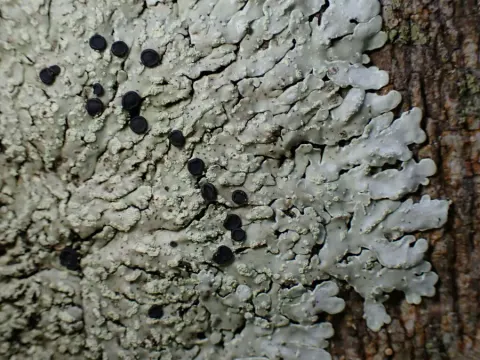
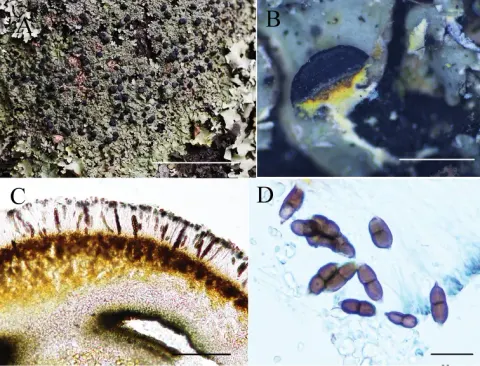
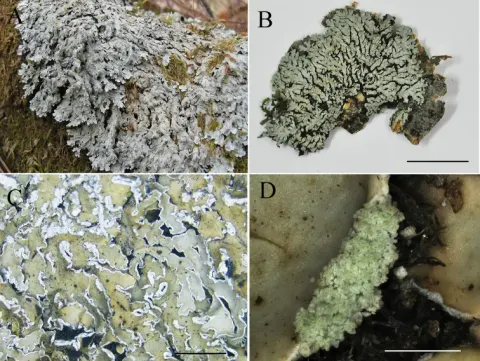
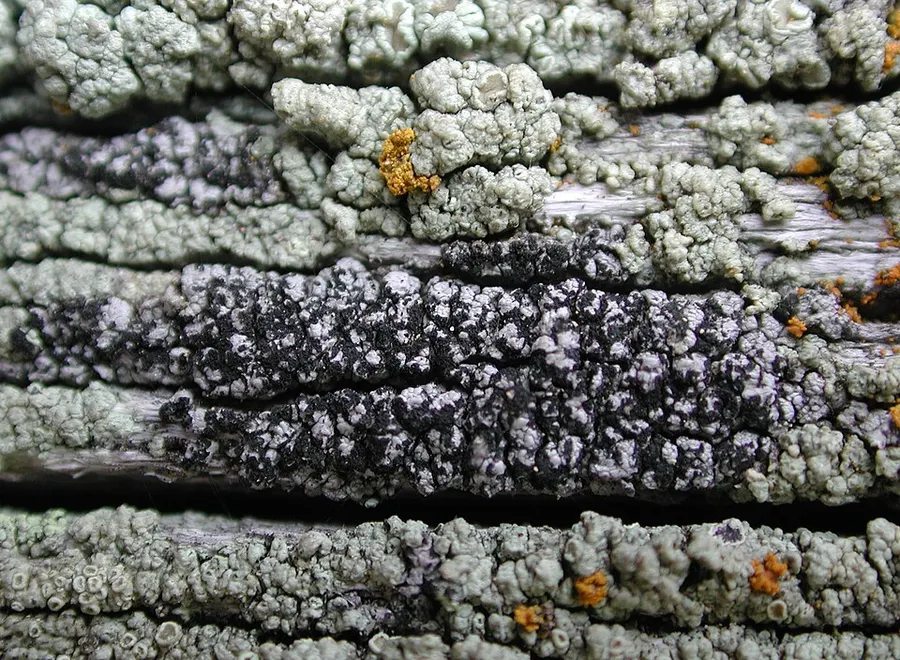
Pseudothelomma ocellatum has a crustose (crust-like) thallus that is well-developed, with either a mosaic-like pattern () or elevated, coarse, and flattened warts, typically coloured grey. The lichen is characterised by frequent isidia, which are small, outgrowth propagules that form irregular but well-defined clusters of blue or brown-black colour, generally slightly raised (convex). The medulla, or inner layer of the thallus, turns a blue colour when iodine is applied (I+ blue). The reproductive structures, known as apothecia, are within the thallus; they are generally absent in this species, although there have been reported instances of this normally sterile lichen as fertile. of P. ocellatum are divided by a single internal cross wall (1-septate), pinched at the division (constricted at the septum), and have an uneven surface; they measure 22–28 micrometres (μm) in length and 12–15 μm in width. They sometimes have a slightly ornamentation consisting of irregular surface striations, visible using light microscopy. Chemical spot tests on the thallus yield negative results (C−, K−, Pd−, UV−), suggesting the absence of secondary metabolites (lichen products). However, the species has occasionally been recorded as containing compounds such as atranorin, norstictic acid, and usnic acid. Specifically, the outer ring of the apothecia () and the mass of ascospores may contain rhizocarpic acid and epanorin.

Sebagian uraian ditampilkan dalam bahasa sumber; terjemahannya belum tersedia atau belum lolos pemeriksaan.

Rujukan: [1]

Pengukuran mengikuti objek, spesimen atau kultur, dan metode yang disebutkan sumber. Baca uraian asli untuk konteks lengkap.

02 / Kehidupan

Habitat dan peran ekologis

Pseudothelomma ocellatum is distributed widely in the Northern Hemisphere, particularly in temperate to cool temperate areas. It was once believed to be confined to the western mountainous regions from southern California to British Columbia, extending as far inland as central Montana. Tibell first documented the species in 1978, with the next report coming from British Columbia in 1992. In 1995, McCune and Rosentreter noted that the species is rarely found west of the Cascade crest in Oregon and Washington and is absent from the extreme coastal regions. In California, the lichen seems to be prevalent in the northeast part of the state and becomes less frequent moving southward, occurring sporadically in both the Sierra foothills and the Coast Ranges. A significant discovery in 2013, however, extended its range to include the Yukon, marking a notable expansion of its distribution. A search of North America herbaria in the mid-1990s turned up a few specimens of Pseudothelomma ocellatum that had been stored under the name Cyphelium inquinans. In California, Pseudothelomma ocellatum has been observed growing on wooden corral boards adjacent to metal fence posts, a specific microhabitat thought to be influenced by nitrate enrichment caused by perching birds around these posts.

Sebagian uraian ditampilkan dalam bahasa sumber; terjemahannya belum tersedia atau belum lolos pemeriksaan.

Rujukan: [1]

Habitat atau konteks temuan
Informasi belum tersedia pada sumber rilis ini.
Substrat
Informasi belum tersedia pada sumber rilis ini.
Peran atau konteks
Pembentuk liken
Temukan hubungan serupa
03 / Siklus hidup

Reproduksi

Pseudothelomma ocellatum has a crustose (crust-like) thallus that is well-developed, with either a mosaic-like pattern () or elevated, coarse, and flattened warts, typically coloured grey. The lichen is characterised by frequent isidia, which are small, outgrowth propagules that form irregular but well-defined clusters of blue or brown-black colour, generally slightly raised (convex). The medulla, or inner layer of the thallus, turns a blue colour when iodine is applied (I+ blue). The reproductive structures, known as apothecia, are within the thallus; they are generally absent in this species, although there have been reported instances of this normally sterile lichen as fertile. of P. ocellatum are divided by a single internal cross wall (1-septate), pinched at the division (constricted at the septum), and have an uneven surface; they measure 22–28 micrometres (μm) in length and 12–15 μm in width.

Sebagian uraian ditampilkan dalam bahasa sumber; terjemahannya belum tersedia atau belum lolos pemeriksaan.

Rujukan: [1]

Sinonim menurut acuan taksonomi rilis: Acolium ocellatum; Cyphelium ocellatum; Thelomma ocellatum; Trachylia tympanella var. ocellata
04 / Batas informasi

Catatan identitas dan cakupan

  • Nama diterima mengikuti Catalogue of Life Base2026-09-11; uraian mempertahankan konsep dan nama sumber aslinya.
  • Original geographic, specimen and life-cycle scope retained; source import awaits individual editorial review.
  • Impor dan terjemahan otomatis belum diperiksa editorial per profil. Struktur reproduktif yang disebutkan tidak membuktikan seluruh siklus hidup diketahui.
  • Pengukuran pada uraian mengikuti spesimen, kultur, dan metode sumber; angka tidak diperluas ke semua populasi.

Catatan distribusi dalam narasi mengikuti sumbernya. Dokumentasi spesimen atau foto mengikuti catatan sumber. Bukti wilayah Indonesia dan penilaian konservasi tidak disimpulkan dari gambar.

05 / Dokumentasi

Melihat dengan konteks

Dokumentasi Pseudothelomma ocellatum dari Wikimedia Commons. The bark-dwelling, crustose lichen Pseudothelomma ocellatum , photographed in Trentino-Alto Adige, Italy, 2007 Identifikasi mengikuti record berkas sumber.

Jenis
Fotografi
Kredit
Juri Nascimbene
Sumber media
Buka entri sumber

Gambar menunjukkan objek menurut identifikasi sumber, bukan verifikasi independen spesimen oleh Fungi. Tidak ada skala baru yang ditambahkan.

06 / Rujukan

Sumber profil

  1. [1] Pseudothelomma ocellatum — Wikipedia (en)Bagian sumber: Frozen revision 1321849430
    Tanggal penghimpunan sumber: 2026-10-12
    Teks sumber: CC BY-SA4.0 · Wikipedia contributors
  2. [2] Catalogue of Life Base2026-09-11 — Pseudothelomma ocellatumBagian sumber: ColDP NameUsage.tsv ID 4PD7N; accepted species; source 2073
    Tanggal penghimpunan sumber: 2026-10-12
  3. [3] Dokumentasi visual — Pseudothelomma ocellatumBagian sumber: Individual media record; identification follows the source, not independent determination
    Tanggal penghimpunan sumber: 2026-10-12
    Media sumber: CC BY-SA 4.0 · Juri Nascimbene

Adaptasi teks: CC BY-SA 4.0. Wikipedia contributors — Pseudothelomma ocellatum — Wikipedia (en)

Uraian asli dan riwayat sumber

Riwayat atau halaman sumber

Ringkasan sumber

Pseudothelomma ocellatum is a species of lignicolous (wood-dwelling), crustose lichen in the family Caliciaceae. This lichen is characterised by its grey, areolate thallus that produces abundant lichenised diaspores, such as short spherical isidia and coarse, dark brown-black soredia. It is typically sterile, meaning apothecia (fruiting bodies) are absent. Pseudothelomma ocellatum is primarily a Northern Hemisphere lichen, especially found in temperate to cool temperate areas, and somewhat rare in North America where its range has expanded from southern California to the Yukon since its first documentation in 1978.

Revisi sumber

Morfologi sumber

Pseudothelomma ocellatum has a crustose (crust-like) thallus that is well-developed, with either a mosaic-like pattern () or elevated, coarse, and flattened warts, typically coloured grey. The lichen is characterised by frequent isidia, which are small, outgrowth propagules that form irregular but well-defined clusters of blue or brown-black colour, generally slightly raised (convex). The medulla, or inner layer of the thallus, turns a blue colour when iodine is applied (I+ blue). The reproductive structures, known as apothecia, are within the thallus; they are generally absent in this species, although there have been reported instances of this normally sterile lichen as fertile. of P. ocellatum are divided by a single internal cross wall (1-septate), pinched at the division (constricted at the septum), and have an uneven surface; they measure 22–28 micrometres (μm) in length and 12–15 μm in width. They sometimes have a slightly ornamentation consisting of irregular surface striations, visible using light microscopy. Chemical spot tests on the thallus yield negative results (C−, K−, Pd−, UV−), suggesting the absence of secondary metabolites (lichen products). However, the species has occasionally been recorded as containing compounds such as atranorin, norstictic acid, and usnic acid. Specifically, the outer ring of the apothecia () and the mass of ascospores may contain rhizocarpic acid and epanorin.

Revisi sumber

Ekologi sumber

Pseudothelomma ocellatum is distributed widely in the Northern Hemisphere, particularly in temperate to cool temperate areas. It was once believed to be confined to the western mountainous regions from southern California to British Columbia, extending as far inland as central Montana. Tibell first documented the species in 1978, with the next report coming from British Columbia in 1992. In 1995, McCune and Rosentreter noted that the species is rarely found west of the Cascade crest in Oregon and Washington and is absent from the extreme coastal regions. In California, the lichen seems to be prevalent in the northeast part of the state and becomes less frequent moving southward, occurring sporadically in both the Sierra foothills and the Coast Ranges. A significant discovery in 2013, however, extended its range to include the Yukon, marking a notable expansion of its distribution. A search of North America herbaria in the mid-1990s turned up a few specimens of Pseudothelomma ocellatum that had been stored under the name Cyphelium inquinans. In California, Pseudothelomma ocellatum has been observed growing on wooden corral boards adjacent to metal fence posts, a specific microhabitat thought to be influenced by nitrate enrichment caused by perching birds around these posts.

Revisi sumber

Struktur reproduksi sumber

Pseudothelomma ocellatum has a crustose (crust-like) thallus that is well-developed, with either a mosaic-like pattern () or elevated, coarse, and flattened warts, typically coloured grey. The lichen is characterised by frequent isidia, which are small, outgrowth propagules that form irregular but well-defined clusters of blue or brown-black colour, generally slightly raised (convex). The medulla, or inner layer of the thallus, turns a blue colour when iodine is applied (I+ blue). The reproductive structures, known as apothecia, are within the thallus; they are generally absent in this species, although there have been reported instances of this normally sterile lichen as fertile. of P. ocellatum are divided by a single internal cross wall (1-septate), pinched at the division (constricted at the septum), and have an uneven surface; they measure 22–28 micrometres (μm) in length and 12–15 μm in width.

Revisi sumber

Rujukan halaman ini

Fungi. Pseudothelomma ocellatum. Rilis data fungi-2026-10-12-expansion-2. https://fungi-atlas.mgadib.chatgpt.site/jamur/pseudothelomma-ocellatum/.

Status: impor sumber; pemeriksaan editorial per profil belum selesai. Untuk klaim biologis, gunakan rujukan pada bagian terkait dan periksa konteks sumber aslinya.