Ciri dan struktur
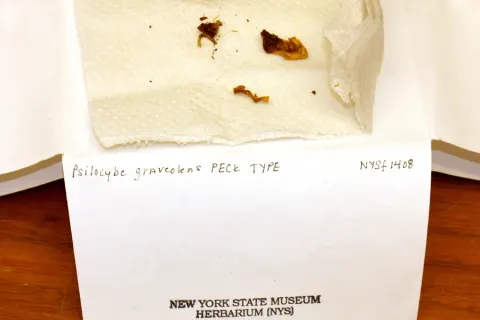
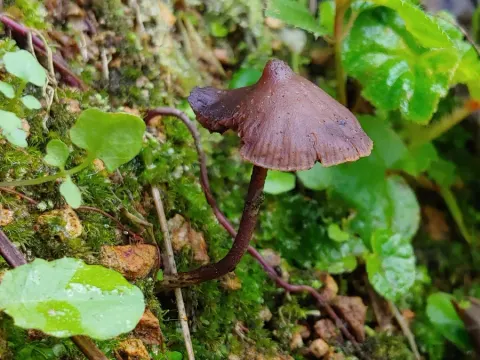
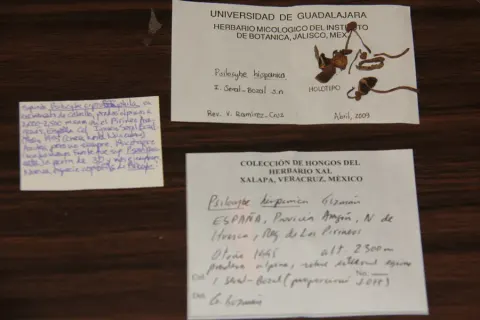
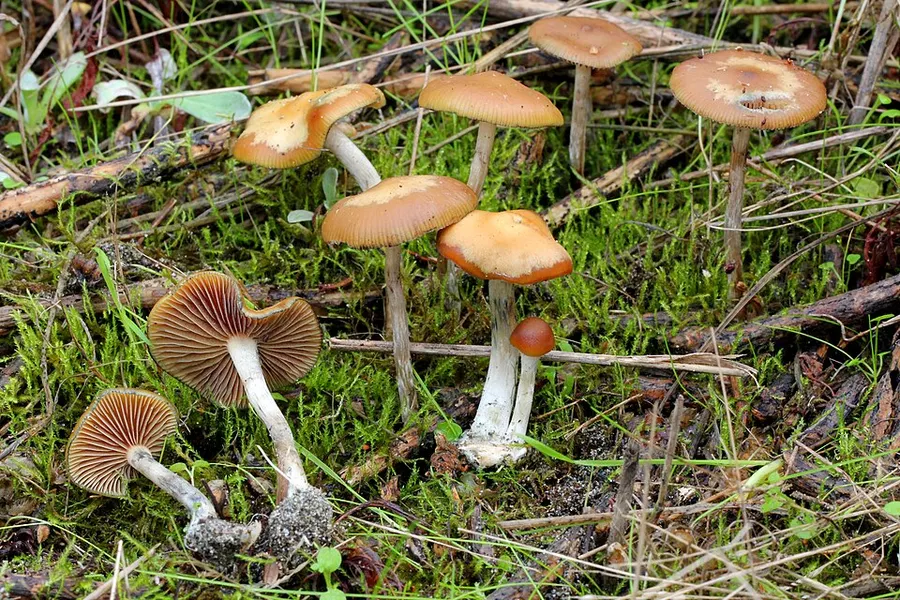
Psilocybe cyanescens has a hygrophanous pileus (cap) that is caramel to chestnut-brown when moist, fading to pale buff or slightly yellowish when dried. Caps generally measure from 1.5-5 cm across, and are normally distinctly wavy in maturity. The lamellae are adnate, and light brown to dark purple brown in maturity, with lighter gill edges. There is no distinct annulus, but immature P. cyanescens specimens do have a cobwebby veil which may leave an annular zone in maturity. According to some authors, the holotype collection of the species from Kew Gardens featured no pleurocystidia, but North American collections are characterized by common clavate-mucronate pleurocystidia. In 2012, an epitype from Hamburg, Germany was designated. Fresh sporocarps and mycelia of P. cyanescens generally bruise blueish or blue-green where damaged, and the staining remains visible after drying. This staining is most noticeable on the stem (which is white when undisturbed) but can also occur on other parts of the mushroom, including the gills, cap, and mycelium. This staining is due primarily to the oxidation of psilocin. (Psilocybin cannot be oxidized directly, but is quickly converted via enzymatic action to psilocin at injury sites which can then be oxidized, so even specimens with little psilocin still generally stain blue.)
Habitat dan peran ekologis
Psilocybe cyanescens grows today primarily on wood chips, especially in and along the perimeter of mulched plant beds in urban areas, In the United States, P. cyanescens occurs mainly in the Pacific Northwest, stretching south to the San Francisco Bay Area. It can also be found in areas such as New Zealand, Western Europe, Central Europe, and parts of west Asia (Iran). The range in which P. cyanescens occurs is rapidly expanding, especially in areas where it is not native as the use of mulch to control weeds has been popularized. This rapid expansion of range may be due in part to the simple expedient of P. cyanescens mycelium having colonized the distribution network of woodchip suppliers and thus being distributed on a large scale with commercial mulch. Although it has been speculated that P. cyanescens native habitat is the coniferous woodlands of the north-western United States Fruiting is dependent on a drop in temperature. and fruiting in other areas generally occurs in fall, when temperatures are between 10-18 C. Psilocybe cyanescens often fruits gregariously or in cespitose clusters, sometimes in great numbers. 100,000 P. cyanescens fruits were once found growing on a racetrack in the south of England.
- Habitat atau konteks temuan
- Informasi belum tersedia pada sumber rilis ini.
- Substrat
- kayu
- Peran atau konteks
- Belum dikategorikan pada rilis ini.
Reproduksi
Fresh sporocarps and mycelia of P. cyanescens generally bruise blueish or blue-green where damaged, and the staining remains visible after drying. This staining is most noticeable on the stem (which is white when undisturbed) but can also occur on other parts of the mushroom, including the gills, cap, and mycelium. This staining is due primarily to the oxidation of psilocin. (Psilocybin cannot be oxidized directly, but is quickly converted via enzymatic action to psilocin at injury sites which can then be oxidized, so even specimens with little psilocin still generally stain blue.)
Catatan identitas dan cakupan
- Nama diterima mengikuti Catalogue of Life Base2026-09-11; uraian mempertahankan konsep dan nama sumber aslinya.
- Original geographic, specimen and life-cycle scope retained; source import awaits individual editorial review.
- Impor dan terjemahan otomatis belum diperiksa editorial per profil. Struktur reproduktif yang disebutkan tidak membuktikan seluruh siklus hidup diketahui.
- Pengukuran pada uraian mengikuti spesimen, kultur, dan metode sumber; angka tidak diperluas ke semua populasi.
Catatan distribusi dalam narasi mengikuti sumbernya. Dokumentasi spesimen atau foto mengikuti catatan sumber. Bukti wilayah Indonesia dan penilaian konservasi tidak disimpulkan dari gambar.
Melihat dengan konteks
Dokumentasi Psilocybe cyanescens dari Wikimedia Commons. Psilocybe cyanescens Wakef. Identifikasi mengikuti record berkas sumber.
- Jenis
- Fotografi
- Kredit
- This image was created by user Alan Rockefeller (Alan Rockefeller) at Mushroom Observer , a source for mycological images. You can contact this user here .
- Lisensi
- CC BY-SA 3.0
- Sumber media
- Buka entri sumber
Sumber profil
- [1] Psilocybe cyanescens — Wikipedia (en)
- [2] Catalogue of Life Base2026-09-11 — Psilocybe cyanescens
- [3] Dokumentasi visual — Psilocybe cyanescens
Rujukan halaman ini
Fungi. Psilocybe cyanescens. Rilis data fungi-2026-10-12-expansion-2. https://fungi-atlas.mgadib.chatgpt.site/jamur/psilocybe-cyanescens/.
Status: impor sumber; pemeriksaan editorial per profil belum selesai. Untuk klaim biologis, gunakan rujukan pada bagian terkait dan periksa konteks sumber aslinya.