Ciri dan struktur
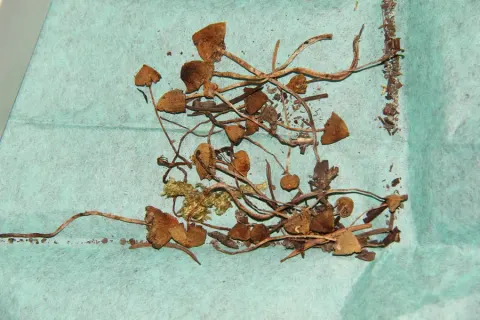
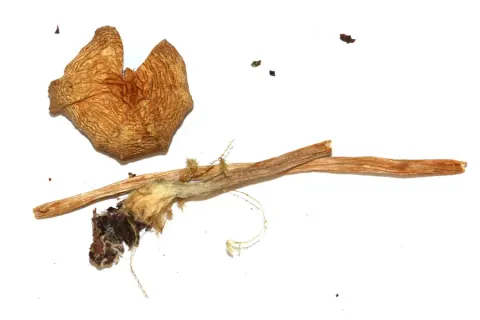
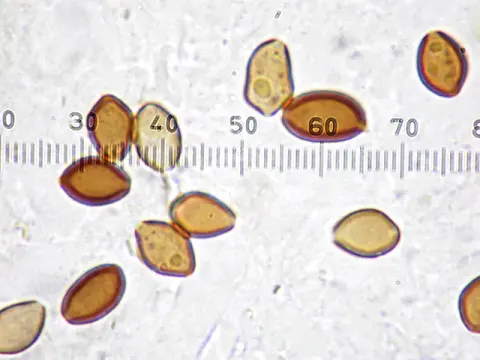
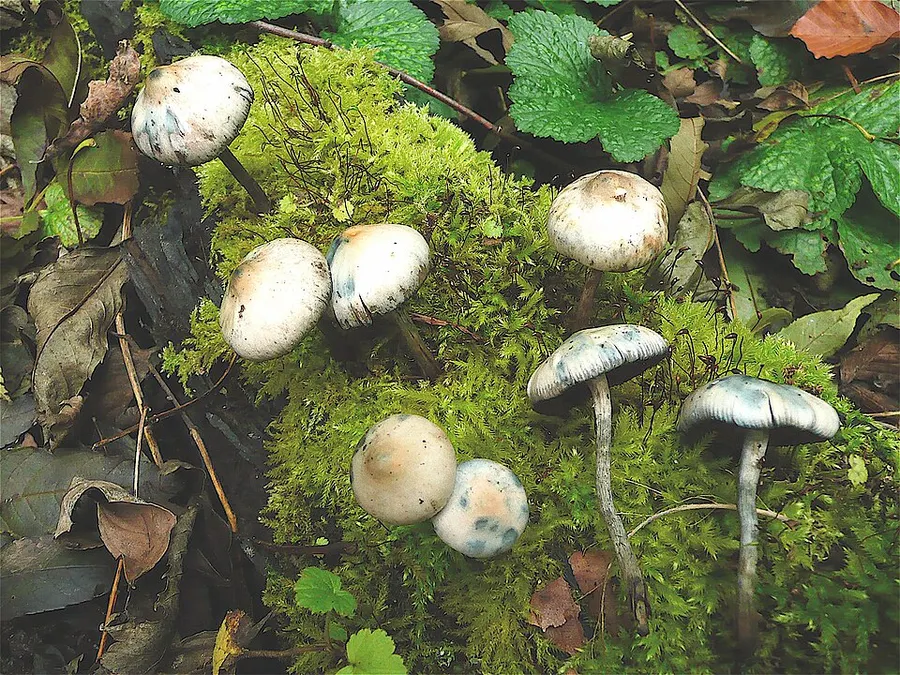
Psilocybe serbica has no specific smell (somewhat raddish, but never farinaceous), and the taste is usually bitter. It is a very variable species. Its cap is 1 - 4 cm in diameter and obtusely conical, later becoming campanulate or convex. It expands to broadly convex or plane in age and is incurved at first then plane or decurved with age. The cap is buff-brown to dingy orangish-brown and pale ochraceous when dry. It is smooth, hygrophanous, and slightly translucent-striate when moist but not viscid and without a separable gelatinous pellicle. The flesh is whitish to cream-colored, bruising blue when injured. Spores are purple-brown, ellipsoid, slightly flattened, and thick-walled, with a distinct germ pore. The size is very variable, mostly 10–13 × 6–7.5 μm, but also much longer. The gills are adnate to adnexed and close, often distinctly subdecurrent. They are initially light brown, becoming dark brown with age with a purple tint, the edges remaining paler. The stipe is 45 - 80 mm long, and 2 - 10 mm thick. It has an equal structure, slightly enlarging at the base. It is whitish with a silky gloss and glabrous, or with some whitish remnants of the fibrillose veil. Pleurocystidia are present and frequent; cheilocystidia often arise from hyphae parallel to the edge of the lamella.
Habitat dan peran ekologis
Psilocybe serbica is found growing mostly in groups, on well decayed deciduous and coniferous wood, and along Urtica spp. or Rubus spp. on twigs, compost, plant residue in forests, usually in moist places along creeks, forest paths, and roadside verges. Hal ini tidak dilaporkan sebagai sinantropik sebagai Psilocybe cyanescens tetapi jarang juga dapat terjadi pada kayu cip.
- Habitat atau konteks temuan
- hutan
- Substrat
- Informasi belum tersedia pada sumber rilis ini.
- Peran atau konteks
- Belum dikategorikan pada rilis ini.
Reproduksi
Psilocybe serbica has no specific smell (somewhat raddish, but never farinaceous), and the taste is usually bitter. It is a very variable species. Its cap is 1 - 4 cm in diameter and obtusely conical, later becoming campanulate or convex. It expands to broadly convex or plane in age and is incurved at first then plane or decurved with age. The cap is buff-brown to dingy orangish-brown and pale ochraceous when dry. It is smooth, hygrophanous, and slightly translucent-striate when moist but not viscid and without a separable gelatinous pellicle. The flesh is whitish to cream-colored, bruising blue when injured. Spores are purple-brown, ellipsoid, slightly flattened, and thick-walled, with a distinct germ pore.
Catatan identitas dan cakupan
- Nama diterima mengikuti Catalogue of Life Base2026-09-11; uraian mempertahankan konsep dan nama sumber aslinya.
- Original geographic, specimen and life-cycle scope retained; source import awaits individual editorial review.
- Impor dan terjemahan otomatis belum diperiksa editorial per profil. Struktur reproduktif yang disebutkan tidak membuktikan seluruh siklus hidup diketahui.
- Pengukuran pada uraian mengikuti spesimen, kultur, dan metode sumber; angka tidak diperluas ke semua populasi.
Catatan distribusi dalam narasi mengikuti sumbernya. Dokumentasi spesimen atau foto mengikuti catatan sumber. Bukti wilayah Indonesia dan penilaian konservasi tidak disimpulkan dari gambar.
Melihat dengan konteks
Dokumentasi Psilocybe serbica dari Wikimedia Commons. Fruit bodies of the fungus Psilocybe serbica var. bohemica . Specimens collected in Bonndorf, Baden-Wuertemberg, Germany. Identifikasi mengikuti record berkas sumber.
- Jenis
- Fotografi
- Kredit
- user: Roberto
- Lisensi
- CC BY-SA 3.0
- Sumber media
- Buka entri sumber
Sumber profil
- [1] Psilocybe serbica — Wikipedia (en)
- [2] Catalogue of Life Base2026-09-11 — Psilocybe serbica
- [3] Dokumentasi visual — Psilocybe serbica
Rujukan halaman ini
Fungi. Psilocybe serbica. Rilis data fungi-2026-10-12-expansion-2. https://fungi-atlas.mgadib.chatgpt.site/jamur/psilocybe-serbica/.
Status: impor sumber; pemeriksaan editorial per profil belum selesai. Untuk klaim biologis, gunakan rujukan pada bagian terkait dan periksa konteks sumber aslinya.