01 / Morfologi

Ciri dan struktur

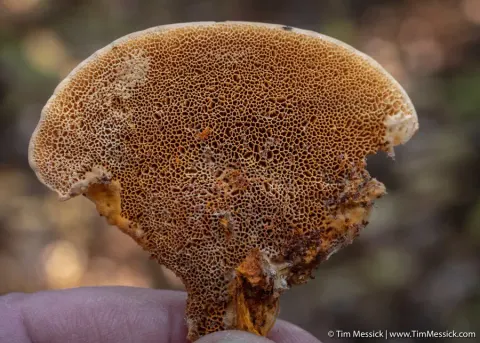
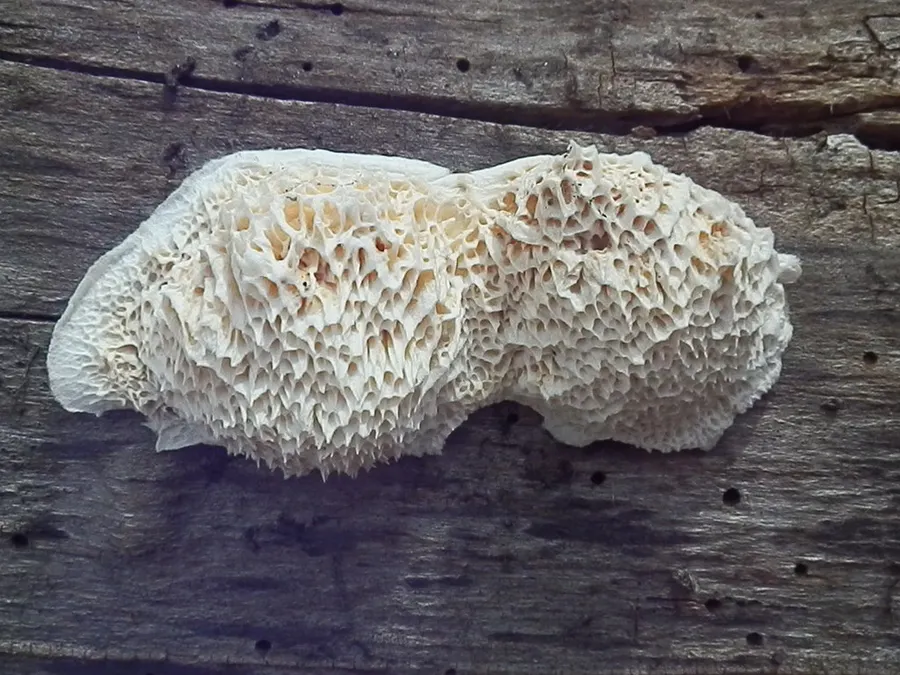
The fruit bodies of P. alboluteus are annual, and are resupinate; they can be spread out on the substrate surface for up to 1 m. Fresh fruit bodies are bright orange, finely grooved, and have a soft and spongy upper surface. The pore surface is orange with angular pores that are usually larger than 1 mm in diameter. It features thin partitions that split to form a teeth-like layer. The flesh is soft and pale orange, up to 2 mm thick, with a felt-like texture. The tubes are the same color as the pores, and continuous with the flesh, measuring up to 2 cm thick. All tissues of the fungus turn bright red if a drop of dilute potassium hydroxide is applied. The edibility of the fruit body is unknown. It has a fragrant odor. In deposit, the spores are white. The spores are cylindrical, smooth, hyaline (translucent), inamyloid, and measure 9–12 by 3–3.5 μm. Pycnoporellus alboluteus has a monomitic hyphal system, meaning it is made of generative hyphae, which are thin-walled, branched, and narrow. Hyphae in the flesh layer are thin- to thick-walled, frequently branched, and measure 2–10 μm in diameter, while those of the pores are roughly similar in morphology, but measure 3–5 μm. Both forms have a thin incrustation on their walls that gives them a rough appearance when viewed with a light microscope. The hymenium (spore-bearing tissue layer) is 40–60 μm thick, and has abundant cystidia, which are hyaline, and measure 7–9 μm in diameter. They are cylindrical, thin-walled to moderately thick-walled, hyaline, have a septum at the base, and measure 60–120 by 5–10 μm. The basidia (spore-bearing cells) are club-shaped, four-spored, and have dimensions of 25–35 by 6–7 μm.

Sebagian uraian ditampilkan dalam bahasa sumber; terjemahannya belum tersedia atau belum lolos pemeriksaan.

Rujukan: [1]

Pengukuran mengikuti objek, spesimen atau kultur, dan metode yang disebutkan sumber. Baca uraian asli untuk konteks lengkap.

02 / Kehidupan

Habitat dan peran ekologis

Pycnoporellus alboluteus causes a brown cubical rot on fallen logs of coniferous trees. In North America, the fruit bodies begin growth under snow in the spring, continuing until midsummer, while in Europe, it is usually encountered in autumn. In Europe, it is one of 32 threatened species proposed for protection under the Bern Convention. It has been recorded from Czechoslovakia, and Poland, where it is mostly found in old-growth forests. It is rare in northern Europe, where it has been found in Finland growing on Picea abies and Alnus incana, and in Sweden. In North America, the fruit bodies of the fungus serve as a food source for the rove beetle species Scaphisoma castaneum, the pleasing fungus beetle species Dacne cyclochilus, and minute tree-fungus beetles, including Octotemnus laevis.

Sebagian uraian ditampilkan dalam bahasa sumber; terjemahannya belum tersedia atau belum lolos pemeriksaan.

Rujukan: [1]

Habitat atau konteks temuan
hutan
Substrat
kayu
Peran atau konteks
Belum dikategorikan pada rilis ini.
Temukan hubungan serupa
03 / Siklus hidup

Reproduksi

In deposit, the spores are white. The spores are cylindrical, smooth, hyaline (translucent), inamyloid, and measure 9–12 by 3–3.5 μm. Pycnoporellus alboluteus has a monomitic hyphal system, meaning it is made of generative hyphae, which are thin-walled, branched, and narrow. Hyphae in the flesh layer are thin- to thick-walled, frequently branched, and measure 2–10 μm in diameter, while those of the pores are roughly similar in morphology, but measure 3–5 μm. Both forms have a thin incrustation on their walls that gives them a rough appearance when viewed with a light microscope. The hymenium (spore-bearing tissue layer) is 40–60 μm thick, and has abundant cystidia, which are hyaline, and measure 7–9 μm in diameter.

Sebagian uraian ditampilkan dalam bahasa sumber; terjemahannya belum tersedia atau belum lolos pemeriksaan.

Rujukan: [1]

Sinonim menurut acuan taksonomi rilis: Aurantiporellus alboluteus; Aurantiporus alboluteus; Fomes alboluteus; Hapalopilus alboluteus; Phaeolus alboluteus; Polyporus alboluteus; Scindalma alboluteum
04 / Batas informasi

Catatan identitas dan cakupan

  • Nama diterima mengikuti Catalogue of Life Base2026-09-11; uraian mempertahankan konsep dan nama sumber aslinya.
  • Original geographic, specimen and life-cycle scope retained; source import awaits individual editorial review.
  • Impor dan terjemahan otomatis belum diperiksa editorial per profil. Struktur reproduktif yang disebutkan tidak membuktikan seluruh siklus hidup diketahui.
  • Pengukuran pada uraian mengikuti spesimen, kultur, dan metode sumber; angka tidak diperluas ke semua populasi.

Catatan distribusi dalam narasi mengikuti sumbernya. Dokumentasi spesimen atau foto mengikuti catatan sumber. Bukti wilayah Indonesia dan penilaian konservasi tidak disimpulkan dari gambar.

05 / Dokumentasi

Melihat dengan konteks

Dokumentasi Pycnoporellus alboluteus menurut asosiasi foto pada record takson iNaturalist. Kredit: pinonbistro. Identitas mengikuti sumber; bukan penentuan spesimen independen.

Jenis
Fotografi
Kredit
(c) pinonbistro, some rights reserved (CC BY-SA), uploaded by pinonbistro
Sumber media
Buka entri sumber

Gambar menunjukkan objek menurut identifikasi sumber, bukan verifikasi independen spesimen oleh Fungi. Tidak ada skala baru yang ditambahkan.

06 / Rujukan

Sumber profil

  1. [1] Pycnoporellus alboluteus — Wikipedia (en)Bagian sumber: Frozen revision 1366988093
    Tanggal penghimpunan sumber: 2026-10-12
    Teks sumber: CC BY-SA4.0 · Wikipedia contributors
  2. [2] Catalogue of Life Base2026-09-11 — Pycnoporellus alboluteusBagian sumber: ColDP NameUsage.tsv ID 4QMTP; accepted species; source 2073
    Tanggal penghimpunan sumber: 2026-10-12
  3. [3] Dokumentasi visual — Pycnoporellus alboluteusBagian sumber: Individual media record; identification follows the source, not independent determination
    Tanggal penghimpunan sumber: 2026-10-12
    Media sumber: CC BY-SA 4.0 · (c) pinonbistro, some rights reserved (CC BY-SA), uploaded by pinonbistro

Adaptasi teks: CC BY-SA 4.0. Wikipedia contributors — Pycnoporellus alboluteus — Wikipedia (en)

Uraian asli dan riwayat sumber

Riwayat atau halaman sumber

Ringkasan sumber

Pycnoporellus alboluteus, commonly known as the orange sponge polypore, is a species of polypore fungus in the family Fomitopsidaceae. The soft, spongy orange fruit bodies grow spread out on the surface of fallen logs. Mature specimens have tooth-like or jagged pore edges. Distributed throughout the boreal conifer zone, the fungus is found in mountainous regions of western North America and in Europe. It causes a brown cubical rot of conifer wood, especially spruce, but also fir and poplar. A snowbank mushroom, it can often be found growing on logs or stumps protruding through melting snow.

Revisi sumber

Morfologi sumber

The fruit bodies of P. alboluteus are annual, and are resupinate; they can be spread out on the substrate surface for up to 1 m. Fresh fruit bodies are bright orange, finely grooved, and have a soft and spongy upper surface. The pore surface is orange with angular pores that are usually larger than 1 mm in diameter. It features thin partitions that split to form a teeth-like layer. The flesh is soft and pale orange, up to 2 mm thick, with a felt-like texture. The tubes are the same color as the pores, and continuous with the flesh, measuring up to 2 cm thick. All tissues of the fungus turn bright red if a drop of dilute potassium hydroxide is applied. The edibility of the fruit body is unknown. It has a fragrant odor. In deposit, the spores are white. The spores are cylindrical, smooth, hyaline (translucent), inamyloid, and measure 9–12 by 3–3.5 μm. Pycnoporellus alboluteus has a monomitic hyphal system, meaning it is made of generative hyphae, which are thin-walled, branched, and narrow. Hyphae in the flesh layer are thin- to thick-walled, frequently branched, and measure 2–10 μm in diameter, while those of the pores are roughly similar in morphology, but measure 3–5 μm. Both forms have a thin incrustation on their walls that gives them a rough appearance when viewed with a light microscope. The hymenium (spore-bearing tissue layer) is 40–60 μm thick, and has abundant cystidia, which are hyaline, and measure 7–9 μm in diameter. They are cylindrical, thin-walled to moderately thick-walled, hyaline, have a septum at the base, and measure 60–120 by 5–10 μm. The basidia (spore-bearing cells) are club-shaped, four-spored, and have dimensions of 25–35 by 6–7 μm.

Revisi sumber

Ekologi sumber

Pycnoporellus alboluteus causes a brown cubical rot on fallen logs of coniferous trees. In North America, the fruit bodies begin growth under snow in the spring, continuing until midsummer, while in Europe, it is usually encountered in autumn. In Europe, it is one of 32 threatened species proposed for protection under the Bern Convention. It has been recorded from Czechoslovakia, and Poland, where it is mostly found in old-growth forests. It is rare in northern Europe, where it has been found in Finland growing on Picea abies and Alnus incana, and in Sweden. In North America, the fruit bodies of the fungus serve as a food source for the rove beetle species Scaphisoma castaneum, the pleasing fungus beetle species Dacne cyclochilus, and minute tree-fungus beetles, including Octotemnus laevis.

Revisi sumber

Struktur reproduksi sumber

In deposit, the spores are white. The spores are cylindrical, smooth, hyaline (translucent), inamyloid, and measure 9–12 by 3–3.5 μm. Pycnoporellus alboluteus has a monomitic hyphal system, meaning it is made of generative hyphae, which are thin-walled, branched, and narrow. Hyphae in the flesh layer are thin- to thick-walled, frequently branched, and measure 2–10 μm in diameter, while those of the pores are roughly similar in morphology, but measure 3–5 μm. Both forms have a thin incrustation on their walls that gives them a rough appearance when viewed with a light microscope. The hymenium (spore-bearing tissue layer) is 40–60 μm thick, and has abundant cystidia, which are hyaline, and measure 7–9 μm in diameter.

Revisi sumber

Rujukan halaman ini

Fungi. Pycnoporellus alboluteus. Rilis data fungi-2026-10-12-expansion-2. https://fungi-atlas.mgadib.chatgpt.site/jamur/pycnoporellus-alboluteus/.

Status: impor sumber; pemeriksaan editorial per profil belum selesai. Untuk klaim biologis, gunakan rujukan pada bagian terkait dan periksa konteks sumber aslinya.