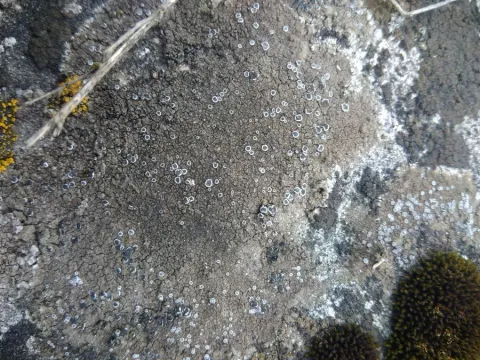
Ciri dan struktur
Pyrenodesmia rugosa differs from P. micromontana by thicker thallus (125–200 μm vs. 95–125 μm), rugose areoles (vs. flat areoles), larger apothecia (0.2–0.7 mm diam. vs. 0.2–0.4 mm diam.), shorter hymenium (60–70 μm vs. 80–100 μm), shorter hypothecium (50–55 μm vs. 80–100 μm) and narrower tip cells of paraphyses (3–4.5 μm vs. 5–6 μm).
Habitat dan peran ekologis
The species occurs on the calcareous rock. The species is currently known from the type collections.
- Habitat atau konteks temuan
- Informasi belum tersedia pada sumber rilis ini.
- Substrat
- Informasi belum tersedia pada sumber rilis ini.
- Peran atau konteks
- Pembentuk liken
Reproduksi
South Korea, Gangwon Province, Gangneung, Okgye-myeon, Mt. Seokbyung (summit), 37°35.21'N, 128°53.87'E, 1,072 m alt., on calcareous rock, 17 June 2020, B.G.Lee & H.J.Lee 2020-000902, with Athallia cf. vitellinula (Nyl.) Arup, Frödén & Søchting, Bagliettoa baldensis (A. Massal.) Vězda, Catillaria lenticularis (Ach.) Th. Fr. and Staurothele aff. succedens (Rehm) Arnold (holotype: BDNA-L-0001102!); same locality, on calcareous rock, 17 June 2020, B.G.Lee & H.J.Lee 2020-000899, with Athallia cf. holocarpa (Hoffm.) Arup, Frödén & Søchting and Staurothele cf. rupifraga (A. Massal.) Arnold (paratype: BDNA-L-0001099; GenBank MW832828 for ITS, MW832825 for mtSSU and MW832804 for LSU). Thallus saxicolous (calcicolous), crustose, mainly areolate or slightly rimose, rugose, greyish-brown to pale brown, often with orange spots, margin indeterminate or determinate when placodioid areoles are arranged around edge, vegetative propagules absent, areoles 0.4–1.0 mm diam., 125–200 μm thick; cortex hyaline with pale brown pigment layer, pale brown pigment K+ purple, 10–40 μm thick, cortical cells granular, 5–10 μm diam., with epinecral layer, 5–7 μm thick; medulla 60–110 μm thick below algal layer or inconspicuous and algal layer shown just above substrate; photobiont coccoid, cells globose to oval, 5–15 μm diam., algal layer 50–70 μm thick.
Catatan identitas dan cakupan
- Nama diterima mengikuti Catalogue of Life Base2026-09-11; uraian mempertahankan konsep dan nama sumber aslinya.
- Preserve original treatment localities, hosts and substrate scope. Materials examined describe documented specimens, not the full global range.
- Impor dan terjemahan otomatis belum diperiksa editorial per profil. Struktur reproduktif yang disebutkan tidak membuktikan seluruh siklus hidup diketahui.
- Pengukuran pada uraian mengikuti spesimen, kultur, dan metode sumber; angka tidak diperluas ke semua populasi.
Catatan distribusi dalam narasi mengikuti sumbernya. Dokumentasi spesimen atau foto mengikuti catatan sumber. Bukti wilayah Indonesia dan penilaian konservasi tidak disimpulkan dari gambar.
Melihat dengan konteks
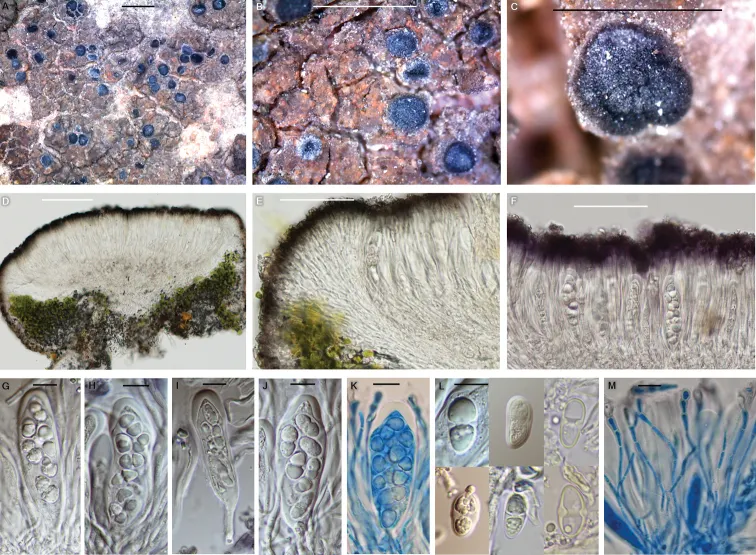
Pyrenodesmia rugosa (BDNA-L-0001102, holotype) in morphology A–C habitus and apothecia. Rugose thallus brown with orange spots and without pruina, but black apothecia often white pruinose D–E zeorine apothecia with well-developed parathecium. Algal layers continue to the base and underlying the hypothecium F epihymenium K+ purple and tiny granules not dissolving in K G–K asci oblong to narrowly clavate with eight spores K in the lactophenol cotton blue L ascospores simple in the beginning and developed polarilocular at maturity M paraphyses anastomosing in lactophenol cotton blue. Paraphysis tips slightly swollen. Scale bars: 1 mm (A–C); 100 μm (D); 50 μm (E, F); 10 μm (G–M).
- Jenis
- Pelat ilmiah
- Kredit
- Beeyoung Gun Lee, Jae-Seoun Hur
- Lisensi
- CC BY 4.0
- Sumber media
- Buka entri sumber
Sumber profil
- [1] Two new calcicolous caloplacoid lichens from South Korea, with a taxonomic key to the species of Huriella and Squamulea — Pyrenodesmia rugosa
- [2] Catalogue of Life Base2026-09-11 — Pyrenodesmia rugosa
- [3] Dokumentasi visual — Pyrenodesmia rugosa
Rujukan halaman ini
Fungi. Pyrenodesmia rugosa. Rilis data fungi-2026-10-12-expansion-2. https://fungi-atlas.mgadib.chatgpt.site/jamur/pyrenodesmia-rugosa/.
Status: impor sumber; pemeriksaan editorial per profil belum selesai. Untuk klaim biologis, gunakan rujukan pada bagian terkait dan periksa konteks sumber aslinya.