01 / Morfologi

Ciri dan struktur

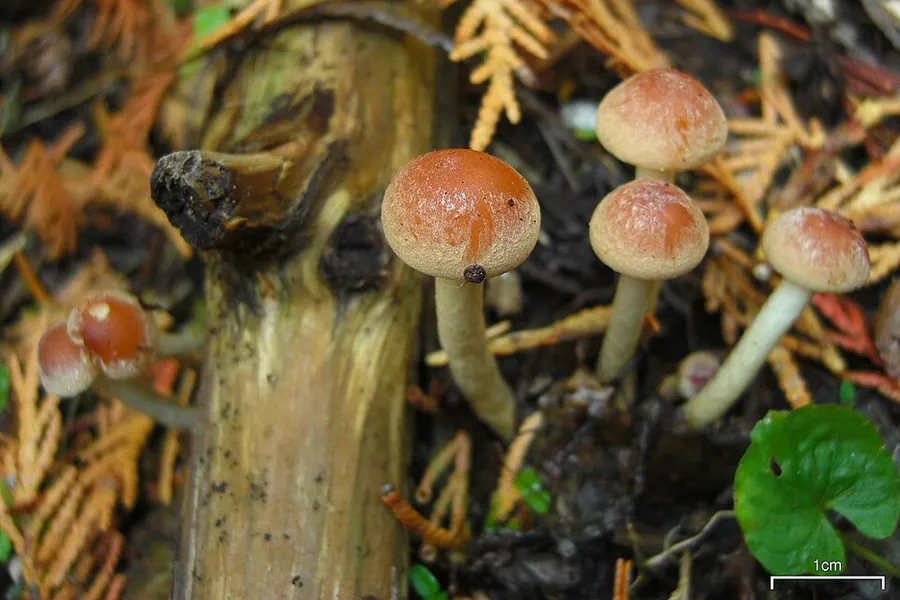
The cap is 2–6 cm broad, hemispheric to convex with a blunt umbo, viscid when moist and brilliant pink‑orange to salmon that fades and blackens with age; the margin is fibrillose, often bearing fleeting veil remnants. The gills are adnexed to adnate, close, yellowish‑brown, the edges paler and fimbriate. The stipe is 4–12 cm long and 4–8 mm thick, cylindrical and flexuous, fibrillose or scaly, often with a cobwebby annulus when young; flesh is orange, staining black on exposure, with a mild odour and bitter taste. The spore print is reddish‑brown to cinnamon. Under the microscope, basidiospores measure 6–6.8–8 by 4–4.4–5 μm, ellipsoid to somewhat ovate in shape, thin‑walled, without a germ pore, pale yellowish‑brown in KOH, and brown in deposit. The basidia are narrowly clavate (club-shaped), 20–28 by 7–8 μm, four‑spored. Pleurocystidia are chrysocystidia—fusiform‑ventricose to clavate with golden inclusions—and measure 42–55 by 12–18 μm; cheilocystidia are narrow, with a long neck and obtuse apex. The pileipellis is an ixocutis of gelatinous hyphae, and clamp connections are present. Though nonpoisonous, the species is regarded as inedible. DNA sequencing may be required to distinguish Pyrrhulomyces astragalinus from P. amariceps.

Sebagian uraian ditampilkan dalam bahasa sumber; terjemahannya belum tersedia atau belum lolos pemeriksaan.

Rujukan: [1]

Pengukuran mengikuti objek, spesimen atau kultur, dan metode yang disebutkan sumber. Baca uraian asli untuk konteks lengkap.

02 / Kehidupan

Habitat dan peran ekologis

Pyrrhulomyces astragalinus is saprotrophic on decaying wood, primarily of conifers, occurring on logs and stumps in late stages of decay. Fruiting usually occurs solitary or in small clusters, from late summer through autumn and, in mild coastal climates, into winter. This species is widespread across temperate regions of the Northern Hemisphere: in Europe (e.g. Italy, Sweden, Switzerland), in East Asia (provinces of Jilin and Jiangxi in China) and in North America—from Alaska, British Columbia, Washington and Idaho eastward to Newfoundland and Maine, southward along the Pacific coast and in high‑elevation conifer forests of the southern Appalachians (North Carolina, Tennessee).

Sebagian uraian ditampilkan dalam bahasa sumber; terjemahannya belum tersedia atau belum lolos pemeriksaan.

Rujukan: [1]

Habitat atau konteks temuan
hutan
Substrat
kayu
Peran atau konteks
Pengurai
Temukan hubungan serupa
03 / Siklus hidup

Reproduksi

The cap is 2–6 cm broad, hemispheric to convex with a blunt umbo, viscid when moist and brilliant pink‑orange to salmon that fades and blackens with age; the margin is fibrillose, often bearing fleeting veil remnants. The gills are adnexed to adnate, close, yellowish‑brown, the edges paler and fimbriate. The stipe is 4–12 cm long and 4–8 mm thick, cylindrical and flexuous, fibrillose or scaly, often with a cobwebby annulus when young; flesh is orange, staining black on exposure, with a mild odour and bitter taste. The spore print is reddish‑brown to cinnamon. Under the microscope, basidiospores measure 6–6.8–8 by 4–4.4–5 μm, ellipsoid to somewhat ovate in shape, thin‑walled, without a germ pore, pale yellowish‑brown in KOH, and brown in deposit.

Sebagian uraian ditampilkan dalam bahasa sumber; terjemahannya belum tersedia atau belum lolos pemeriksaan.

Rujukan: [1]

Sinonim menurut acuan taksonomi rilis: Agaricus astragalinus; Dryophila astragalina; Flammopsis astragalinus; Flammula astragalina; Flammula astragalina var. perelegans; Gymnopilus astragalinus; Naucoria astragalina; Pholiota astragalina; Pholiotina astragalina
04 / Batas informasi

Catatan identitas dan cakupan

  • Nama diterima mengikuti Catalogue of Life Base2026-09-11; uraian mempertahankan konsep dan nama sumber aslinya.
  • Original geographic, specimen and life-cycle scope retained; source import awaits individual editorial review.
  • Impor dan terjemahan otomatis belum diperiksa editorial per profil. Struktur reproduktif yang disebutkan tidak membuktikan seluruh siklus hidup diketahui.
  • Pengukuran pada uraian mengikuti spesimen, kultur, dan metode sumber; angka tidak diperluas ke semua populasi.

Catatan distribusi dalam narasi mengikuti sumbernya. Dokumentasi spesimen atau foto mengikuti catatan sumber. Bukti wilayah Indonesia dan penilaian konservasi tidak disimpulkan dari gambar.

05 / Dokumentasi

Melihat dengan konteks

Dokumentasi Pyrrhulomyces astragalinus dari Wikimedia Commons. Pholiota astraglina 20090927.17 Canada, BC, Incomappleux Inland Rainforest Identifikasi mengikuti record berkas sumber.

Jenis
Fotografi
Kredit
Jason Hollinger
Lisensi
CC BY 2.0
Sumber media
Buka entri sumber

Gambar menunjukkan objek menurut identifikasi sumber, bukan verifikasi independen spesimen oleh Fungi. Tidak ada skala baru yang ditambahkan.

06 / Rujukan

Sumber profil

  1. [1] Pyrrhulomyces astragalinus — Wikipedia (en)Bagian sumber: Frozen revision 1321666740
    Tanggal penghimpunan sumber: 2026-10-12
    Teks sumber: CC BY-SA4.0 · Wikipedia contributors
  2. [2] Catalogue of Life Base2026-09-11 — Pyrrhulomyces astragalinusBagian sumber: ColDP NameUsage.tsv ID 9ZF3P; accepted species; source 2073
    Tanggal penghimpunan sumber: 2026-10-12
  3. [3] Dokumentasi visual — Pyrrhulomyces astragalinusBagian sumber: Individual media record; identification follows the source, not independent determination
    Tanggal penghimpunan sumber: 2026-10-12
    Media sumber: CC BY 2.0 · Jason Hollinger

Adaptasi teks: CC BY-SA 4.0. Wikipedia contributors — Pyrrhulomyces astragalinus — Wikipedia (en)

Uraian asli dan riwayat sumber

Riwayat atau halaman sumber

Ringkasan sumber

{{Speciesbox The species is characterized by its pink-orange cap and stem that blacken when bruised, smooth spores lacking a germ pore, and bitter taste. Found throughout temperate regions of the Northern Hemisphere, this saprotroph grows on decaying conifer wood and though non-poisonous, is considered inedible.

Revisi sumber

Morfologi sumber

The cap is 2–6 cm broad, hemispheric to convex with a blunt umbo, viscid when moist and brilliant pink‑orange to salmon that fades and blackens with age; the margin is fibrillose, often bearing fleeting veil remnants. The gills are adnexed to adnate, close, yellowish‑brown, the edges paler and fimbriate. The stipe is 4–12 cm long and 4–8 mm thick, cylindrical and flexuous, fibrillose or scaly, often with a cobwebby annulus when young; flesh is orange, staining black on exposure, with a mild odour and bitter taste. The spore print is reddish‑brown to cinnamon. Under the microscope, basidiospores measure 6–6.8–8 by 4–4.4–5 μm, ellipsoid to somewhat ovate in shape, thin‑walled, without a germ pore, pale yellowish‑brown in KOH, and brown in deposit. The basidia are narrowly clavate (club-shaped), 20–28 by 7–8 μm, four‑spored. Pleurocystidia are chrysocystidia—fusiform‑ventricose to clavate with golden inclusions—and measure 42–55 by 12–18 μm; cheilocystidia are narrow, with a long neck and obtuse apex. The pileipellis is an ixocutis of gelatinous hyphae, and clamp connections are present. Though nonpoisonous, the species is regarded as inedible. DNA sequencing may be required to distinguish Pyrrhulomyces astragalinus from P. amariceps.

Revisi sumber

Ekologi sumber

Pyrrhulomyces astragalinus is saprotrophic on decaying wood, primarily of conifers, occurring on logs and stumps in late stages of decay. Fruiting usually occurs solitary or in small clusters, from late summer through autumn and, in mild coastal climates, into winter. This species is widespread across temperate regions of the Northern Hemisphere: in Europe (e.g. Italy, Sweden, Switzerland), in East Asia (provinces of Jilin and Jiangxi in China) and in North America—from Alaska, British Columbia, Washington and Idaho eastward to Newfoundland and Maine, southward along the Pacific coast and in high‑elevation conifer forests of the southern Appalachians (North Carolina, Tennessee).

Revisi sumber

Struktur reproduksi sumber

The cap is 2–6 cm broad, hemispheric to convex with a blunt umbo, viscid when moist and brilliant pink‑orange to salmon that fades and blackens with age; the margin is fibrillose, often bearing fleeting veil remnants. The gills are adnexed to adnate, close, yellowish‑brown, the edges paler and fimbriate. The stipe is 4–12 cm long and 4–8 mm thick, cylindrical and flexuous, fibrillose or scaly, often with a cobwebby annulus when young; flesh is orange, staining black on exposure, with a mild odour and bitter taste. The spore print is reddish‑brown to cinnamon. Under the microscope, basidiospores measure 6–6.8–8 by 4–4.4–5 μm, ellipsoid to somewhat ovate in shape, thin‑walled, without a germ pore, pale yellowish‑brown in KOH, and brown in deposit.

Revisi sumber

Rujukan halaman ini

Fungi. Pyrrhulomyces astragalinus. Rilis data fungi-2026-10-12-expansion-2. https://fungi-atlas.mgadib.chatgpt.site/jamur/pyrrhulomyces-astragalinus/.

Status: impor sumber; pemeriksaan editorial per profil belum selesai. Untuk klaim biologis, gunakan rujukan pada bagian terkait dan periksa konteks sumber aslinya.