01 / Morfologi

Ciri dan struktur

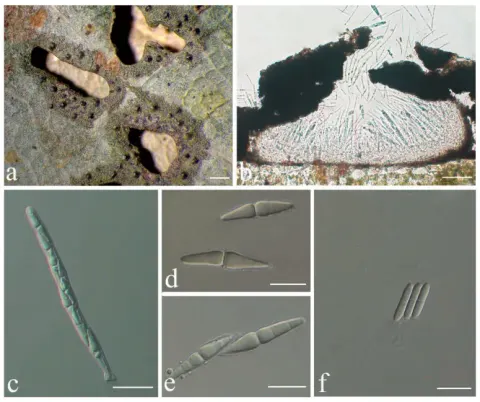
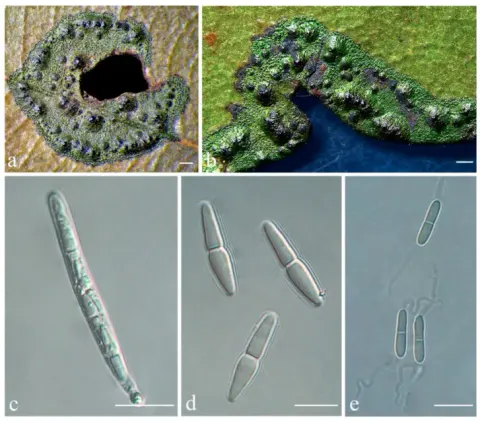
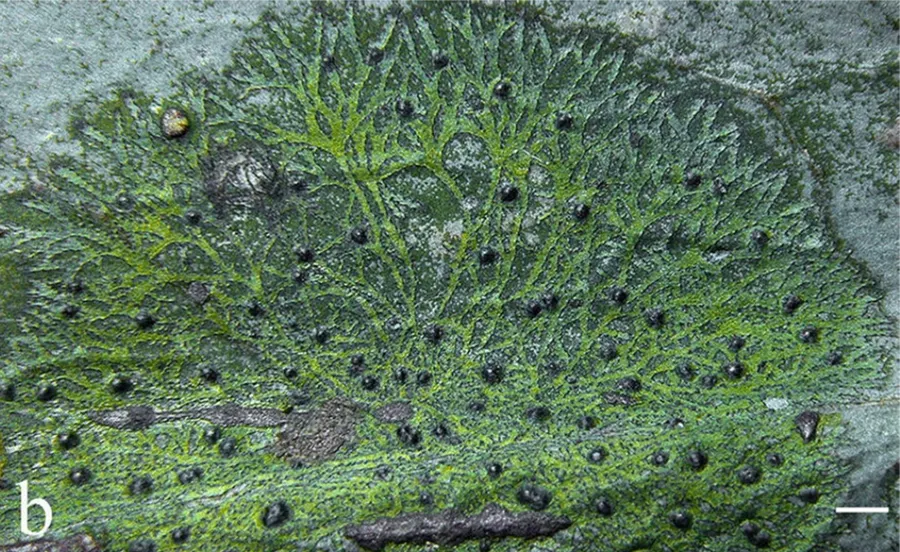
Racoplaca melanobapha is a leaf-dwelling species that forms a very thin thallus just beneath the leaf cuticle. The thallus is usually rounded and , typically 10–20 (sometimes to 25) mm across, and made up of narrow, more or less linear (0.1–0.3 mm wide) that branch dichotomously and usually remain separate rather than forming a net. It is dark greyish green and often glossy, with a smooth to slightly wrinkled surface. The lobe margins are outlined by a fine black line (resembling a hypothallus), and the thallus commonly bears many tiny, evenly scattered black (about 0.03 mm wide), usually spaced roughly 0.1 mm apart. In section, the thallus is very thin (about 10–16 μm), with a simple . The species produces black, convex perithecia that spread slightly at the base, measuring 0.45–0.7 mm in diameter and about 150–250 μm high. The asci are narrowly club-shaped (60–110 × 6–10 μm) and contain eight ascospores that are typically 1-septate (rarely 3-septate), with pointed ends, and slightly pinched at the septum (14–22 × 3–5 μm). Pycnidia are also common; they are black and glossy, 0.2–0.3 mm in diameter, and produce , rod-shaped macroconidia (10–12 × 2–3 μm). Microconidia were not observed in the material described. The symbiotic alga was considered likely to be a Cephaleuros species, with rectangular to oblong cells 9–13 × 4–7 μm that often form continuous, radiating plates.

Sebagian uraian ditampilkan dalam bahasa sumber; terjemahannya belum tersedia atau belum lolos pemeriksaan.

Rujukan: [1]

Pengukuran mengikuti objek, spesimen atau kultur, dan metode yang disebutkan sumber. Baca uraian asli untuk konteks lengkap.

02 / Kehidupan

Habitat dan peran ekologis

In his 1952 treatment, Santesson characterised Racoplaca melanobapha as a rare species with a scattered tropical range, and suggested it was "probably pantropical". He also remarked that records from the Americas were few, which he found striking for a taxon thought to occur widely in the tropics. The material Santesson cited included a single Brazilian collection from Amazonas, together with records from Sierra Leone and from what was then the Belgian Congo (localities around Léopoldville, including Inkisi). In Asia and the western Pacific, he reported the species from Fujian in southeastern China (near Fuzhou on Gushan, 500–600 m), Sarawak (Borneo), Palawan in the Philippines, and New Guinea (including Goroka at about 1,300 m, and Valsche Pisangs Island off western New Guinea). Santesson also noted additional published Chinese reports that he treated as unverified. More recent records have extended its distribution to include Kenya, Tanzania, India (Western Ghats), Sri Lanka, Hawaii, Micronesia, and South Korea. Modern fieldwork has reconfirmed its presence in the Democratic Republic of the Congo and elaborated a more widespread presence in Brazil.

Sebagian uraian ditampilkan dalam bahasa sumber; terjemahannya belum tersedia atau belum lolos pemeriksaan.

Rujukan: [1]

Habitat atau konteks temuan
Informasi belum tersedia pada sumber rilis ini.
Substrat
Informasi belum tersedia pada sumber rilis ini.
Peran atau konteks
Pembentuk liken
Temukan hubungan serupa
03 / Siklus hidup

Reproduksi

The species produces black, convex perithecia that spread slightly at the base, measuring 0.45–0.7 mm in diameter and about 150–250 μm high. The asci are narrowly club-shaped (60–110 × 6–10 μm) and contain eight ascospores that are typically 1-septate (rarely 3-septate), with pointed ends, and slightly pinched at the septum (14–22 × 3–5 μm). Pycnidia are also common; they are black and glossy, 0.2–0.3 mm in diameter, and produce , rod-shaped macroconidia (10–12 × 2–3 μm). Microconidia were not observed in the material described. The symbiotic alga was considered likely to be a Cephaleuros species, with rectangular to oblong cells 9–13 × 4–7 μm that often form continuous, radiating plates.

Sebagian uraian ditampilkan dalam bahasa sumber; terjemahannya belum tersedia atau belum lolos pemeriksaan.

Rujukan: [1]

Sinonim menurut acuan taksonomi rilis: Strigula melanobapha; Verrucaria melanobapha
04 / Batas informasi

Catatan identitas dan cakupan

  • Nama diterima mengikuti Catalogue of Life Base2026-09-11; uraian mempertahankan konsep dan nama sumber aslinya.
  • Original geographic, specimen and life-cycle scope retained; source import awaits individual editorial review.
  • Impor dan terjemahan otomatis belum diperiksa editorial per profil. Struktur reproduktif yang disebutkan tidak membuktikan seluruh siklus hidup diketahui.
  • Pengukuran pada uraian mengikuti spesimen, kultur, dan metode sumber; angka tidak diperluas ke semua populasi.

Catatan distribusi dalam narasi mengikuti sumbernya. Dokumentasi spesimen atau foto mengikuti catatan sumber. Bukti wilayah Indonesia dan penilaian konservasi tidak disimpulkan dari gambar.

05 / Dokumentasi

Melihat dengan konteks

Dokumentasi Racoplaca melanobapha dari Wikimedia Commons. The leaf-dwelling lichen Racoplaca melanobapha Identifikasi mengikuti record berkas sumber.

Jenis
Fotografi
Kredit
Unknown author Unknown author
Sumber media
Buka entri sumber

Gambar menunjukkan objek menurut identifikasi sumber, bukan verifikasi independen spesimen oleh Fungi. Tidak ada skala baru yang ditambahkan.

06 / Rujukan

Sumber profil

  1. [1] Racoplaca melanobapha — Wikipedia (en)Bagian sumber: Frozen revision 1378606676
    Tanggal penghimpunan sumber: 2026-10-12
    Teks sumber: CC BY-SA4.0 · Wikipedia contributors
  2. [2] Catalogue of Life Base2026-09-11 — Racoplaca melanobaphaBagian sumber: ColDP NameUsage.tsv ID 9ZF43; accepted species; source 2073
    Tanggal penghimpunan sumber: 2026-10-12
  3. [3] Dokumentasi visual — Racoplaca melanobaphaBagian sumber: Individual media record; identification follows the source, not independent determination
    Tanggal penghimpunan sumber: 2026-10-12
    Media sumber: CC BY-SA 4.0 · Unknown author Unknown author

Adaptasi teks: CC BY-SA 4.0. Wikipedia contributors — Racoplaca melanobapha — Wikipedia (en)

Uraian asli dan riwayat sumber

Riwayat atau halaman sumber

Ringkasan sumber

Racoplaca melanobapha is a species of leaf-dwelling lichen in the family Strigulaceae. The species was first described in 1874 from a specimen collected in Borneo, though its taxonomic placement remained uncertain for many decades until it was transferred to the genus Strigula in 1952 and later to Racoplaca in 2020. It forms very thin, dark greyish-green patches on leaf surfaces, with narrow branching lobes outlined by fine black lines and scattered with tiny black dots. Molecular studies suggest that what has traditionally been treated as a single widespread tropical species may actually represent several closely related species that are difficult to distinguish by appearance alone.

Revisi sumber

Morfologi sumber

Racoplaca melanobapha is a leaf-dwelling species that forms a very thin thallus just beneath the leaf cuticle. The thallus is usually rounded and , typically 10–20 (sometimes to 25) mm across, and made up of narrow, more or less linear (0.1–0.3 mm wide) that branch dichotomously and usually remain separate rather than forming a net. It is dark greyish green and often glossy, with a smooth to slightly wrinkled surface. The lobe margins are outlined by a fine black line (resembling a hypothallus), and the thallus commonly bears many tiny, evenly scattered black (about 0.03 mm wide), usually spaced roughly 0.1 mm apart. In section, the thallus is very thin (about 10–16 μm), with a simple . The species produces black, convex perithecia that spread slightly at the base, measuring 0.45–0.7 mm in diameter and about 150–250 μm high. The asci are narrowly club-shaped (60–110 × 6–10 μm) and contain eight ascospores that are typically 1-septate (rarely 3-septate), with pointed ends, and slightly pinched at the septum (14–22 × 3–5 μm). Pycnidia are also common; they are black and glossy, 0.2–0.3 mm in diameter, and produce , rod-shaped macroconidia (10–12 × 2–3 μm). Microconidia were not observed in the material described. The symbiotic alga was considered likely to be a Cephaleuros species, with rectangular to oblong cells 9–13 × 4–7 μm that often form continuous, radiating plates.

Revisi sumber

Ekologi sumber

In his 1952 treatment, Santesson characterised Racoplaca melanobapha as a rare species with a scattered tropical range, and suggested it was "probably pantropical". He also remarked that records from the Americas were few, which he found striking for a taxon thought to occur widely in the tropics. The material Santesson cited included a single Brazilian collection from Amazonas, together with records from Sierra Leone and from what was then the Belgian Congo (localities around Léopoldville, including Inkisi). In Asia and the western Pacific, he reported the species from Fujian in southeastern China (near Fuzhou on Gushan, 500–600 m), Sarawak (Borneo), Palawan in the Philippines, and New Guinea (including Goroka at about 1,300 m, and Valsche Pisangs Island off western New Guinea). Santesson also noted additional published Chinese reports that he treated as unverified. More recent records have extended its distribution to include Kenya, Tanzania, India (Western Ghats), Sri Lanka, Hawaii, Micronesia, and South Korea. Modern fieldwork has reconfirmed its presence in the Democratic Republic of the Congo and elaborated a more widespread presence in Brazil.

Revisi sumber

Struktur reproduksi sumber

The species produces black, convex perithecia that spread slightly at the base, measuring 0.45–0.7 mm in diameter and about 150–250 μm high. The asci are narrowly club-shaped (60–110 × 6–10 μm) and contain eight ascospores that are typically 1-septate (rarely 3-septate), with pointed ends, and slightly pinched at the septum (14–22 × 3–5 μm). Pycnidia are also common; they are black and glossy, 0.2–0.3 mm in diameter, and produce , rod-shaped macroconidia (10–12 × 2–3 μm). Microconidia were not observed in the material described. The symbiotic alga was considered likely to be a Cephaleuros species, with rectangular to oblong cells 9–13 × 4–7 μm that often form continuous, radiating plates.

Revisi sumber

Rujukan halaman ini

Fungi. Racoplaca melanobapha. Rilis data fungi-2026-10-12-expansion-2. https://fungi-atlas.mgadib.chatgpt.site/jamur/racoplaca-melanobapha/.

Status: impor sumber; pemeriksaan editorial per profil belum selesai. Untuk klaim biologis, gunakan rujukan pada bagian terkait dan periksa konteks sumber aslinya.