Ciri dan struktur
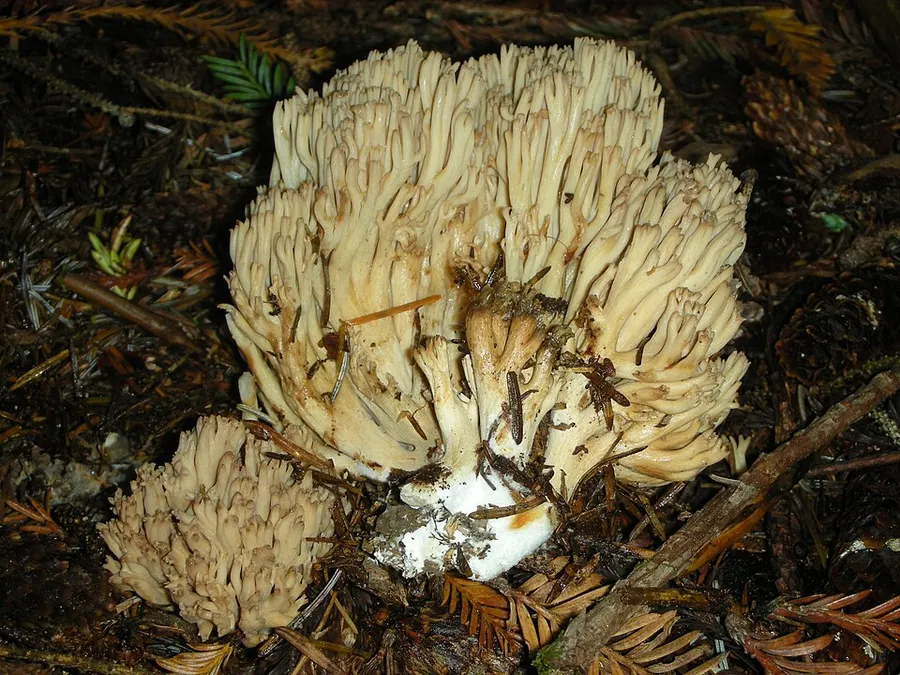
The whitish fruit bodies are large, generally taller than wide, measuring 5 – 29 cm tall by 1.5 – 18 cm wide. The stipe, which is often deeply buried, is slender and tapered, measuring 1.5 – 9 cm by 1 – 3 cm wide. Fruit bodies consist of elongated branches with roughly parallel arrangements. Each branch itself branches up to 9 times in a dichotomous fashion; each of these branches is slender, typically 1–12 mm in diameter. The branch tips are usually rounded. The context has a fleshy or fibrous consistency, but it becomes brittle and chalky when dry; it sometimes has pinkish or brownish tones in age, and does not react to iron sulfate or Melzer's reagent. The stipe of young fruit bodies is white, while the branches range from shades of grey, to beige, and even orange. The spores have pale yellow and cream colors. The lower branches tend to bruise a brownish color. The color of the branch tips varies, ranging from more or less the same color as the branch, to pallid, or, especially in young specimens, infused with pinkish or purple tones in a small spotted transition. The spore print is grayish-yellow. Spores are somewhat cylindrical to roughly elliptical, ornamented with lobed warts, and measure about 10.1 by 4.9 μm. The basidia (spore-bearing cells) are club-shaped, one- to four-spored (although most have four), and measure 40–90 by 7–13 μm. The species lacks basal clamps.
Habitat dan peran ekologis
Fruit bodies of Ramaria acrisiccescens grow on the ground under western hemlock, typically in mixed forests. It has been recorded from Washington and California.
- Habitat atau konteks temuan
- hutan
- Substrat
- tanah
- Peran atau konteks
- Belum dikategorikan pada rilis ini.
Reproduksi
The whitish fruit bodies are large, generally taller than wide, measuring 5 – 29 cm tall by 1.5 – 18 cm wide. The stipe, which is often deeply buried, is slender and tapered, measuring 1.5 – 9 cm by 1 – 3 cm wide. Fruit bodies consist of elongated branches with roughly parallel arrangements. Each branch itself branches up to 9 times in a dichotomous fashion; each of these branches is slender, typically 1–12 mm in diameter. The branch tips are usually rounded. The context has a fleshy or fibrous consistency, but it becomes brittle and chalky when dry; it sometimes has pinkish or brownish tones in age, and does not react to iron sulfate or Melzer's reagent. The stipe of young fruit bodies is white, while the branches range from shades of grey, to beige, and even orange.
Catatan identitas dan cakupan
- Nama diterima mengikuti Catalogue of Life Base2026-09-11; uraian mempertahankan konsep dan nama sumber aslinya.
- Original geographic, specimen and life-cycle scope retained; source import awaits individual editorial review.
- Impor dan terjemahan otomatis belum diperiksa editorial per profil. Struktur reproduktif yang disebutkan tidak membuktikan seluruh siklus hidup diketahui.
- Pengukuran pada uraian mengikuti spesimen, kultur, dan metode sumber; angka tidak diperluas ke semua populasi.
Catatan distribusi dalam narasi mengikuti sumbernya. Dokumentasi spesimen atau foto mengikuti catatan sumber. Bukti wilayah Indonesia dan penilaian konservasi tidak disimpulkan dari gambar.
Melihat dengan konteks
Dokumentasi Ramaria acrisiccescens dari Wikimedia Commons. Fruit bodies of the coral fungus Ramaria acrisiccescens Marr & D.E. Stuntz. Photographed in Jedediah Smith State Park, Del Norte Co., California, USA. Identifikasi mengikuti record berkas sumber.
- Jenis
- Fotografi
- Kredit
- Ron Pastorino (Ronpast)
- Lisensi
- CC BY-SA 3.0
- Sumber media
- Buka entri sumber
Sumber profil
- [1] Ramaria acrisiccescens — Wikipedia (en)
- [2] Catalogue of Life Base2026-09-11 — Ramaria acrisiccescens
- [3] Dokumentasi visual — Ramaria acrisiccescens
Rujukan halaman ini
Fungi. Ramaria acrisiccescens. Rilis data fungi-2026-10-12-expansion-2. https://fungi-atlas.mgadib.chatgpt.site/jamur/ramaria-acrisiccescens/.
Status: impor sumber; pemeriksaan editorial per profil belum selesai. Untuk klaim biologis, gunakan rujukan pada bagian terkait dan periksa konteks sumber aslinya.