Ciri dan struktur
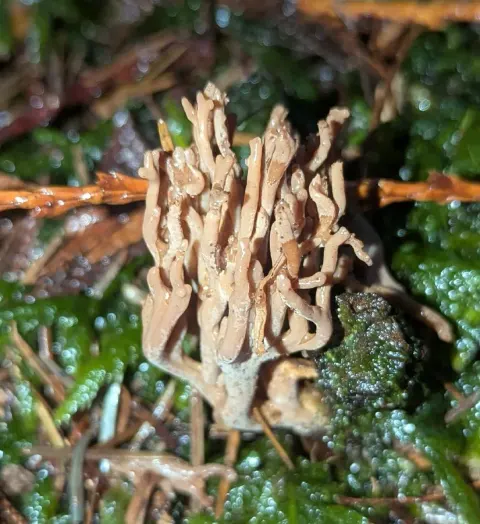
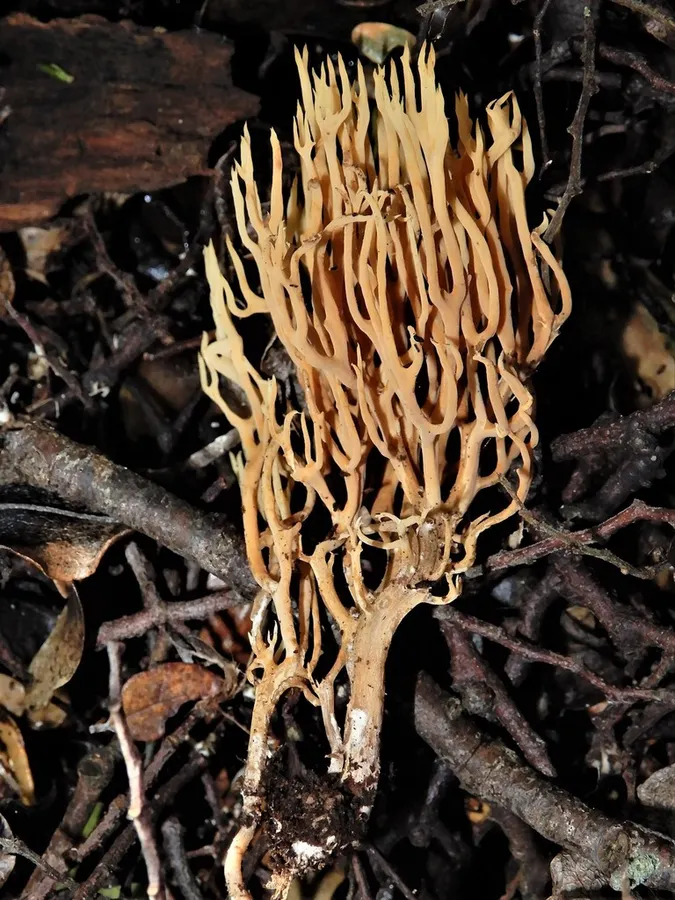
Fruit bodies up to 4 cm high, up to 3 cm broad, repeatedly branched, arbuscular, arising from tangles of slender, white, fragile rhizomorphic strands. Stipe up to 20 x 4 mm, channelled to grooved, white below, when young concolourous with branches, in age darkening to brown colours ("tawny-olive", "Verona-brown"). Branches curved-ascending to strict, up to 2 mm thick, flattened, tan to fleshy tan ("cinnamon buff', "clay-color", "buckthorn-brown", "tawny-olive"); hymenium unilateral; axils narrowly to openly rounded or lunate; internodes diminishing gradually. Apices elongate, acute, pale creamy beige ("cream-buff", "light buff", "warm buff", "pale ochraceous buff"). Stipe and lower branches appearing watersoaked, especially when bruised, easily changing colour to watery brown. Odour fresh, perhaps of pipe tobacco; taste bitter. Sections of branches in 2% KOH leaching pinkish pigment briefly, then leaching yellow-brown. Macrochemical reactions: NOH, KOH = leaching peach to coral-coloured briefly, then yellow-brown; FCL = green-black; PHN, GUA = negative; ANO = ambiguous; PYR = positive. Tramal hyphae of branches 3.5-8 gm diam., clamped, parallel, hyaline, free, slightly thick-walled (wall up to 0.2 gm thick). Basidia 25-30 x 5-6 I.m, clavate, clamped, yellowish under phase contrast; sterigmata 4, spindly, erect. Spores (Fig. 99) 7.6-8.6 x 4-4.3 gm (E =1.83-2.19; E'" = 2.03; L'° = 8.24 gm),.curved teardrop-shaped, roughened;' contents homogeneous to obscurely refringent; wall up to 0.2 gm thick; hilar appendix curved, not prominent, appearing as extension of spore body; ornamentation of narrow, blunt spines up to 2 gm long, scattered all over spore surface.
Habitat dan peran ekologis
This is difficult to distinguish from Ramaria ambigua, which shares general stature, rich ochre colouration and snow-white base and rhizomorphs. The two are easily separated on spore shape, which also separates them from both R. ochracea and its variety sicco-olivacea. Most characters match the Ramaria flaccida complex, with unilateral hymenium and teardrop-shaped spores of appropriate size. Of these taxa, R. perfluo-punicea produces the longest spores (but by only less than 1 gm). Even the watersoaked appearance of the fruit bodies matches the same character in R. flaccida (Fr.) Rick. Indeed, the two taxa are virtually indistinguishable (at least from dried material and the fresh material I have seen from Scandinavia and New Zealand). I keep them separate until more material can be seen. Corner (1970) considered Ramaria flaccida (Fr.) Bourd. almost cosmopolitan, but Petersen (1981) used narrower taxonomic concepts, restricting R. flaccida to a fungus seen only from the North Temperate Zone. I have seen no specimens from the tropics which exactly match R. flaccida. Although there is always a possibility that R. flaccida was introduced to New Zealand as the mycorrhizal symbiont of some higher plant, I prefer to keep the taxon separate at present.
- Habitat atau konteks temuan
- Informasi belum tersedia pada sumber rilis ini.
- Substrat
- Informasi belum tersedia pada sumber rilis ini.
- Peran atau konteks
- Mitra tumbuhan
Reproduksi
Fruit bodies up to 4 cm high, up to 3 cm broad, repeatedly branched, arbuscular, arising from tangles of slender, white, fragile rhizomorphic strands. Stipe up to 20 x 4 mm, channelled to grooved, white below, when young concolourous with branches, in age darkening to brown colours ("tawny-olive", "Verona-brown"). Branches curved-ascending to strict, up to 2 mm thick, flattened, tan to fleshy tan ("cinnamon buff', "clay-color", "buckthorn-brown", "tawny-olive"); hymenium unilateral; axils narrowly to openly rounded or lunate; internodes diminishing gradually. Apices elongate, acute, pale creamy beige ("cream-buff", "light buff", "warm buff", "pale ochraceous buff"). Stipe and lower branches appearing watersoaked, especially when bruised, easily changing colour to watery brown.
Catatan identitas dan cakupan
- Nama diterima mengikuti Catalogue of Life Base2026-09-11; uraian mempertahankan konsep dan nama sumber aslinya.
- Historical description as cited by BiotaNZ. Preserve explicit New Zealand/locality, host and specimen qualifiers. Distribution is the cited source scope, not a current global range.
- Impor dan terjemahan otomatis belum diperiksa editorial per profil. Struktur reproduktif yang disebutkan tidak membuktikan seluruh siklus hidup diketahui.
- Pengukuran pada uraian mengikuti spesimen, kultur, dan metode sumber; angka tidak diperluas ke semua populasi.
Catatan distribusi dalam narasi mengikuti sumbernya. Dokumentasi spesimen atau foto mengikuti catatan sumber. Bukti wilayah Indonesia dan penilaian konservasi tidak disimpulkan dari gambar.
Melihat dengan konteks
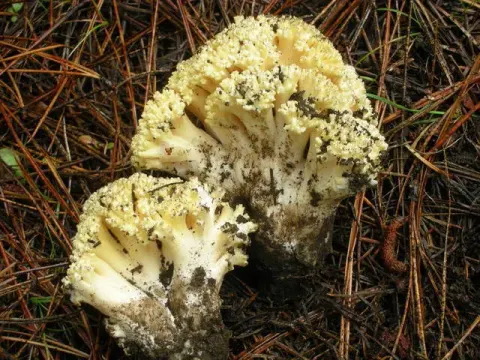
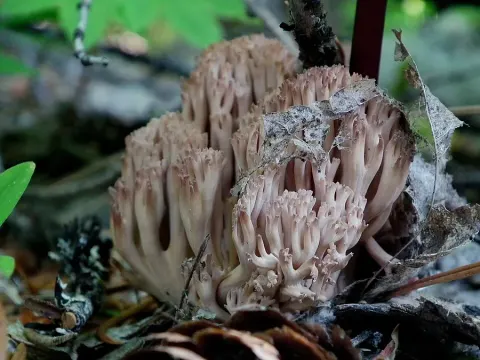
Dokumentasi Ramaria perfluopunicea menurut asosiasi foto pada record takson iNaturalist. Kredit: Grey Smith. Identitas mengikuti sumber; bukan penentuan spesimen independen.
- Jenis
- Fotografi
- Kredit
- (c) Grey Smith, some rights reserved (CC BY), uploaded by Grey Smith
- Lisensi
- CC BY 4.0
- Sumber media
- Buka entri sumber
Sumber profil
- [1] Petersen, R.H. 1988: The clavarioid fungi of New Zealand. New Zealand Department of Scientific and Industrial Research, Bulletin. 236. — Ramaria perfluopunicea
- [2] Catalogue of Life Base2026-09-11 — Ramaria perfluopunicea
- [3] Dokumentasi visual — Ramaria perfluopunicea
Rujukan halaman ini
Fungi. Ramaria perfluopunicea. Rilis data fungi-2026-10-12-expansion-2. https://fungi-atlas.mgadib.chatgpt.site/jamur/ramaria-perfluopunicea/.
Status: impor sumber; pemeriksaan editorial per profil belum selesai. Untuk klaim biologis, gunakan rujukan pada bagian terkait dan periksa konteks sumber aslinya.