01 / Morfologi

Ciri dan struktur

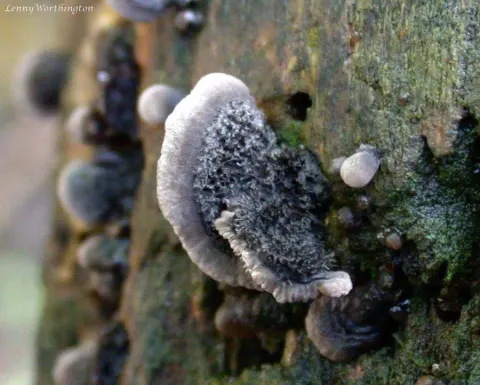
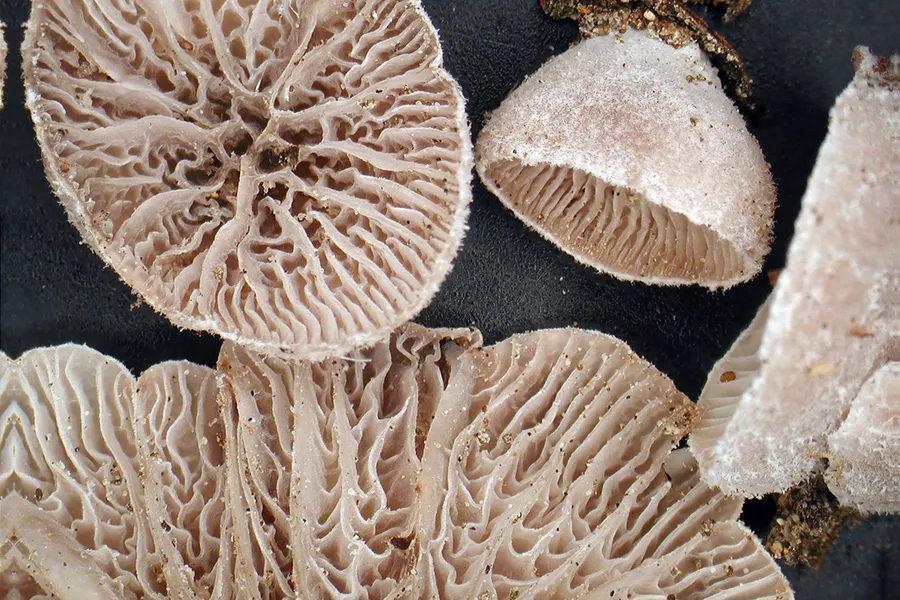
Basidiome conchate to orbicular, sessile, attached dorsally, centrically to excentrically, gelatinous when fresh, drying hard and horny. Pileus 3-30 mm diam., convex, livid vinaceus (12C4) drying light greyish-brown (5E3), surface floccose especially when dry, and margin even, thin. Hymenophore concolorous, favoloid in the centric to excentric middle region (depending on point of attachment) from which up to 14 main lamellae radiate, separated by 2-3 series of crowded lamellulae, all connected by very frequent cross-veining at a somewhat lower level. Lamellae fairly narrow and relatively thin. Flesh gelatinous. Smell and taste unknown. Spore print pure white. Spores 6.0-7.0 x 3.5-4.0 (6.0 x 3.6) µm, Q = 1.6, elliptic-oblong, sometimes slightly ovoid, fairly uniform in size, hyaline, inamyloid, not dextrinoid or cyanophilic, thin-walled, with a very small apiculus. Basidia 15-17 x 4-5 µm, clavate, with 4 long (-6 µm) sterigmata. Cheilocystidia 18-25 x 4-5 µm, hyaline, thin-walled, sinuato-cylindric to ventricose, ail apically diverticulate to nodulose, forming a sterile margin. Pleurocystidia absent. Trama of narrow (2-4 µm diam.), moderately gelatinised hyphae with conspicuous medallion clamp connections, interwoven to subparallel. Subhymenium similarly gelatinised, very narrow and not easily distinguished. Context of very strongly gelatinised, extremely narrow hyphae, with some broader ones (-5 µm diam.) with oily yellow contents. Pileipellis of narrow (-4 µm diam.) hyphae with yellow (in KOH) plasmatic pigment, giving rise to erect, diverticulate to well-developed asterostromelloid elements.

Sebagian uraian ditampilkan dalam bahasa sumber; terjemahannya belum tersedia atau belum lolos pemeriksaan.

Rujukan: [1]

Pengukuran mengikuti objek, spesimen atau kultur, dan metode yang disebutkan sumber. Baca uraian asli untuk konteks lengkap.

02 / Kehidupan

Habitat dan peran ekologis

Gregarious on fallen wood of unknown species in indigenous podocarp-dicotyledonous forest.

Sebagian uraian ditampilkan dalam bahasa sumber; terjemahannya belum tersedia atau belum lolos pemeriksaan.

Rujukan: [1]

Habitat atau konteks temuan
Informasi belum tersedia pada sumber rilis ini.
Substrat
Informasi belum tersedia pada sumber rilis ini.
Peran atau konteks
Belum dikategorikan pada rilis ini.
Temukan hubungan serupa
03 / Siklus hidup

Reproduksi

Basidiome conchate to orbicular, sessile, attached dorsally, centrically to excentrically, gelatinous when fresh, drying hard and horny. Pileus 3-30 mm diam., convex, livid vinaceus (12C4) drying light greyish-brown (5E3), surface floccose especially when dry, and margin even, thin. Hymenophore concolorous, favoloid in the centric to excentric middle region (depending on point of attachment) from which up to 14 main lamellae radiate, separated by 2-3 series of crowded lamellulae, all connected by very frequent cross-veining at a somewhat lower level. Lamellae fairly narrow and relatively thin. Flesh gelatinous. Smell and taste unknown. Spore print pure white. Spores 6.0-7.0 x 3.5-4.0 (6.0 x 3.6) µm, Q = 1.6, elliptic-oblong, sometimes slightly ovoid, fairly uniform in size, hyaline, inamyloid, not dextrinoid or cyanophilic, thin-walled, with a very small apiculus.

Sebagian uraian ditampilkan dalam bahasa sumber; terjemahannya belum tersedia atau belum lolos pemeriksaan.

Rujukan: [1]

Sinonim menurut acuan taksonomi rilis: Campanella vinosolivida
04 / Batas informasi

Catatan identitas dan cakupan

  • Nama diterima mengikuti Catalogue of Life Base2026-09-11; uraian mempertahankan konsep dan nama sumber aslinya.
  • Historical description as cited by BiotaNZ. Preserve explicit New Zealand/locality, host and specimen qualifiers. Distribution is the cited source scope, not a current global range.
  • Impor dan terjemahan otomatis belum diperiksa editorial per profil. Struktur reproduktif yang disebutkan tidak membuktikan seluruh siklus hidup diketahui.
  • Pengukuran pada uraian mengikuti spesimen, kultur, dan metode sumber; angka tidak diperluas ke semua populasi.

Catatan distribusi dalam narasi mengikuti sumbernya. Dokumentasi spesimen atau foto mengikuti catatan sumber. Bukti wilayah Indonesia dan penilaian konservasi tidak disimpulkan dari gambar.

05 / Dokumentasi

Melihat dengan konteks

Dokumentasi Resupinatus vinosolividus menurut asosiasi foto pada record takson iNaturalist. Kredit: Jerry Cooper. Identitas mengikuti sumber; bukan penentuan spesimen independen.

Jenis
Fotografi
Kredit
(c) Jerry Cooper, some rights reserved (CC BY), uploaded by Jerry Cooper
Lisensi
CC BY 4.0
Sumber media
Buka entri sumber

Gambar menunjukkan objek menurut identifikasi sumber, bukan verifikasi independen spesimen oleh Fungi. Tidak ada skala baru yang ditambahkan.

06 / Rujukan

Sumber profil

  1. [1] Segedin, B.P. 1993: Studies in the Agaricales of New Zealand: some new and revised species of Campanella (Tricholomataceae: Collybieae). New Zealand Journal of Botany 31: 375-384. — Campanella vinosolividaBagian sumber: biota:1cb0fae9-36b9-11d5-9548-00d0592d548c:1cb18078-36b9-11d5-9548-00d0592d548c
    Tanggal penghimpunan sumber: 2026-10-12
    Teks sumber: CC BY 4.0 · Segedin, B.P. 1993: Studies in the Agaricales of New Zealand: some new and revised species of Campanella (Tricholomataceae: Collybieae). New Zealand Journal of Botany 31: 375-384.
  2. [2] Catalogue of Life Base2026-09-11 — Resupinatus vinosolividusBagian sumber: ColDP NameUsage.tsv ID 6WSC9; accepted species; source 2073
    Tanggal penghimpunan sumber: 2026-10-12
  3. [3] Dokumentasi visual — Resupinatus vinosolividusBagian sumber: Individual media record; identification follows the source, not independent determination
    Tanggal penghimpunan sumber: 2026-10-12
    Media sumber: CC BY 4.0 · (c) Jerry Cooper, some rights reserved (CC BY), uploaded by Jerry Cooper

Adaptasi teks: CC BY 4.0. Segedin, B.P. 1993: Studies in the Agaricales of New Zealand: some new and revised species of Campanella (Tricholomataceae: Collybieae). New Zealand Journal of Botany 31: 375-384. — Segedin, B.P. 1993: Studies in the Agaricales of New Zealand: some new and revised species of Campanella (Tricholomataceae: Collybieae). New Zealand Journal of Botany 31: 375-384. — Campanella vinosolivida

Uraian asli dan riwayat sumber

Riwayat atau halaman sumber

Ringkasan sumber

Basidiome conchate to orbicular, sessile, attached dorsally, centrically to excentrically, gelatinous when fresh, drying hard and horny. Pileus 3-30 mm diam., convex, livid vinaceus (12C4) drying light greyish-brown (5E3), surface floccose especially when dry, and margin even, thin. Hymenophore concolorous, favoloid in the centric to excentric middle region (depending on point of attachment) from which up to 14 main lamellae radiate, separated by 2-3 series of crowded lamellulae, all connected by very frequent cross-veining at a somewhat lower level.

Revisi sumber

Morfologi sumber

Basidiome conchate to orbicular, sessile, attached dorsally, centrically to excentrically, gelatinous when fresh, drying hard and horny. Pileus 3-30 mm diam., convex, livid vinaceus (12C4) drying light greyish-brown (5E3), surface floccose especially when dry, and margin even, thin. Hymenophore concolorous, favoloid in the centric to excentric middle region (depending on point of attachment) from which up to 14 main lamellae radiate, separated by 2-3 series of crowded lamellulae, all connected by very frequent cross-veining at a somewhat lower level. Lamellae fairly narrow and relatively thin. Flesh gelatinous. Smell and taste unknown. Spore print pure white. Spores 6.0-7.0 x 3.5-4.0 (6.0 x 3.6) µm, Q = 1.6, elliptic-oblong, sometimes slightly ovoid, fairly uniform in size, hyaline, inamyloid, not dextrinoid or cyanophilic, thin-walled, with a very small apiculus. Basidia 15-17 x 4-5 µm, clavate, with 4 long (-6 µm) sterigmata. Cheilocystidia 18-25 x 4-5 µm, hyaline, thin-walled, sinuato-cylindric to ventricose, ail apically diverticulate to nodulose, forming a sterile margin. Pleurocystidia absent. Trama of narrow (2-4 µm diam.), moderately gelatinised hyphae with conspicuous medallion clamp connections, interwoven to subparallel. Subhymenium similarly gelatinised, very narrow and not easily distinguished. Context of very strongly gelatinised, extremely narrow hyphae, with some broader ones (-5 µm diam.) with oily yellow contents. Pileipellis of narrow (-4 µm diam.) hyphae with yellow (in KOH) plasmatic pigment, giving rise to erect, diverticulate to well-developed asterostromelloid elements.

Revisi sumber

Ekologi sumber

Gregarious on fallen wood of unknown species in indigenous podocarp-dicotyledonous forest.

Revisi sumber

Struktur reproduksi sumber

Basidiome conchate to orbicular, sessile, attached dorsally, centrically to excentrically, gelatinous when fresh, drying hard and horny. Pileus 3-30 mm diam., convex, livid vinaceus (12C4) drying light greyish-brown (5E3), surface floccose especially when dry, and margin even, thin. Hymenophore concolorous, favoloid in the centric to excentric middle region (depending on point of attachment) from which up to 14 main lamellae radiate, separated by 2-3 series of crowded lamellulae, all connected by very frequent cross-veining at a somewhat lower level. Lamellae fairly narrow and relatively thin. Flesh gelatinous. Smell and taste unknown. Spore print pure white. Spores 6.0-7.0 x 3.5-4.0 (6.0 x 3.6) µm, Q = 1.6, elliptic-oblong, sometimes slightly ovoid, fairly uniform in size, hyaline, inamyloid, not dextrinoid or cyanophilic, thin-walled, with a very small apiculus.

Revisi sumber

Rujukan halaman ini

Fungi. Resupinatus vinosolividus. Rilis data fungi-2026-10-12-expansion-2. https://fungi-atlas.mgadib.chatgpt.site/jamur/resupinatus-vinosolividus/.

Status: impor sumber; pemeriksaan editorial per profil belum selesai. Untuk klaim biologis, gunakan rujukan pada bagian terkait dan periksa konteks sumber aslinya.