Ciri dan struktur
Basidiomata small to medium-sized. Pileus 3–5 cm in diameter, hemispherical to applanate, surface dry, densely subtomentose, black (4F3) to blackish (4E2) in the center and gray (3D1) or yellowish-gray (3C2-3) towards margin, context 2.5 cm thick in the center of the pileus, pallid gray (2D1) to cream (2C3-4), unchanging when bruised. Hymenophore adnate or slightly depressed around apex of stipe; pores angular, tubes up to 11 mm long, 0.3–1 mm wide, white (2B1) when young and yellowish (2A2) in age, becoming brownish-yellow (5C7-8) when injured. Stipe 4–6 × 0.8–1.2 cm, clavate to flexuous, solid; surface dry, blackish to gray, prominently and coarsely reticulate over the upper 1/3; context white (2A1) in the upper part and yellowish to cream yellow downwards, unchanging when injured; basal mycelium white (2A1). Taste and odor indistinct. Basidia 26–38 × 6–10 μm, clavate, thin-walled, 4-spored, hyaline to yellowish in KOH. Basidiospores [60/3/2] (7)8–10.5(11) × 3–4.5(5) μm [Q = (1.89) 2–3.33 (3.67), Q m = 2.52 ± 0.42], subfusiform and inequilateral in side view with shallow suprahilar depression, elongate fusoid or narrowly oblong in ventral view, slightly thick-walled (up to 0.5 μm), brownish to yellowish-brown in KOH, olive-brown to brown in Melzer’s reagent, smooth. Hymenophoral trama boletoid; hyphae cylindrical, 3.5–9 μm wide, hyaline to yellowish in KOH, yellowish to brownish-yellow in Melzer’s reagent. Cheilo- and pleurocystidia 26–55 × 6–10 μm, abundant, subfusiform to fusiform, thin-walled, with yellowish-brown contents, surface without encrustations. Caulocystidia forming the reticulum over the stipe surface, similar to cheilo- and pleurocystidia.
Habitat dan peran ekologis
Solitary on the ground in forests dominated by plants in the family Fagaceae; currently known from southwestern China.
- Habitat atau konteks temuan
- hutan
- Substrat
- tanah
- Peran atau konteks
- Belum dikategorikan pada rilis ini.
Reproduksi
Basidiomata small to medium-sized. Pileus 3–5 cm in diameter, hemispherical to applanate, surface dry, densely subtomentose, black (4F3) to blackish (4E2) in the center and gray (3D1) or yellowish-gray (3C2-3) towards margin, context 2.5 cm thick in the center of the pileus, pallid gray (2D1) to cream (2C3-4), unchanging when bruised. Hymenophore adnate or slightly depressed around apex of stipe; pores angular, tubes up to 11 mm long, 0.3–1 mm wide, white (2B1) when young and yellowish (2A2) in age, becoming brownish-yellow (5C7-8) when injured. Stipe 4–6 × 0.8–1.2 cm, clavate to flexuous, solid; surface dry, blackish to gray, prominently and coarsely reticulate over the upper 1/3; context white (2A1) in the upper part and yellowish to cream yellow downwards, unchanging when injured; basal mycelium white (2A1).
Catatan identitas dan cakupan
- Nama diterima mengikuti Catalogue of Life Base2026-09-11; uraian mempertahankan konsep dan nama sumber aslinya.
- Preserve original treatment localities, hosts and substrate scope. Materials examined describe documented specimens, not the full global range.
- Impor dan terjemahan otomatis belum diperiksa editorial per profil. Struktur reproduktif yang disebutkan tidak membuktikan seluruh siklus hidup diketahui.
- Pengukuran pada uraian mengikuti spesimen, kultur, dan metode sumber; angka tidak diperluas ke semua populasi.
Catatan distribusi dalam narasi mengikuti sumbernya. Dokumentasi spesimen atau foto mengikuti catatan sumber. Bukti wilayah Indonesia dan penilaian konservasi tidak disimpulkan dari gambar.
Melihat dengan konteks
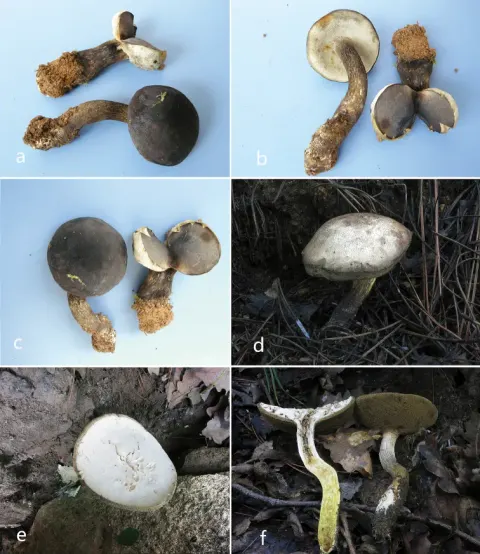
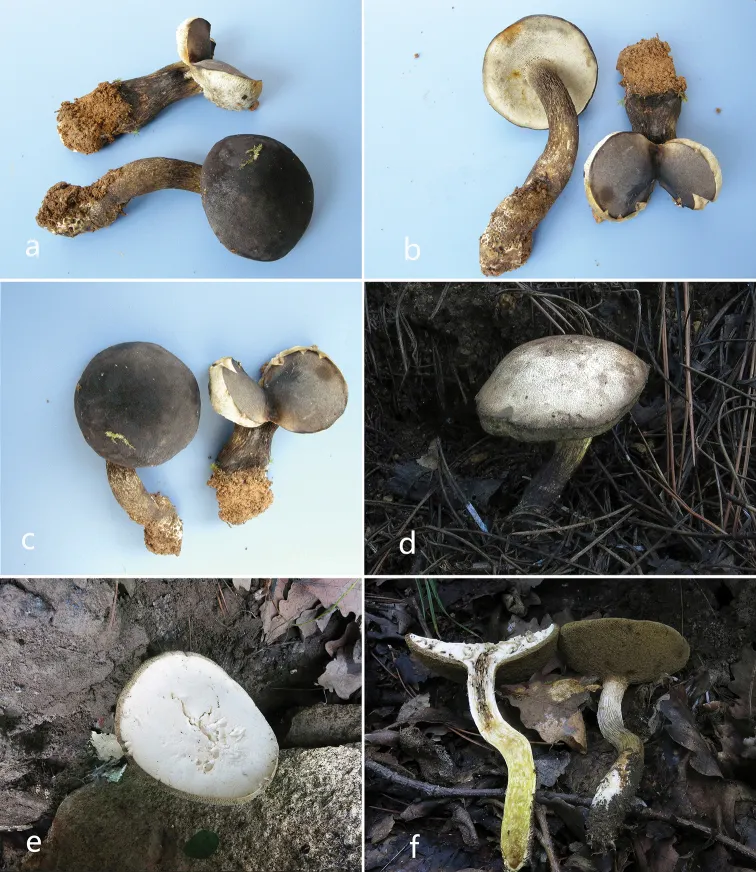
Habitat of the new Retiboletus species. a–c R. ater (from KUN -HKAS 56069) d–f R. sinogriseus (d from KUN -HKAS 91288 e–f from KUN -HKAS 91286).
- Jenis
- Pelat ilmiah
- Kredit
- Hai-Ying Liu, Yan-Chun Li, Tolgor Bau
- Lisensi
- CC BY 4.0
- Sumber media
- Buka entri sumber
Dokumentasi tambahan
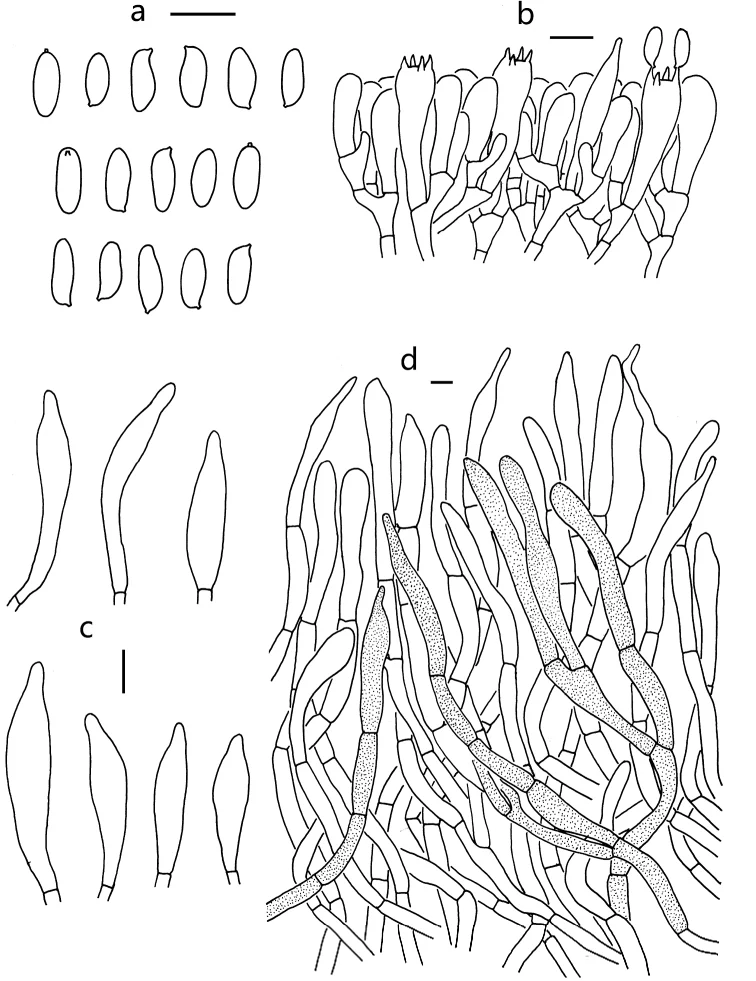
Microscopic features of R. ater (KUN -HKAS 56069). a Basidiospores b basidia and pleurocystidium c cheilo- and pleurocystidia d pileipellis. Scale bars: 10 μm.
Kredit dan penggunaan
Hai-Ying Liu, Yan-Chun Li, Tolgor Bau
Ukuran dan format gambar disesuaikan tanpa pemotongan, retus, atau penambahan skala. Lisensi sumber dipertahankan.
Sumber profil
- [1] New species of Retiboletus (Boletales, Boletaceae) from China based on morphological and molecular data — Retiboletus ater
- [2] Catalogue of Life Base2026-09-11 — Retiboletus ater
- [3] Dokumentasi visual — Retiboletus ater
- [4] Dokumentasi visual — Retiboletus ater
Rujukan halaman ini
Fungi. Retiboletus ater. Rilis data fungi-2026-10-12-expansion-2. https://fungi-atlas.mgadib.chatgpt.site/jamur/retiboletus-ater/.
Status: impor sumber; pemeriksaan editorial per profil belum selesai. Untuk klaim biologis, gunakan rujukan pada bagian terkait dan periksa konteks sumber aslinya.