Ciri dan struktur
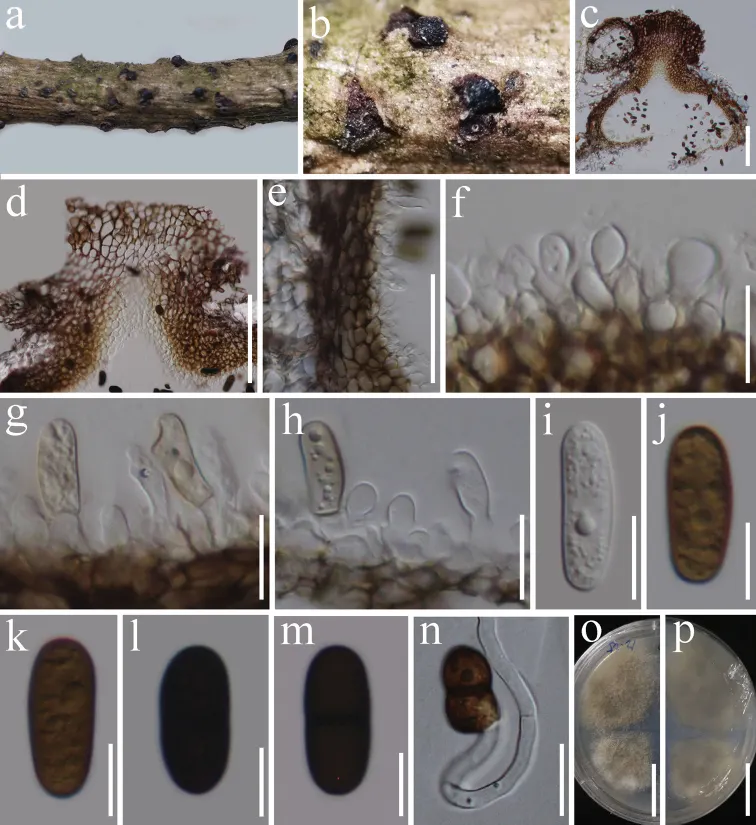
Similar to R. hysterinum and R. rufulum, but differs in some conidial features. Saprobic on woody litter of Prunus sp. Sexual morph Undetermined. Asexual morph Conidiomata 448–464 × 324–422 µm (x̄ = 454 × 378 μm, n = 5), solitary, scattered, semi-immersed in the host, black, unilocular, subglobose to ampulliform. Ostioles 178–227 × 166–234 µm (x̄ = 205 × 198 μm, n = 6), central, short papillate. Conidiomata wall 30–40 μm thick, 4–6 layers, reddish-brown to dark brown cells of textura angularis. Conidiogenous cells 5–8 × 3–6 µm (x̄ = 6.8 × 4.5 μm, n = 10), subglobose or ellipsoidal, hyaline, smooth, forming in a single layer over the entire inner surface of the wall, discrete, producing a single conidium at the apex. Conidia 20–25 × 8–10 μm (x̄ = 22 × 9 μm, n = 20), hyaline to yellowish-brown when immature, becoming brown to dark brown at maturity, oblong to ellipsoidal, with rounded ends, straight to slightly curved, aseptate when immature, becoming 1-septate when mature, with granular appearance, slightly constricted at septa.
Habitat dan peran ekologis
Saprobic on woody litter of Prunus sp. Sexual morph Undetermined. Asexual morph Conidiomata 448–464 × 324–422 µm (x̄ = 454 × 378 μm, n = 5), solitary, scattered, semi-immersed in the host, black, unilocular, subglobose to ampulliform. Ostioles 178–227 × 166–234 µm (x̄ = 205 × 198 μm, n = 6), central, short papillate. Conidiomata wall 30–40 μm thick, 4–6 layers, reddish-brown to dark brown cells of textura angularis. Conidiogenous cells 5–8 × 3–6 µm (x̄ = 6.8 × 4.5 μm, n = 10), subglobose or ellipsoidal, hyaline, smooth, forming in a single layer over the entire inner surface of the wall, discrete, producing a single conidium at the apex. Conidia 20–25 × 8–10 μm (x̄ = 22 × 9 μm, n = 20), hyaline to yellowish-brown when immature, becoming brown to dark brown at maturity, oblong to ellipsoidal, with rounded ends, straight to slightly curved, aseptate when immature, becoming 1-septate when mature, with granular appearance, slightly constricted at septa. China, Yunnan Province, Kunming city, Xiaokong Mountain (25.171311°N, 102.703690°E), on dead wood of Prunus sp. (Rosaceae), 21-Dec-2019, G.C. Ren, KM18 (HKAS 112728, holotype), ex-type living culture KUMCC 20-0160; KM17 (HKAS 112727, paratype), ex-paratype living culture KUMCC 20-0158.
- Habitat atau konteks temuan
- kultur yang didokumentasikan
- Substrat
- kayu
- Peran atau konteks
- Pengurai
Reproduksi
Similar to R. hysterinum and R. rufulum, but differs in some conidial features. Saprobic on woody litter of Prunus sp. Sexual morph Undetermined. Asexual morph Conidiomata 448–464 × 324–422 µm (x̄ = 454 × 378 μm, n = 5), solitary, scattered, semi-immersed in the host, black, unilocular, subglobose to ampulliform. Ostioles 178–227 × 166–234 µm (x̄ = 205 × 198 μm, n = 6), central, short papillate. Conidiomata wall 30–40 μm thick, 4–6 layers, reddish-brown to dark brown cells of textura angularis. Conidiogenous cells 5–8 × 3–6 µm (x̄ = 6.8 × 4.5 μm, n = 10), subglobose or ellipsoidal, hyaline, smooth, forming in a single layer over the entire inner surface of the wall, discrete, producing a single conidium at the apex.
Catatan identitas dan cakupan
- Nama diterima mengikuti Catalogue of Life Base2026-09-11; uraian mempertahankan konsep dan nama sumber aslinya.
- Preserve original treatment localities, hosts and substrate scope. Materials examined describe documented specimens, not the full global range.
- Impor dan terjemahan otomatis belum diperiksa editorial per profil. Struktur reproduktif yang disebutkan tidak membuktikan seluruh siklus hidup diketahui.
- Pengukuran pada uraian mengikuti spesimen, kultur, dan metode sumber; angka tidak diperluas ke semua populasi.
Catatan distribusi dalam narasi mengikuti sumbernya. Dokumentasi spesimen atau foto mengikuti catatan sumber. Bukti wilayah Indonesia dan penilaian konservasi tidak disimpulkan dari gambar.
Melihat dengan konteks
Rhytidhysteron xiaokongense (HKAS 112728, holotype) a, b conidiomata on natural wood surface c sections through conidioma d ostiolar neck e conidioma wall f–h conidiogenous cells and developing conidia i–m conidia n germinated conidium o, p culture characters on PDA (o = above, p = reverse). Scale bars: 100 μm (c, d); 50 μm (e); 15 μm (f–h); 10 μm (i–m); 20 μm (n); 25 mm (o, p).
- Jenis
- Pelat ilmiah
- Kredit
- Guang-Cong Ren, Dhanushka N. Wanasinghe, Rajesh Jeewon, Jutamart Monkai, Peter E. Mortimer, Kevin D. Hyde, Jian-Chu Xu, Heng Gui
- Lisensi
- CC BY 4.0
- Sumber media
- Buka entri sumber
Sumber profil
- [1] Taxonomy and phylogeny of the novel rhytidhysteron-like collections in the Greater Mekong Subregion — Rhytidhysteron xiaokongense
- [2] Catalogue of Life Base2026-09-11 — Rhytidhysteron xiaokongense
- [3] Dokumentasi visual — Rhytidhysteron xiaokongense
Rujukan halaman ini
Fungi. Rhytidhysteron xiaokongense. Rilis data fungi-2026-10-12-expansion-2. https://fungi-atlas.mgadib.chatgpt.site/jamur/rhytidhysteron-xiaokongense/.
Status: impor sumber; pemeriksaan editorial per profil belum selesai. Untuk klaim biologis, gunakan rujukan pada bagian terkait dan periksa konteks sumber aslinya.