01 / Morfologi

Ciri dan struktur

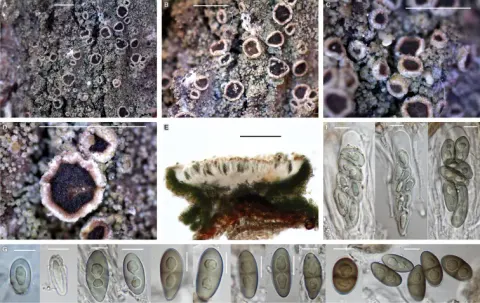
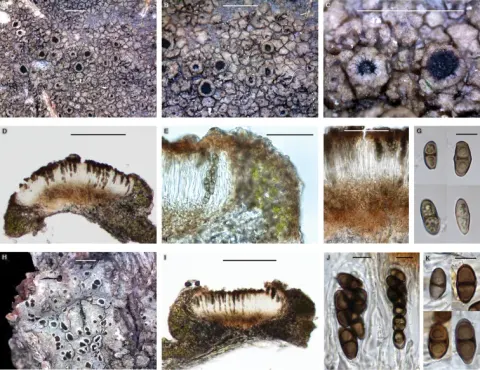
Rinodina exigua is characterised by its relatively thin thallus (main body) that appears pale grey-green in colour. The thallus has an irregular, cracked structure with an uneven, surface that sometimes develops small scale-like formations (), and lacks distinct boundaries, spreading diffusely across its substrate. No clearly defined border () is visible between the lichen and surrounding surfaces. The reproductive structures (apothecia) are quite noticeable, measuring 300–460 μm in diameter. These dark fruiting bodies are either attached to the surface () or partially embedded within the thallus (semi-). They often occur abundantly and may grow so closely together that they touch. Each apothecium is surrounded by a rim () that matches the colour of the main thallus, measuring 20–30 μm wide. This rim remains intact throughout the lichen's development, though it may develop slight scalloping () with age. The central of the apothecium is black, initially flat but becoming convex as it matures. The spore-producing layer (hymenium) measures 160–200 μm in height and turns blue when stained with iodine solution (I+). Beneath this lies a pale yellow layer () measuring 120–140 μm that does not react with iodine (I−). The spore sacs (asci) measure 130–160 by 15–19 μm with uniformly thick inner walls. The dark brown spores () measure (12.5–) 14–17.5 by (7–) 8–10 μm, featuring thick walls with rounded to conical compartments. They have a structure typical of the Physcia-type, with the central dividing wall (septum) being thickened and darkly pigmented in the middle. The spores lack a gelatinous outer coating.

Sebagian uraian ditampilkan dalam bahasa sumber; terjemahannya belum tersedia atau belum lolos pemeriksaan.

Rujukan: [1]

Pengukuran mengikuti objek, spesimen atau kultur, dan metode yang disebutkan sumber. Baca uraian asli untuk konteks lengkap.

02 / Kehidupan

Habitat dan peran ekologis

Rinodina exigua is an epiphyte that grows on the bark of trees. In Greece, it can use Robinia as a host tree. In the United Kingdom, R. exigua grows on the bark of old Fraxinus and Quercus trees. Within Ukraine, R. exigua has been documented in both the Crimean Peninsula and the Carpathian mountain range. Its European distribution shows a distinct pattern: in the southern regions of Europe, it primarily inhabits mountainous areas, whereas in Central Europe, the species can be found across a broader altitudinal range, from lowlands to mid-elevation sites. The lichen typically grows alongside other nitrogen-tolerant species, including Rinodina pyrina, Lecanora hagenii, Caloplaca alnetorum, and Caloplaca holocarpa. It does not occur in South Africa; historical records of taxa labelled under this named were later determined to be Rinodina ficta.

Sebagian uraian ditampilkan dalam bahasa sumber; terjemahannya belum tersedia atau belum lolos pemeriksaan.

Rujukan: [1]

Habitat atau konteks temuan
Informasi belum tersedia pada sumber rilis ini.
Substrat
Informasi belum tersedia pada sumber rilis ini.
Peran atau konteks
Pembentuk liken
Temukan hubungan serupa
03 / Siklus hidup

Reproduksi

The reproductive structures (apothecia) are quite noticeable, measuring 300–460 μm in diameter. These dark fruiting bodies are either attached to the surface () or partially embedded within the thallus (semi-). They often occur abundantly and may grow so closely together that they touch. Each apothecium is surrounded by a rim () that matches the colour of the main thallus, measuring 20–30 μm wide. This rim remains intact throughout the lichen's development, though it may develop slight scalloping () with age. The central of the apothecium is black, initially flat but becoming convex as it matures. The spore-producing layer (hymenium) measures 160–200 μm in height and turns blue when stained with iodine solution (I+).

Sebagian uraian ditampilkan dalam bahasa sumber; terjemahannya belum tersedia atau belum lolos pemeriksaan.

Rujukan: [1]

Sinonim menurut acuan taksonomi rilis: Berengeria exigua; Courtoisia exigua; Lecanora atra var. exigua; Lecanora exigua; Lecanora periclea var. exigua; Lecanora sophodes f. exigua; Lecanora sophodes subsp. exigua; Lecanora sophodes var. exigua; Lichen exiguus; Parmelia exigua; Parmelia periclea var. exigua; Parmelia sophodes f. exigua; Parmelia sophodes var. exigua; Patellaria exigua; Psora exigua; Rinodina metabolica var. exigua; Rinodina sophodes f. exigua; Rinodina sophodes subsp. exigua; Rinodina sophodes var. exigua
04 / Batas informasi

Catatan identitas dan cakupan

  • Nama diterima mengikuti Catalogue of Life Base2026-09-11; uraian mempertahankan konsep dan nama sumber aslinya.
  • Original geographic, specimen and life-cycle scope retained; source import awaits individual editorial review.
  • Impor dan terjemahan otomatis belum diperiksa editorial per profil. Struktur reproduktif yang disebutkan tidak membuktikan seluruh siklus hidup diketahui.
  • Pengukuran pada uraian mengikuti spesimen, kultur, dan metode sumber; angka tidak diperluas ke semua populasi.

Catatan distribusi dalam narasi mengikuti sumbernya. Dokumentasi spesimen atau foto mengikuti catatan sumber. Bukti wilayah Indonesia dan penilaian konservasi tidak disimpulkan dari gambar.

05 / Dokumentasi

Melihat dengan konteks

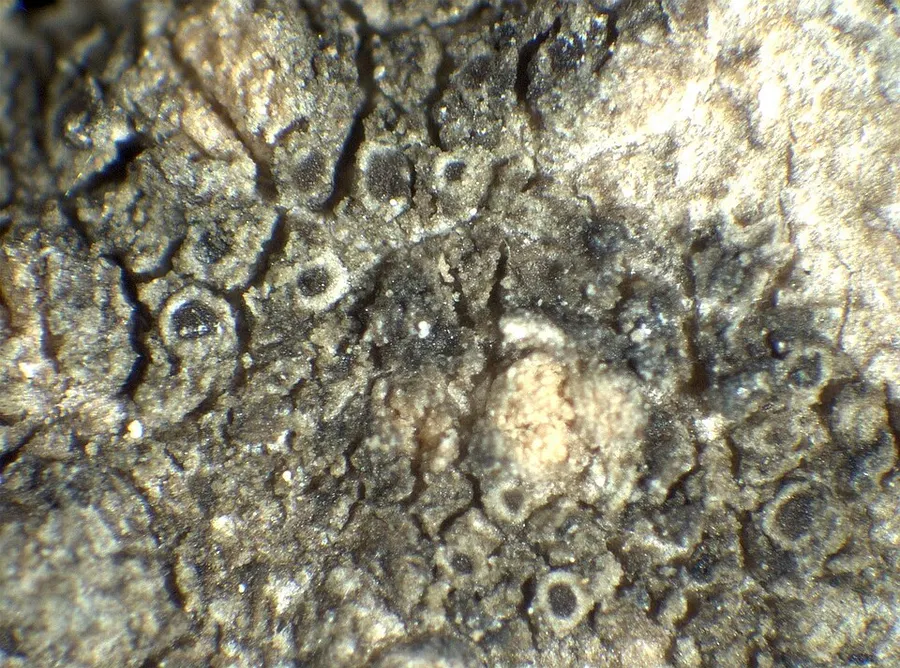
Dokumentasi Rinodina exigua dari Wikimedia Commons. The crustose, bark-dwelling lichen Rinodina exigua Identifikasi mengikuti record berkas sumber.

Jenis
Fotografi
Kredit
Pier Luigi Nimis
Sumber media
Buka entri sumber

Gambar menunjukkan objek menurut identifikasi sumber, bukan verifikasi independen spesimen oleh Fungi. Tidak ada skala baru yang ditambahkan.

06 / Rujukan

Sumber profil

  1. [1] Rinodina exigua — Wikipedia (en)Bagian sumber: Frozen revision 1353399992
    Tanggal penghimpunan sumber: 2026-10-12
    Teks sumber: CC BY-SA4.0 · Wikipedia contributors
  2. [2] Catalogue of Life Base2026-09-11 — Rinodina exiguaBagian sumber: ColDP NameUsage.tsv ID 4T3ZM; accepted species; source 2073
    Tanggal penghimpunan sumber: 2026-10-12
  3. [3] Dokumentasi visual — Rinodina exiguaBagian sumber: Individual media record; identification follows the source, not independent determination
    Tanggal penghimpunan sumber: 2026-10-12
    Media sumber: CC BY-SA 4.0 · Pier Luigi Nimis

Adaptasi teks: CC BY-SA 4.0. Wikipedia contributors — Rinodina exigua — Wikipedia (en)

Uraian asli dan riwayat sumber

Riwayat atau halaman sumber

Ringkasan sumber

Rinodina exigua is a species of lichen belonging to the family Physciaceae, characterised by its thin, pale grey-green thallus (body) with an irregular, cracked surface. First described by Erik Acharius in 1798, it features distinctive black reproductive structures (apothecia) that measure 300–460 micrometres in diameter. The lichen grows primarily on tree bark, particularly on ash and oak trees in the United Kingdom, while in continental Europe it shows an altitudinal distribution pattern, occurring mainly in mountains in southern regions but across various elevations in Central Europe.

Revisi sumber

Morfologi sumber

Rinodina exigua is characterised by its relatively thin thallus (main body) that appears pale grey-green in colour. The thallus has an irregular, cracked structure with an uneven, surface that sometimes develops small scale-like formations (), and lacks distinct boundaries, spreading diffusely across its substrate. No clearly defined border () is visible between the lichen and surrounding surfaces. The reproductive structures (apothecia) are quite noticeable, measuring 300–460 μm in diameter. These dark fruiting bodies are either attached to the surface () or partially embedded within the thallus (semi-). They often occur abundantly and may grow so closely together that they touch. Each apothecium is surrounded by a rim () that matches the colour of the main thallus, measuring 20–30 μm wide. This rim remains intact throughout the lichen's development, though it may develop slight scalloping () with age. The central of the apothecium is black, initially flat but becoming convex as it matures. The spore-producing layer (hymenium) measures 160–200 μm in height and turns blue when stained with iodine solution (I+). Beneath this lies a pale yellow layer () measuring 120–140 μm that does not react with iodine (I−). The spore sacs (asci) measure 130–160 by 15–19 μm with uniformly thick inner walls. The dark brown spores () measure (12.5–) 14–17.5 by (7–) 8–10 μm, featuring thick walls with rounded to conical compartments. They have a structure typical of the Physcia-type, with the central dividing wall (septum) being thickened and darkly pigmented in the middle. The spores lack a gelatinous outer coating.

Revisi sumber

Ekologi sumber

Rinodina exigua is an epiphyte that grows on the bark of trees. In Greece, it can use Robinia as a host tree. In the United Kingdom, R. exigua grows on the bark of old Fraxinus and Quercus trees. Within Ukraine, R. exigua has been documented in both the Crimean Peninsula and the Carpathian mountain range. Its European distribution shows a distinct pattern: in the southern regions of Europe, it primarily inhabits mountainous areas, whereas in Central Europe, the species can be found across a broader altitudinal range, from lowlands to mid-elevation sites. The lichen typically grows alongside other nitrogen-tolerant species, including Rinodina pyrina, Lecanora hagenii, Caloplaca alnetorum, and Caloplaca holocarpa. It does not occur in South Africa; historical records of taxa labelled under this named were later determined to be Rinodina ficta.

Revisi sumber

Struktur reproduksi sumber

The reproductive structures (apothecia) are quite noticeable, measuring 300–460 μm in diameter. These dark fruiting bodies are either attached to the surface () or partially embedded within the thallus (semi-). They often occur abundantly and may grow so closely together that they touch. Each apothecium is surrounded by a rim () that matches the colour of the main thallus, measuring 20–30 μm wide. This rim remains intact throughout the lichen's development, though it may develop slight scalloping () with age. The central of the apothecium is black, initially flat but becoming convex as it matures. The spore-producing layer (hymenium) measures 160–200 μm in height and turns blue when stained with iodine solution (I+).

Revisi sumber

Rujukan halaman ini

Fungi. Rinodina exigua. Rilis data fungi-2026-10-12-expansion-2. https://fungi-atlas.mgadib.chatgpt.site/jamur/rinodina-exigua/.

Status: impor sumber; pemeriksaan editorial per profil belum selesai. Untuk klaim biologis, gunakan rujukan pada bagian terkait dan periksa konteks sumber aslinya.