01 / Morfologi

Ciri dan struktur

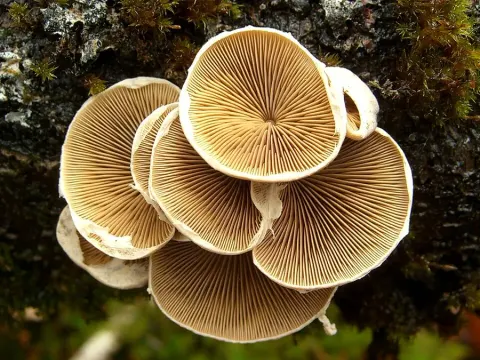
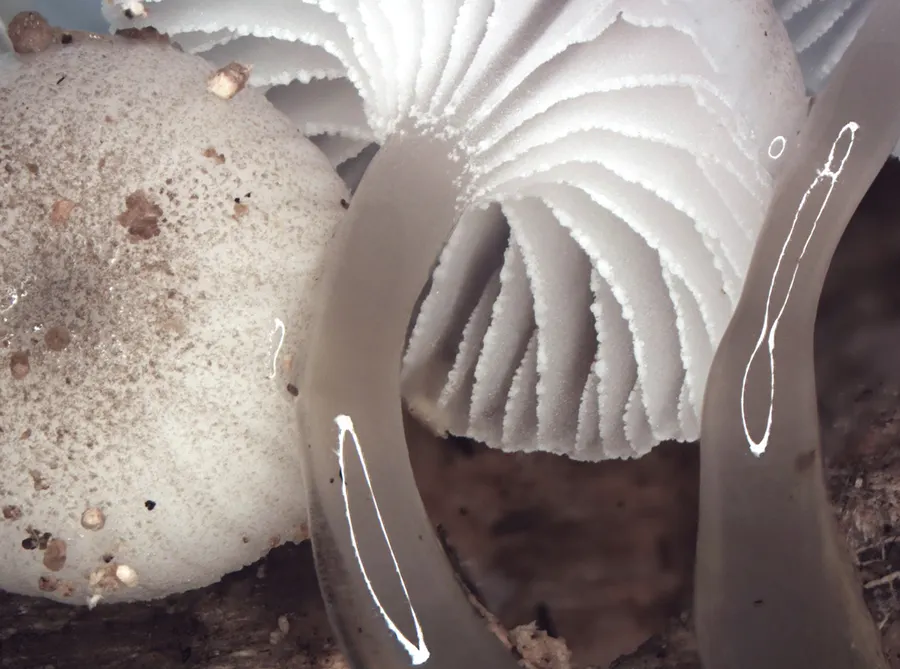
The cap is shallowly convex to convex or irregularly convex, and with or without a shallow umbo, measuring up to 16 mm in diameter and up to 5 mm high. The cap margin is curved downward, sometimes slightly flared, and sometimes has translucent radial striations marking the positions of the gills underneath. The white flesh—thickest at the center of the cap—tapers gradually to the margin. The gills are broadly adnate (fused) to decurrent (running down the length of the stipe). The gill edges are either smooth and even, or may have minute teeth. The gills are well-spaced, with 16 to 24 gills extending fully from the cap margin to the stipe, and two or three tiers of interspersed lamellulae (short gills that do not extend fully from the cap margin to the stipe). The smooth, cylindrical stipe is up to 27 mm long, and up to 2.5 mm in diameter at the base, narrowing towards the top. It is hollow, silky to shiny, and mucilaginous—usually with thick slime at the base. Sometimes, there are short white hairs at the bottom of the stipe, although their presence is variable. The mushroom has no distinctive odor. Spores are roughly ellipsoidal in shape with a Q ratio (the fraction of length/width) of 1.6, and dimensions of 9.4–15.4 by 6.2–9.0 μm. They have a small, oblique apiculus, lack oil droplets, and are smooth with thin walls, and hyaline (translucent). The spores are acyanophilous and strongly amyloid, meaning they stain with Methyl blue and Melzer's reagent, respectively. The basidia (spore-bearing cells) are four-spored (rarely two-spored) and club-shaped with long, robust sterigmata up to 6.0 μm long; they have clamp connections at their bases, and measure 35.3–49.6 by 10.3–14.4 μm.

Sebagian uraian ditampilkan dalam bahasa sumber; terjemahannya belum tersedia atau belum lolos pemeriksaan.

Rujukan: [1]

Pengukuran mengikuti objek, spesimen atau kultur, dan metode yang disebutkan sumber. Baca uraian asli untuk konteks lengkap.

02 / Kehidupan

Habitat dan peran ekologis

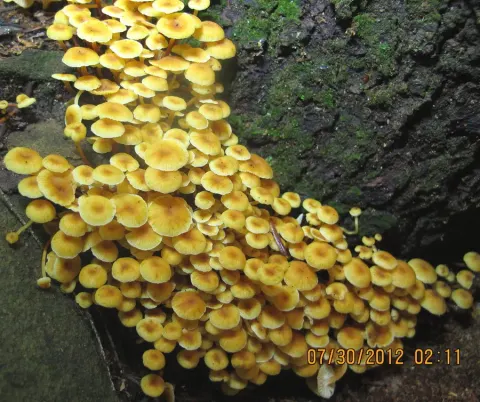
Like all members of its genus, Roridomyces austrororidus grows as a saprophyte on rotting wood. In Australia, the fungus fruits in clusters or groups on rainforest trees, decayed logs, fallen Eucalyptus branches, Bedfordia salicina logs and branches, and Nothofagus cunninghamii logs. Fruiting usually occurs after rainy periods from April to June, although the mushroom has also been collected in August. New Zealand collections have been reported to grow on Pinus, Leptospermum, and Ripogonum. A study of fungal succession in a wet eucalypt forest in Tasmania demonstrated that R. austrororidus prefers mature forests (with at least 70 years of growth since the last wildfire), and fruits on small diameter wood—typically twigs with a width less than 15 mm. Roridomyces austrororidus occurs in Argentina, Chile, New Zealand, and Australia. Its Australian distribution includes Queensland, New South Wales, Victoria, Tasmania and Western Australia. Australian mycologist Tony Young suggests that the geographical distribution of the fungus indicates that its ancestor may have originated from the ancient continent Gondwana.

Sebagian uraian ditampilkan dalam bahasa sumber; terjemahannya belum tersedia atau belum lolos pemeriksaan.

Rujukan: [1]

Habitat atau konteks temuan
hutan
Substrat
kayu
Peran atau konteks
Belum dikategorikan pada rilis ini.
Temukan hubungan serupa
03 / Siklus hidup

Reproduksi

Spores are roughly ellipsoidal in shape with a Q ratio (the fraction of length/width) of 1.6, and dimensions of 9.4–15.4 by 6.2–9.0 μm. They have a small, oblique apiculus, lack oil droplets, and are smooth with thin walls, and hyaline (translucent). The spores are acyanophilous and strongly amyloid, meaning they stain with Methyl blue and Melzer's reagent, respectively. The basidia (spore-bearing cells) are four-spored (rarely two-spored) and club-shaped with long, robust sterigmata up to 6.0 μm long; they have clamp connections at their bases, and measure 35.3–49.6 by 10.3–14.4 μm. Roridomyces austrororidus has two types of cheilocystidia (cystidia on gill edges). One is rare, broadly club-shaped, and tapers to a narrow stem; it measures 24.1–39.5 by 6.8–12.7 μm.

Sebagian uraian ditampilkan dalam bahasa sumber; terjemahannya belum tersedia atau belum lolos pemeriksaan.

Rujukan: [1]

Sinonim menurut acuan taksonomi rilis: Mycena austrororida; Mycena austrororida var. erythrophylla
04 / Batas informasi

Catatan identitas dan cakupan

  • Nama diterima mengikuti Catalogue of Life Base2026-09-11; uraian mempertahankan konsep dan nama sumber aslinya.
  • Original geographic, specimen and life-cycle scope retained; source import awaits individual editorial review.
  • Impor dan terjemahan otomatis belum diperiksa editorial per profil. Struktur reproduktif yang disebutkan tidak membuktikan seluruh siklus hidup diketahui.
  • Pengukuran pada uraian mengikuti spesimen, kultur, dan metode sumber; angka tidak diperluas ke semua populasi.

Catatan distribusi dalam narasi mengikuti sumbernya. Dokumentasi spesimen atau foto mengikuti catatan sumber. Bukti wilayah Indonesia dan penilaian konservasi tidak disimpulkan dari gambar.

05 / Dokumentasi

Melihat dengan konteks

Dokumentasi Roridomyces austrororidus menurut asosiasi foto pada record takson iNaturalist. Kredit: Jerry Cooper. Identitas mengikuti sumber; bukan penentuan spesimen independen.

Jenis
Fotografi
Kredit
(c) Jerry Cooper, some rights reserved (CC BY), uploaded by Jerry Cooper
Lisensi
CC BY 4.0
Sumber media
Buka entri sumber

Gambar menunjukkan objek menurut identifikasi sumber, bukan verifikasi independen spesimen oleh Fungi. Tidak ada skala baru yang ditambahkan.

06 / Rujukan

Sumber profil

  1. [1] Roridomyces austrororidus — Wikipedia (en)Bagian sumber: Frozen revision 1195439674
    Tanggal penghimpunan sumber: 2026-10-12
    Teks sumber: CC BY-SA4.0 · Wikipedia contributors
  2. [2] Catalogue of Life Base2026-09-11 — Roridomyces austrororidusBagian sumber: ColDP NameUsage.tsv ID 4TCM9; accepted species; source 2073
    Tanggal penghimpunan sumber: 2026-10-12
  3. [3] Dokumentasi visual — Roridomyces austrororidusBagian sumber: Individual media record; identification follows the source, not independent determination
    Tanggal penghimpunan sumber: 2026-10-12
    Media sumber: CC BY 4.0 · (c) Jerry Cooper, some rights reserved (CC BY), uploaded by Jerry Cooper

Adaptasi teks: CC BY-SA 4.0. Wikipedia contributors — Roridomyces austrororidus — Wikipedia (en)

Uraian asli dan riwayat sumber

Riwayat atau halaman sumber

Ringkasan sumber

Roridomyces austrororidus, commonly known as the austro dripping bonnet, is a species of agaric fungus in the family Mycenaceae. Described as new to science in 1962 by American mycologist Rolf Singer, it is found in South America, New Zealand, and Australia, where it grows on rotting wood. The fruit bodies (mushrooms) have several distinguishing characteristics that facilitate identification, including thick, white, mucilaginous stipes, and white to pale cream, convex caps that measure 1 – 2 cm.

Revisi sumber

Morfologi sumber

The cap is shallowly convex to convex or irregularly convex, and with or without a shallow umbo, measuring up to 16 mm in diameter and up to 5 mm high. The cap margin is curved downward, sometimes slightly flared, and sometimes has translucent radial striations marking the positions of the gills underneath. The white flesh—thickest at the center of the cap—tapers gradually to the margin. The gills are broadly adnate (fused) to decurrent (running down the length of the stipe). The gill edges are either smooth and even, or may have minute teeth. The gills are well-spaced, with 16 to 24 gills extending fully from the cap margin to the stipe, and two or three tiers of interspersed lamellulae (short gills that do not extend fully from the cap margin to the stipe). The smooth, cylindrical stipe is up to 27 mm long, and up to 2.5 mm in diameter at the base, narrowing towards the top. It is hollow, silky to shiny, and mucilaginous—usually with thick slime at the base. Sometimes, there are short white hairs at the bottom of the stipe, although their presence is variable. The mushroom has no distinctive odor. Spores are roughly ellipsoidal in shape with a Q ratio (the fraction of length/width) of 1.6, and dimensions of 9.4–15.4 by 6.2–9.0 μm. They have a small, oblique apiculus, lack oil droplets, and are smooth with thin walls, and hyaline (translucent). The spores are acyanophilous and strongly amyloid, meaning they stain with Methyl blue and Melzer's reagent, respectively. The basidia (spore-bearing cells) are four-spored (rarely two-spored) and club-shaped with long, robust sterigmata up to 6.0 μm long; they have clamp connections at their bases, and measure 35.3–49.6 by 10.3–14.4 μm.

Revisi sumber

Ekologi sumber

Like all members of its genus, Roridomyces austrororidus grows as a saprophyte on rotting wood. In Australia, the fungus fruits in clusters or groups on rainforest trees, decayed logs, fallen Eucalyptus branches, Bedfordia salicina logs and branches, and Nothofagus cunninghamii logs. Fruiting usually occurs after rainy periods from April to June, although the mushroom has also been collected in August. New Zealand collections have been reported to grow on Pinus, Leptospermum, and Ripogonum. A study of fungal succession in a wet eucalypt forest in Tasmania demonstrated that R. austrororidus prefers mature forests (with at least 70 years of growth since the last wildfire), and fruits on small diameter wood—typically twigs with a width less than 15 mm. Roridomyces austrororidus occurs in Argentina, Chile, New Zealand, and Australia. Its Australian distribution includes Queensland, New South Wales, Victoria, Tasmania and Western Australia. Australian mycologist Tony Young suggests that the geographical distribution of the fungus indicates that its ancestor may have originated from the ancient continent Gondwana.

Revisi sumber

Struktur reproduksi sumber

Spores are roughly ellipsoidal in shape with a Q ratio (the fraction of length/width) of 1.6, and dimensions of 9.4–15.4 by 6.2–9.0 μm. They have a small, oblique apiculus, lack oil droplets, and are smooth with thin walls, and hyaline (translucent). The spores are acyanophilous and strongly amyloid, meaning they stain with Methyl blue and Melzer's reagent, respectively. The basidia (spore-bearing cells) are four-spored (rarely two-spored) and club-shaped with long, robust sterigmata up to 6.0 μm long; they have clamp connections at their bases, and measure 35.3–49.6 by 10.3–14.4 μm. Roridomyces austrororidus has two types of cheilocystidia (cystidia on gill edges). One is rare, broadly club-shaped, and tapers to a narrow stem; it measures 24.1–39.5 by 6.8–12.7 μm.

Revisi sumber

Rujukan halaman ini

Fungi. Roridomyces austrororidus. Rilis data fungi-2026-10-12-expansion-2. https://fungi-atlas.mgadib.chatgpt.site/jamur/roridomyces-austrororidus/.

Status: impor sumber; pemeriksaan editorial per profil belum selesai. Untuk klaim biologis, gunakan rujukan pada bagian terkait dan periksa konteks sumber aslinya.