Ciri dan struktur
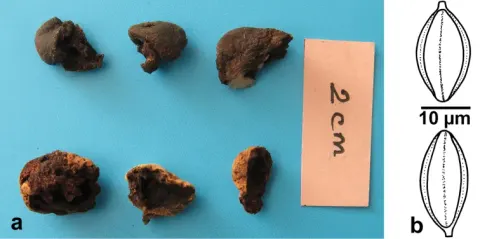
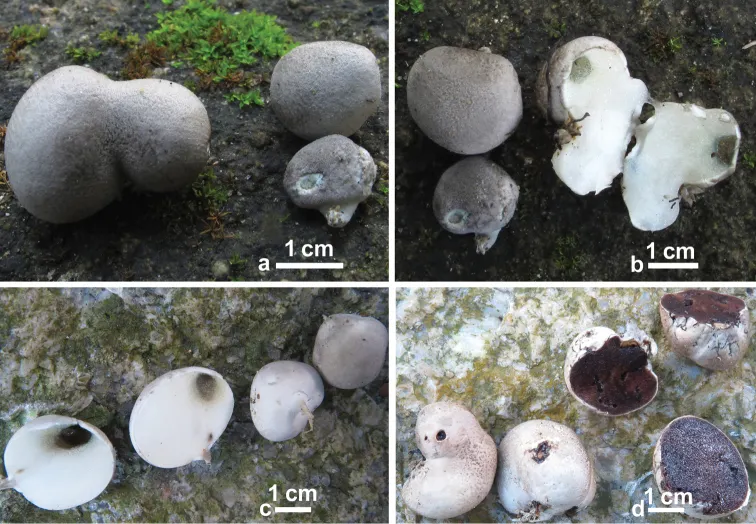
Basidiomata hypogeous, small; pileus grayish white to grayish brown, surface bluing slightly when injured; hymenophore dull white to very pale blue in some portion when injured, finally rusty brown to dark brown at maturity; stipe absent; basidiospores 17–20 × (8–)9–12 μm, fusoid, ornamented with 4-longitudinal ridges (star-shaped in cross section), brown to dark brown; pileipellis a subcutis, with terminal elements short cylindro-clavate. Basidiomata hypogeous, 15–35 mm broad, 12–25 mm high, small, globose to subglobose, napiform, sometimes deformed or reniform, fleshy when fresh, firm when dry. Pileus very thin, surface glabrous to slightly velvety, shiny, grayish white to grayish brown, whitish at the lower portion, turning to pale blue when touched or injured. Hymenophore off-white, white to dull white when young, becoming pale blue to bluish in some parts/patches then rusty brown to dark brown when exposed to air for 3–5 minutes, often greenish brown around insect damage, firm, composed of minute, irregular locules, becoming partially collapsed with many small empty chambers when dried. Stipe absent. Stipe base present but reduced, white, dull white to grayish white, somewhat dendroid or as a small basal pad or rhizomorph. Odor and taste not recorded. Basidiospores [50/2/2] 17–20(−21) × (8–)9–12(–13) μm [mean = 18.5 × 10.5 μm, Q = (1.52–)1.63–1.91(–2.1), Q m = 1.81 ± 0.18] fusoid, ornamented with 4-longitudinal ridges (star-shaped in cross section) (up to 2.5 μm high), inamyloid, non-dextrinoid, brown to dark brown in KOH and H 2 O, thick-walled up to 2 μm thick, hilar appendages 1.5–3 μm long.
Habitat dan peran ekologis
Solitary or in small groups beneath or on the ground, hypogeous or partially epigeous in a subtropical evergreen broad-leaved forest, putatively associated with Castanopsis fissa, C. chinensis, C. fabri and Schima superba. Currently known only from south China (Guangdong Province, Xiangtoushan National Nature Reserve).
- Habitat atau konteks temuan
- hutan
- Substrat
- tanah
- Peran atau konteks
- Belum dikategorikan pada rilis ini.
Reproduksi
Basidiomata hypogeous, small; pileus grayish white to grayish brown, surface bluing slightly when injured; hymenophore dull white to very pale blue in some portion when injured, finally rusty brown to dark brown at maturity; stipe absent; basidiospores 17–20 × (8–)9–12 μm, fusoid, ornamented with 4-longitudinal ridges (star-shaped in cross section), brown to dark brown; pileipellis a subcutis, with terminal elements short cylindro-clavate. Basidiomata hypogeous, 15–35 mm broad, 12–25 mm high, small, globose to subglobose, napiform, sometimes deformed or reniform, fleshy when fresh, firm when dry. Pileus very thin, surface glabrous to slightly velvety, shiny, grayish white to grayish brown, whitish at the lower portion, turning to pale blue when touched or injured.
Catatan identitas dan cakupan
- Nama diterima mengikuti Catalogue of Life Base2026-09-11; uraian mempertahankan konsep dan nama sumber aslinya.
- Preserve original treatment localities, hosts and substrate scope. Materials examined describe documented specimens, not the full global range.
- Impor dan terjemahan otomatis belum diperiksa editorial per profil. Struktur reproduktif yang disebutkan tidak membuktikan seluruh siklus hidup diketahui.
- Pengukuran pada uraian mengikuti spesimen, kultur, dan metode sumber; angka tidak diperluas ke semua populasi.
Catatan distribusi dalam narasi mengikuti sumbernya. Dokumentasi spesimen atau foto mengikuti catatan sumber. Bukti wilayah Indonesia dan penilaian konservasi tidak disimpulkan dari gambar.
Melihat dengan konteks
Basidiomata of Rossbeevera griseobrunnea. a Unchanged pileus surface with reduced stipe (GDGM 45266) b Unchanged pileus surface and pale blue (in some patches) hymenophore when injured (GDGM 45266) c Pale bluing hymenophore (after injured) with reduced stipe (GDGM 45913, holotype) d Dark brownish hymenophore after exposed to air (GDGM 45913, holotype).
- Jenis
- Pelat ilmiah
- Kredit
- Md. Iqbal Hosen, Xiang-Jing Zhong, Genevieve Gates, Takamichi Orihara, Tai-Hui Li
- Lisensi
- CC BY 4.0
- Sumber media
- Buka entri sumber
Dokumentasi tambahan
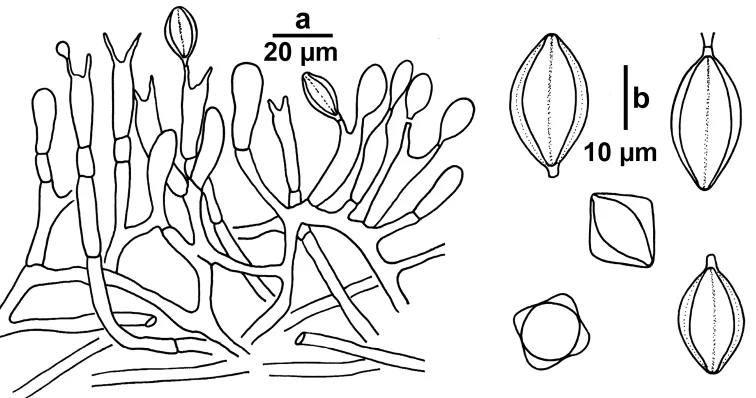
Microscopic features of Rossbeevera griseobrunnea. a Basidia and basidioles development at different stages (GDGM 45266) b Basidiospores in different views (star-shaped in side view and quadrangular in polar view) (GDGM 45913, holotype).
Kredit dan penggunaan
Md. Iqbal Hosen, Xiang-Jing Zhong, Genevieve Gates, Takamichi Orihara, Tai-Hui Li
Ukuran dan format gambar disesuaikan tanpa pemotongan, retus, atau penambahan skala. Lisensi sumber dipertahankan.
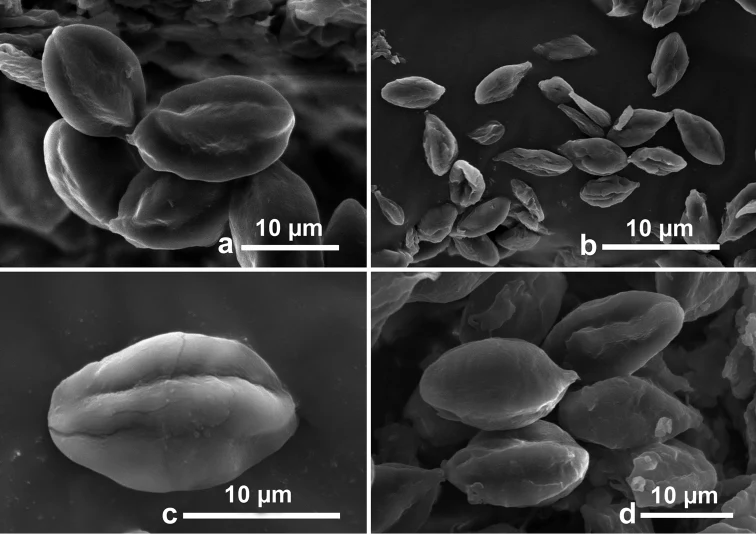
SEM of basidiospores of Rossbeevera species. a, b Rossbeevera bispora (a GDGM 45612 b GDGM 45639) c, d Rossbeevera griseobrunnea (c GDGM 45266 d GDGM 45913, holotype).
Kredit dan penggunaan
Md. Iqbal Hosen, Xiang-Jing Zhong, Genevieve Gates, Takamichi Orihara, Tai-Hui Li
Ukuran dan format gambar disesuaikan tanpa pemotongan, retus, atau penambahan skala. Lisensi sumber dipertahankan.
Sumber profil
- [1] Type studies of Rossbeevera bispora, and a new species of Rossbeevera from south China — Rossbeevera griseobrunnea
- [2] Catalogue of Life Base2026-09-11 — Rossbeevera griseobrunnea
- [3] Dokumentasi visual — Rossbeevera griseobrunnea
- [4] Dokumentasi visual — Rossbeevera griseobrunnea
- [5] Dokumentasi visual — Rossbeevera griseobrunnea
Rujukan halaman ini
Fungi. Rossbeevera griseobrunnea. Rilis data fungi-2026-10-12-expansion-2. https://fungi-atlas.mgadib.chatgpt.site/jamur/rossbeevera-griseobrunnea/.
Status: impor sumber; pemeriksaan editorial per profil belum selesai. Untuk klaim biologis, gunakan rujukan pada bagian terkait dan periksa konteks sumber aslinya.