01 / Morfologi

Ciri dan struktur

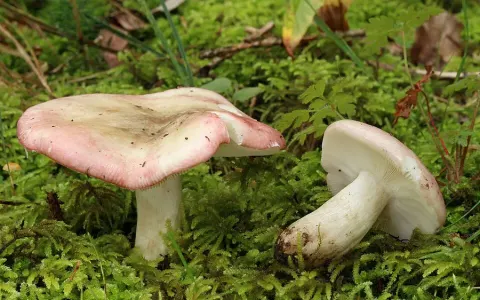
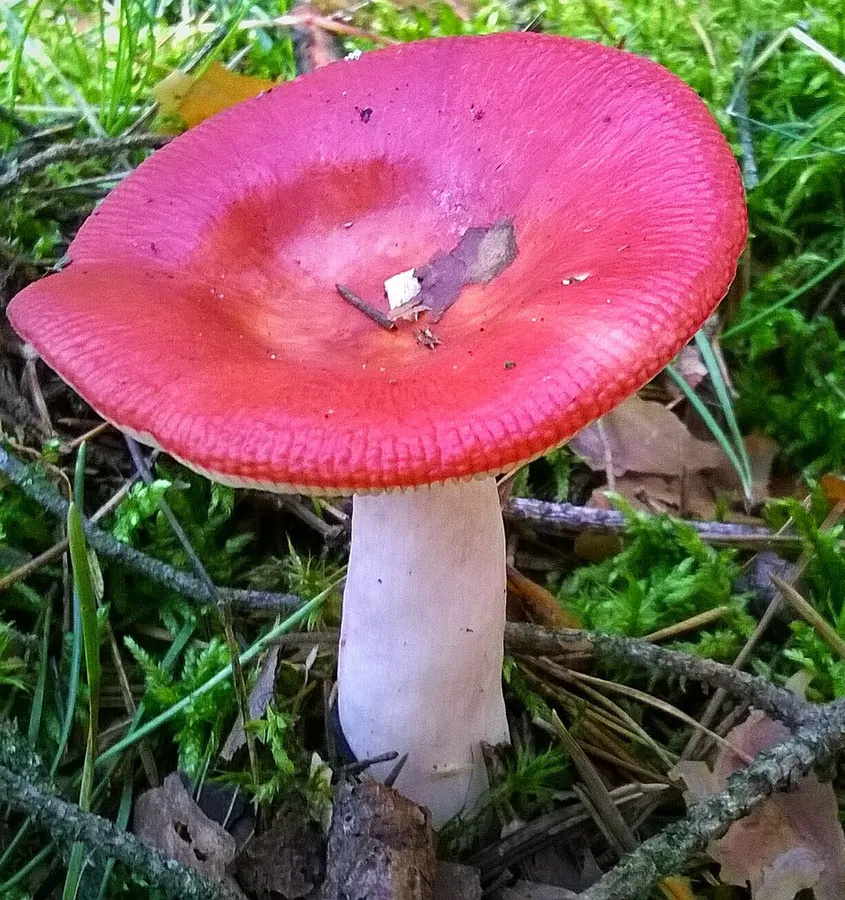
The sticky cap of R. emetica is 2.5–10 cm wide, with a shape ranging from convex (in young specimens) to flattened, sometimes with a central depression, and sometimes with a shallow umbo. It is a bright scarlet or cherry red, and in maturity, the margins have fine radial grooves extending 2–7 mm towards the center of the cap. The cuticle can be readily peeled from the cap almost to the centre. The brittle flesh is white (or tinged with red directly under the cap cuticle), measures 4–9 mm thick, and has a very sharp and peppery taste. The gills are closely spaced, white to creamy-white, and adnate to adnexed or completely free. They are intervenose (containing cross-veins in the spaces between the gills) and occasionally forked near the cap margin. The white stem measures 4.5–10.5 cm long by 0.7–2.4 cm thick, and is roughly the same width throughout its length, although it can be a bit thicker near the base. Its surface is dry and smooth, sometimes marked by faint longitudinal grooves. It is either stuffed (filled with a cottony pith) or partially hollow, and lacks a ring or partial veil. The fruit bodies have a slightly fruity or spicy smell. Russula emetica produces a white to yellowish-white spore print. The spores are roughly elliptical to egg-shaped, with a strongly warted and partially reticulate (web-like) surface. They have dimensions of 8.8–11.0 by 6.6–8 μm, and are amyloid, meaning that they will stain blue, bluish-grey, to blackish in Melzer's reagent. Basidia (spore-bearing cells) are club-shaped, four-spored, hyaline (translucent), and measure 32.9–50 by 9.0–11.6 μm.

Sebagian uraian ditampilkan dalam bahasa sumber; terjemahannya belum tersedia atau belum lolos pemeriksaan.

Rujukan: [1]

Pengukuran mengikuti objek, spesimen atau kultur, dan metode yang disebutkan sumber. Baca uraian asli untuk konteks lengkap.

02 / Kehidupan

Habitat dan peran ekologis

Like all species of Russula, R. emetica is mycorrhizal, and forms mutually beneficial partnerships with roots of trees and certain herbaceous plants. Preferred host plants are conifers, especially pines. Both the red squirrel (Sciurus vulgaris) and the American red squirrel (Tamiasciurus hudsonicus) are known to forage for, store and eat R. emetica; However, references to "R.emetica" in older studies may actually refer to relatives that are now considered distinct species.

Sebagian uraian ditampilkan dalam bahasa sumber; terjemahannya belum tersedia atau belum lolos pemeriksaan.

Rujukan: [1]

Habitat atau konteks temuan
Informasi belum tersedia pada sumber rilis ini.
Substrat
Informasi belum tersedia pada sumber rilis ini.
Peran atau konteks
Mitra tumbuhan
Temukan hubungan serupa
03 / Siklus hidup

Reproduksi

Russula emetica produces a white to yellowish-white spore print. The spores are roughly elliptical to egg-shaped, with a strongly warted and partially reticulate (web-like) surface. They have dimensions of 8.8–11.0 by 6.6–8 μm, and are amyloid, meaning that they will stain blue, bluish-grey, to blackish in Melzer's reagent. Basidia (spore-bearing cells) are club-shaped, four-spored, hyaline (translucent), and measure 32.9–50 by 9.0–11.6 μm. Cystidia located on the gill face (pleurocystidia) are somewhat cylindrical to club-shaped or somewhat spindle-shaped, and measure 35–88 by 7.3–12.4 μm. They are yellowish, and contain granular contents. Cheilocystidia (found on the edges of the gills), which are similar in shape to the pleurocystidia, are thin-walled, hyaline, and measure 14–24 by 4.4–7.3 μm.

Sebagian uraian ditampilkan dalam bahasa sumber; terjemahannya belum tersedia atau belum lolos pemeriksaan.

Rujukan: [1]

Sinonim menurut acuan taksonomi rilis: Agaricus emeticus; Agaricus emeticus var. fallax; Agaricus integer var. sanguineus; Agaricus linnaei var. emeticus; Agaricus pectinatus var. fulvus; Agaricus ruber; Amanita rubra; Russula alnijorullensis; Russula alpestris; Russula alpina; Russula atropurpurina; Russula clusii; Russula emetica f. cordae; Russula emetica f. lilacea; Russula emetica f. truncigena; Russula emetica subsp. alnijorullensis; Russula emetica subsp. alpestris; Russula emetica subsp. alpina; Russula emetica subsp. atropurpurina; Russula emetica subsp. euemetica; Russula emetica subsp. lacustris; Russula emetica var. alpestris; Russula emetica var. alpina; Russula emetica var. atropurpurea; Russula emetica var. clusii; Russula emetica var. fumosa; Russula emetica var. gregaria; Russula emetica var. multifurcata; Russula emetica var. pseudolongipes; Russula emetica var. violacea; Russula foetens f. alpestris; Russula fragilis var. alpestris; Russula gregaria; Russula nana var. alpina; Russula nobilis var. fumosa; Russula pectinata var. truncigena; Russula rubra; Russula rubra f. poliopus; Russula rubra var. hymenocystidiata; Russula sanguinea var. clusii; Russula silvestris var. lacustris; Russula truncigena
04 / Batas informasi

Catatan identitas dan cakupan

  • Nama diterima mengikuti Catalogue of Life Base2026-09-11; uraian mempertahankan konsep dan nama sumber aslinya.
  • Original geographic, specimen and life-cycle scope retained; source import awaits individual editorial review.
  • Impor dan terjemahan otomatis belum diperiksa editorial per profil. Struktur reproduktif yang disebutkan tidak membuktikan seluruh siklus hidup diketahui.
  • Pengukuran pada uraian mengikuti spesimen, kultur, dan metode sumber; angka tidak diperluas ke semua populasi.

Catatan distribusi dalam narasi mengikuti sumbernya. Dokumentasi spesimen atau foto mengikuti catatan sumber. Bukti wilayah Indonesia dan penilaian konservasi tidak disimpulkan dari gambar.

05 / Dokumentasi

Melihat dengan konteks

Dokumentasi Russula emetica dari Wikimedia Commons. Russula emetica in Poland Identifikasi mengikuti record berkas sumber.

Jenis
Fotografi
Kredit
MichalPL
Sumber media
Buka entri sumber

Gambar menunjukkan objek menurut identifikasi sumber, bukan verifikasi independen spesimen oleh Fungi. Tidak ada skala baru yang ditambahkan.

06 / Rujukan

Sumber profil

  1. [1] Russula emetica — Wikipedia (en)Bagian sumber: Frozen revision 1363040221
    Tanggal penghimpunan sumber: 2026-10-12
    Teks sumber: CC BY-SA4.0 · Wikipedia contributors
  2. [2] Catalogue of Life Base2026-09-11 — Russula emeticaBagian sumber: ColDP NameUsage.tsv ID 4TRVW; accepted species; source 2073
    Tanggal penghimpunan sumber: 2026-10-12
  3. [3] Dokumentasi visual — Russula emeticaBagian sumber: Individual media record; identification follows the source, not independent determination
    Tanggal penghimpunan sumber: 2026-10-12
    Media sumber: CC BY-SA 4.0 · MichalPL

Adaptasi teks: CC BY-SA 4.0. Wikipedia contributors — Russula emetica — Wikipedia (en)

Uraian asli dan riwayat sumber

Riwayat atau halaman sumber

Ringkasan sumber

Russula emetica, commonly known as the sickener, emetic russula, or vomiting russula, is a basidiomycete mushroom, and the type species of the genus Russula. It was first described in 1774. It has a red, convex to flat cap up to 8.5 cm in diameter, with a cuticle that can be peeled off almost to the centre. The gills are white to pale cream, and closely spaced. A smooth white stem measures up to 10.5 cm long and 2.4 cm thick. There are many similar russulas with a red cap and white stem and gills, some of which can be reliably distinguished only by microscopy.

Revisi sumber

Morfologi sumber

The sticky cap of R. emetica is 2.5–10 cm wide, with a shape ranging from convex (in young specimens) to flattened, sometimes with a central depression, and sometimes with a shallow umbo. It is a bright scarlet or cherry red, and in maturity, the margins have fine radial grooves extending 2–7 mm towards the center of the cap. The cuticle can be readily peeled from the cap almost to the centre. The brittle flesh is white (or tinged with red directly under the cap cuticle), measures 4–9 mm thick, and has a very sharp and peppery taste. The gills are closely spaced, white to creamy-white, and adnate to adnexed or completely free. They are intervenose (containing cross-veins in the spaces between the gills) and occasionally forked near the cap margin. The white stem measures 4.5–10.5 cm long by 0.7–2.4 cm thick, and is roughly the same width throughout its length, although it can be a bit thicker near the base. Its surface is dry and smooth, sometimes marked by faint longitudinal grooves. It is either stuffed (filled with a cottony pith) or partially hollow, and lacks a ring or partial veil. The fruit bodies have a slightly fruity or spicy smell. Russula emetica produces a white to yellowish-white spore print. The spores are roughly elliptical to egg-shaped, with a strongly warted and partially reticulate (web-like) surface. They have dimensions of 8.8–11.0 by 6.6–8 μm, and are amyloid, meaning that they will stain blue, bluish-grey, to blackish in Melzer's reagent. Basidia (spore-bearing cells) are club-shaped, four-spored, hyaline (translucent), and measure 32.9–50 by 9.0–11.6 μm.

Revisi sumber

Ekologi sumber

Like all species of Russula, R. emetica is mycorrhizal, and forms mutually beneficial partnerships with roots of trees and certain herbaceous plants. Preferred host plants are conifers, especially pines. Both the red squirrel (Sciurus vulgaris) and the American red squirrel (Tamiasciurus hudsonicus) are known to forage for, store and eat R. emetica; However, references to "R.emetica" in older studies may actually refer to relatives that are now considered distinct species.

Revisi sumber

Struktur reproduksi sumber

Russula emetica produces a white to yellowish-white spore print. The spores are roughly elliptical to egg-shaped, with a strongly warted and partially reticulate (web-like) surface. They have dimensions of 8.8–11.0 by 6.6–8 μm, and are amyloid, meaning that they will stain blue, bluish-grey, to blackish in Melzer's reagent. Basidia (spore-bearing cells) are club-shaped, four-spored, hyaline (translucent), and measure 32.9–50 by 9.0–11.6 μm. Cystidia located on the gill face (pleurocystidia) are somewhat cylindrical to club-shaped or somewhat spindle-shaped, and measure 35–88 by 7.3–12.4 μm. They are yellowish, and contain granular contents. Cheilocystidia (found on the edges of the gills), which are similar in shape to the pleurocystidia, are thin-walled, hyaline, and measure 14–24 by 4.4–7.3 μm.

Revisi sumber

Rujukan halaman ini

Fungi. Russula emetica. Rilis data fungi-2026-10-12-expansion-2. https://fungi-atlas.mgadib.chatgpt.site/jamur/russula-emetica/.

Status: impor sumber; pemeriksaan editorial per profil belum selesai. Untuk klaim biologis, gunakan rujukan pada bagian terkait dan periksa konteks sumber aslinya.