Ciri dan struktur
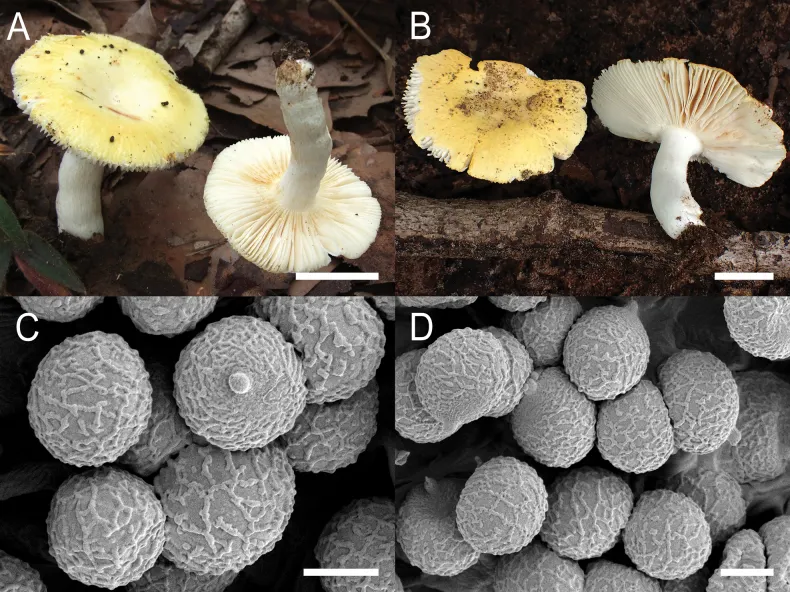
Russula sublaevis is a species with medium-sized basidiomata, a bright yellow pileus, white stipe, mild taste and cream-coloured spore print. Microscopically, the small subglobose spores with a very low ornamentation are noticeable. Growth habit: solitary or in groups of two. Pileus: medium-sized, 50–70 mm in diam., slightly convex to plane, centrally with a low shallow depression; margin even, finely striate up to 15 mm, regularly shaped; cuticle smooth, pruinose all over, under a magnifying glass with fine, whitish areolae, peelable up to ¾ of the pileus radius, colour yellow to bright yellow (3A2), becoming paler with age, near the centre sometimes slightly paler or darker. Lamellae: 5–6 mm wide, 8–9 lamellae present along 1 cm near the pileus margin, adnexed, at first white, then becoming pale cream, furcations and anastomoses absent, sometimes with dispersed lamellulae; edges entire, concolourous. Stipe: 35–45 × 8–10 mm, cylindrical, somewhat bulging here and there, smooth to slightly rugose, annulus absent, white; cottony stuffed, cavernate, with 2–3 distinct chambers. Context: 4–5 mm thick at half pileus radius, white, unchanging when bruised, brittle, taste mild, odour inconspicuous. Macrochemical reactions: guaiac after 8–10 seconds weakly positive (+) or negative (-) on stipe and positive (++) on lamellae surfaces; FeSO 4 salmon orange, sulphovanillin negative; KOH negative; phenol negative. Spore print: cream (IIc). Spores: (5.4–)6–6.3–6.7(–7.1) × (4.5–)5.1–5.4–5.6(–6) µm (n = 90), Q = (1.06–)1.12–1.18–1.24(–1.31), subglobose to broadly ellipsoid; surface almost smooth, ornamentation very inconspicuous, composed of very dense, weakly amyloid pustules and crests hardly visible under light microscope, ornamentation approx. 0.1 µm high as estimated by SEM, abundantly connected by fine lines forming a complete reticulum; few scattered isolated warts only visible by SEM; suprahilar plage small, inamyloid, partially covered by even lower ornamentation only visible by SEM.
Habitat dan peran ekologis
Widely distributed in Sudanian woodlands in tropical Africa. Kown from Benin, DRC and Zimbabwe.
- Habitat atau konteks temuan
- Informasi belum tersedia pada sumber rilis ini.
- Substrat
- Informasi belum tersedia pada sumber rilis ini.
- Peran atau konteks
- Belum dikategorikan pada rilis ini.
Reproduksi
Russula sublaevis is a species with medium-sized basidiomata, a bright yellow pileus, white stipe, mild taste and cream-coloured spore print. Microscopically, the small subglobose spores with a very low ornamentation are noticeable. Growth habit: solitary or in groups of two. Pileus: medium-sized, 50–70 mm in diam., slightly convex to plane, centrally with a low shallow depression; margin even, finely striate up to 15 mm, regularly shaped; cuticle smooth, pruinose all over, under a magnifying glass with fine, whitish areolae, peelable up to ¾ of the pileus radius, colour yellow to bright yellow (3A2), becoming paler with age, near the centre sometimes slightly paler or darker. Lamellae: 5–6 mm wide, 8–9 lamellae present along 1 cm near the pileus margin, adnexed, at first white, then becoming pale cream, furcations and anastomoses absent, sometimes with dispersed lamellulae; edges entire, concolourous.
Catatan identitas dan cakupan
- Nama diterima mengikuti Catalogue of Life Base2026-09-11; uraian mempertahankan konsep dan nama sumber aslinya.
- Preserve original treatment localities, hosts and substrate scope. Materials examined describe documented specimens, not the full global range.
- Impor dan terjemahan otomatis belum diperiksa editorial per profil. Struktur reproduktif yang disebutkan tidak membuktikan seluruh siklus hidup diketahui.
- Pengukuran pada uraian mengikuti spesimen, kultur, dan metode sumber; angka tidak diperluas ke semua populasi.
Catatan distribusi dalam narasi mengikuti sumbernya. Dokumentasi spesimen atau foto mengikuti catatan sumber. Bukti wilayah Indonesia dan penilaian konservasi tidak disimpulkan dari gambar.
Melihat dengan konteks
Russula sublaevis A, B field pictures of basidiomata: A CM-21-148, B CM-21-219; C, D scanning electron microscopical pictures of basidiospores (both CM-21-148). Scale bars: 2 cm (A, B); 3 µm (C, D).
- Jenis
- Pelat ilmiah
- Kredit
- Cathrin Manz, Mario Amalfi, Bart Buyck, Felix Hampe, Nourou S. Yorou, Slavomír Adamčík, Meike Piepenbring
- Lisensi
- CC BY 4.0
- Sumber media
- Buka entri sumber
Dokumentasi tambahan
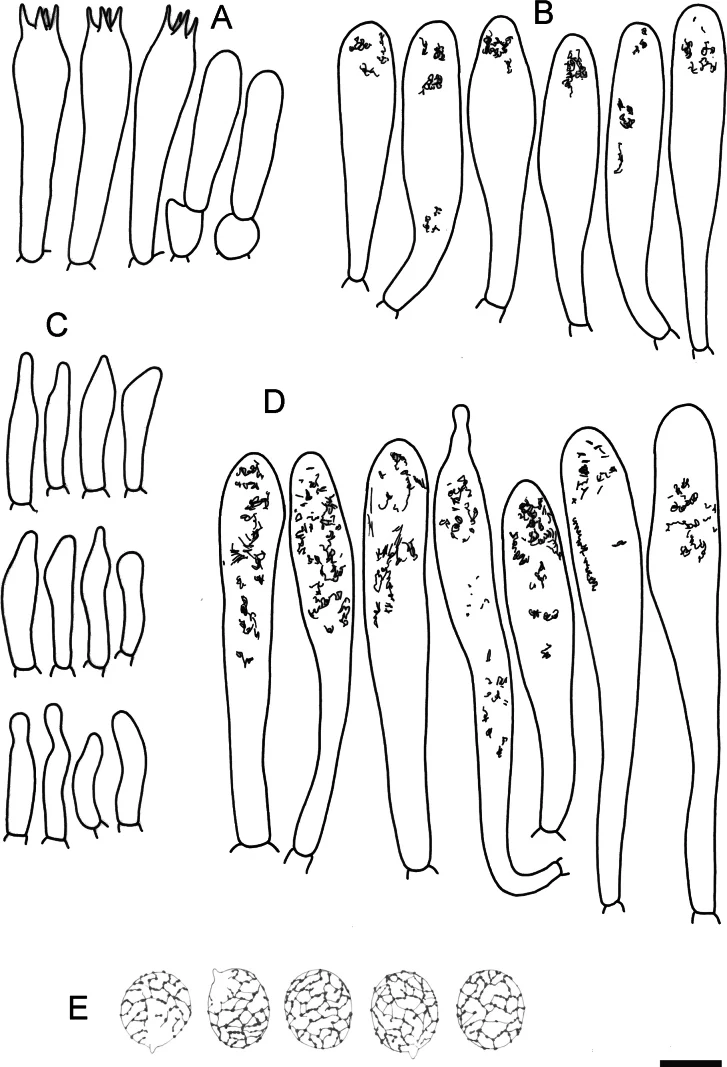
Hymenial elements of Russula sublaevis (CM-21-148) A basidia and basidiola, B hymenial cystidia near the lamellar edges, C marginal cells, D hymenial cystidia, E spores as seen in Melzer’s reagent. Scale bar: 10 μm, but only 5 μm for spores.
Kredit dan penggunaan
Cathrin Manz, Mario Amalfi, Bart Buyck, Felix Hampe, Nourou S. Yorou, Slavomír Adamčík, Meike Piepenbring
Ukuran dan format gambar disesuaikan tanpa pemotongan, retus, atau penambahan skala. Lisensi sumber dipertahankan.
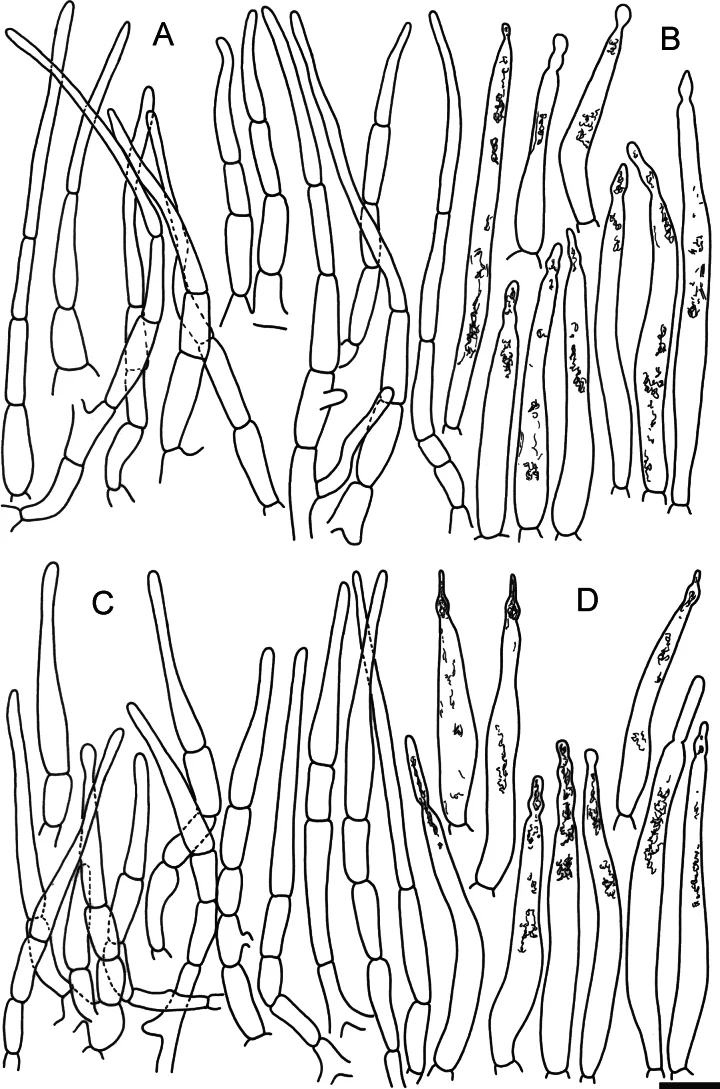
Elements of the pileipellis of Russula sublaevis (CM-21-148) A, B elements near the pileus centre: A hyphal terminations, B pileocystidia; C, D elements near the pileus margin: C hyphal terminations, D pileocystidia. Scale bar: 10 μm.
Kredit dan penggunaan
Cathrin Manz, Mario Amalfi, Bart Buyck, Felix Hampe, Nourou S. Yorou, Slavomír Adamčík, Meike Piepenbring
Ukuran dan format gambar disesuaikan tanpa pemotongan, retus, atau penambahan skala. Lisensi sumber dipertahankan.
Sumber profil
- [1] Just the tip of the iceberg: uncovering a hyperdiverse clade of African Russula (Basidiomycota, Russulales, Russulaceae) species with signs of evolutionary habitat adaptations — Russula sublaevis
- [2] Catalogue of Life Base2026-09-11 — Russula sublaevis
- [3] Dokumentasi visual — Russula sublaevis
- [4] Dokumentasi visual — Russula sublaevis
- [5] Dokumentasi visual — Russula sublaevis
Rujukan halaman ini
Fungi. Russula sublaevis. Rilis data fungi-2026-10-12-expansion-2. https://fungi-atlas.mgadib.chatgpt.site/jamur/russula-sublaevis/.
Status: impor sumber; pemeriksaan editorial per profil belum selesai. Untuk klaim biologis, gunakan rujukan pada bagian terkait dan periksa konteks sumber aslinya.