Ciri dan struktur
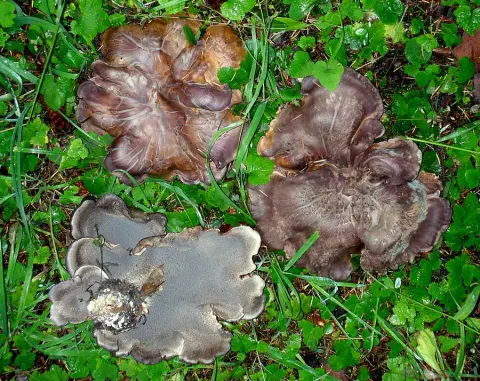
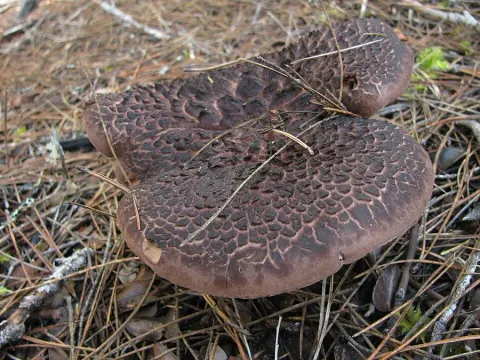
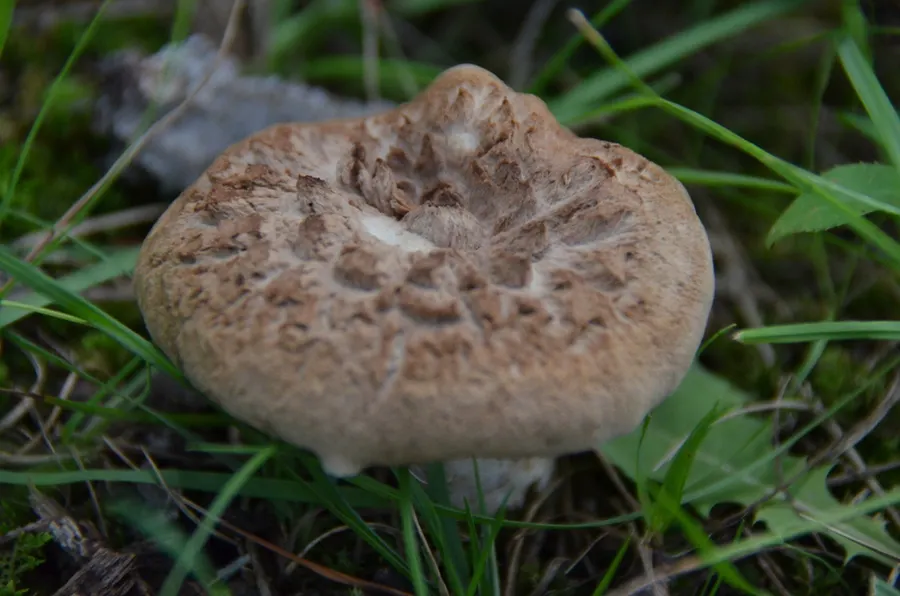
The cap is 6–14 cm broad, initially convex then flattening with a low, sometimes indistinct central bump (umbo. Its surface slips free from the flesh and breaks into coarse, concentric scales that are brown to grey‑brown, darker or almost black towards the centre. The margin is smooth, incurved and finely striate. Beneath the cap, the hymenophore (the fertile, spore-bering surface) bears short, decurrent spines ("teeth") 5–8 mm long, pale cream when young, becoming grey‑brown in maturity. The stipe is 5–8 cm tall by 1–1.5 cm thick, club‑shaped, initially cream‑coloured but ageing to grey‑brown, and carries a few scattered spines near the apex. The flesh is firm, cream‑white, slowly greying on exposure, with a faintly bitter taste and a mild fungoid odour. In contact with 10 % KOH it turns greyish‑green. Microscopically, the spores are broadly egg‑shaped to roughly spherical (globose), finely tuberculate, measuring 6.5–7.4 by 5.4–6.4 micrometres (μm) (average 7.0 by 5.9 μm). The basidia are 30–40 by 8–10 μm and mostly bear four spores. Clamp connections — small hook‑like hyphal structures involved in cell division — are abundant on all tissues, including the cap cuticle, spines and stipe trama. The hyphal system is monomitic, meaning it contains only generative hyphae.
Habitat dan peran ekologis
This species is strictly ectomycorrhizal with sessile oak, downy oak and European beech, fruiting on the forest floor of pure deciduous stands of sessile oak and Italian maple. The soil at the type locality is slightly acidic (pH ≈ 6.7) at 400 m elevation. Fruiting occurs in summer and early autumn (July–September). All known collections come from north‑eastern Catalonia: five gatherings under sessile oak at La Vall de Bianya (400 m) between 2007 and 2010, and a single autumn 2010 record from mixed beech–oak woodland near Rupit (1000 m) in the El Vilar de Pruit area (Osona).
- Habitat atau konteks temuan
- hutan
- Substrat
- Informasi belum tersedia pada sumber rilis ini.
- Peran atau konteks
- Mitra tumbuhan
Reproduksi
Beneath the cap, the hymenophore (the fertile, spore-bering surface) bears short, decurrent spines ("teeth") 5–8 mm long, pale cream when young, becoming grey‑brown in maturity. The stipe is 5–8 cm tall by 1–1.5 cm thick, club‑shaped, initially cream‑coloured but ageing to grey‑brown, and carries a few scattered spines near the apex. The flesh is firm, cream‑white, slowly greying on exposure, with a faintly bitter taste and a mild fungoid odour. In contact with 10 % KOH it turns greyish‑green. Microscopically, the spores are broadly egg‑shaped to roughly spherical (globose), finely tuberculate, measuring 6.5–7.4 by 5.4–6.4 micrometres (μm) (average 7.0 by 5.9 μm). The basidia are 30–40 by 8–10 μm and mostly bear four spores.
Catatan identitas dan cakupan
- Nama diterima mengikuti Catalogue of Life Base2026-09-11; uraian mempertahankan konsep dan nama sumber aslinya.
- Original geographic, specimen and life-cycle scope retained; source import awaits individual editorial review.
- Impor dan terjemahan otomatis belum diperiksa editorial per profil. Struktur reproduktif yang disebutkan tidak membuktikan seluruh siklus hidup diketahui.
- Pengukuran pada uraian mengikuti spesimen, kultur, dan metode sumber; angka tidak diperluas ke semua populasi.
Catatan distribusi dalam narasi mengikuti sumbernya. Dokumentasi spesimen atau foto mengikuti catatan sumber. Bukti wilayah Indonesia dan penilaian konservasi tidak disimpulkan dari gambar.
Melihat dengan konteks
Dokumentasi Sarcodon quercinofibulatus menurut asosiasi foto pada record takson iNaturalist. Kredit: Jessica Williams. Identitas mengikuti sumber; bukan penentuan spesimen independen.
- Jenis
- Fotografi
- Kredit
- (c) Jessica Williams, some rights reserved (CC BY)
- Lisensi
- CC BY 4.0
- Sumber media
- Buka entri sumber
Dokumentasi tambahan
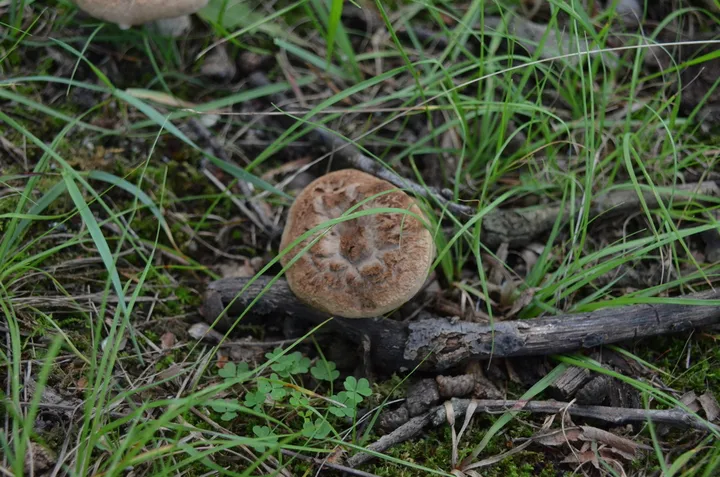
Foto yang diasosiasikan dengan Sarcodon quercinofibulatus pada iNaturalist. Identifikasi mengikuti sumber; bukan penentuan spesimen independen.
Kredit dan penggunaan
(c) Jessica Williams, some rights reserved (CC BY)
Ukuran dan format gambar disesuaikan tanpa pemotongan, retus, atau penambahan skala. Lisensi sumber dipertahankan.
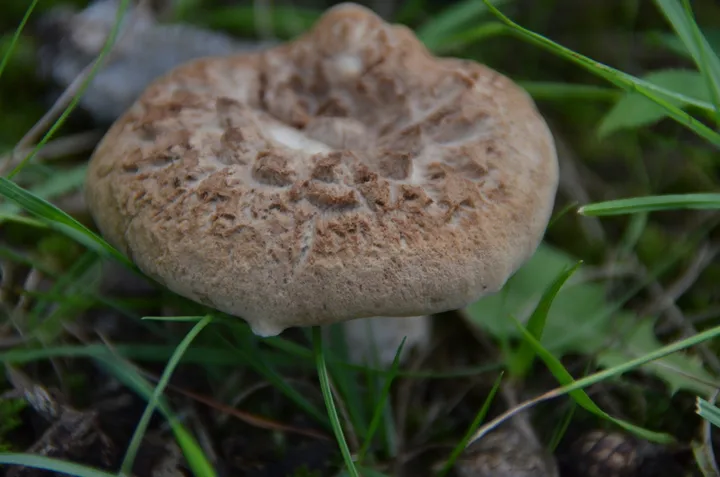
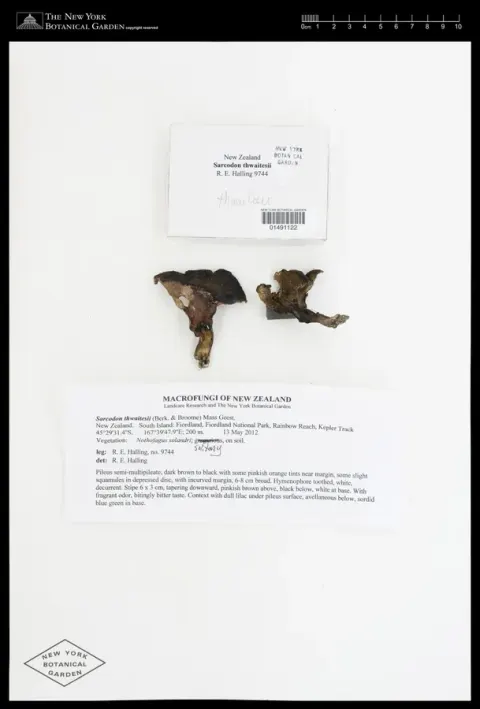
Foto yang diasosiasikan dengan Sarcodon quercinofibulatus pada iNaturalist. Identifikasi mengikuti sumber; bukan penentuan spesimen independen.
Kredit dan penggunaan
(c) Jessica Williams, some rights reserved (CC BY)
Ukuran dan format gambar disesuaikan tanpa pemotongan, retus, atau penambahan skala. Lisensi sumber dipertahankan.
Sumber profil
- [1] Sarcodon quercinofibulatus — Wikipedia (en)
- [2] Catalogue of Life Base2026-09-11 — Sarcodon quercinofibulatus
- [3] Dokumentasi visual — Sarcodon quercinofibulatus
- [4] Dokumentasi visual — Sarcodon quercinofibulatus
- [5] Dokumentasi visual — Sarcodon quercinofibulatus
Rujukan halaman ini
Fungi. Sarcodon quercinofibulatus. Rilis data fungi-2026-10-12-expansion-2. https://fungi-atlas.mgadib.chatgpt.site/jamur/sarcodon-quercinofibulatus/.
Status: impor sumber; pemeriksaan editorial per profil belum selesai. Untuk klaim biologis, gunakan rujukan pada bagian terkait dan periksa konteks sumber aslinya.