Ciri dan struktur
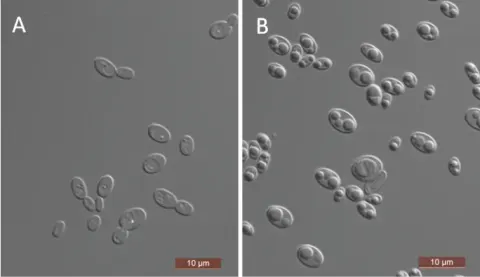
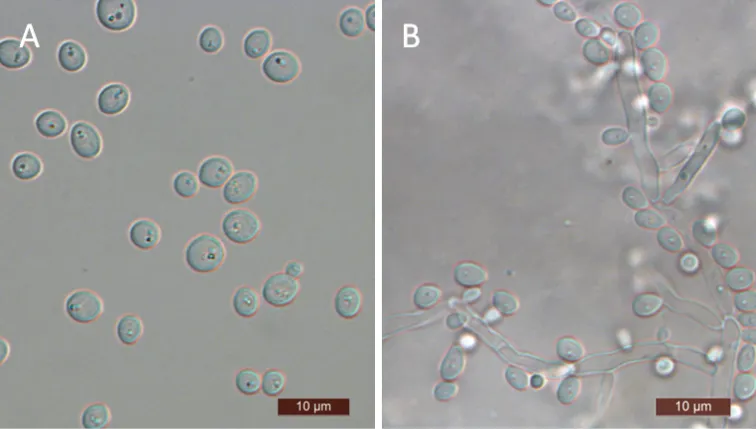
The cells are spherical or ovoid (2.5–6 × 2.5–7.5 μm) and occur singly or in pairs (Fig. 4A) when placed in YM broth after 3 days at 25 °C. Budding is multilateral. After 3 days of growth on YM agar at 25 °C, the colonies are white to cream-colored, buttery, and smooth with entire margins. After 12 days at 25 °C on a Dalmau plate culture with CM agar, pseudohyphae were observed but true hyphae were not (Fig. 4B). Asci or signs of conjugation were not observed on sporulation media. Glucose, galactose, trehalose, cellobiose (weak), and d-xylose (weak) are fermented, but maltose, sucrose, melibiose, lactose, melezitose, raffinose, and inulin are not. Glucose, galactose, d-glucosamine, d-xylose, maltose, trehalose, cellobiose, salicin, glycerol, ribitol, d-glucitol, d-mannitol, d-glucono-1, 5-lactone, 2-keto-d-gluconate, 5-keto-d-gluconate, succinate, citrate, and ethanol are all assimilated. No growth was observed in l-sorbose, d-ribose, l-arabinose, d-arabinose, l-rhamnose, sucrose, methyl α-d-glucoside, arbutin, melibiose, lactose, raffinose, melezitose, inulin, erythritol, xylitol, l-arabinitol, galactitol, myo -inositol, d-gluconate, d-glucuronate, dl-lactate, or methanol. For the assimilation of nitrogen compounds, growth on l-lysine, glucosamine, or d-tryptophan is positive, while growth on nitrate, nitrite, ethylamine, cadaverine, creatine, creatinine, and imidazole is negative. Growth is observed at 37 °C, but not at 40 °C. Growth in the presence of 0.01% cycloheximide is positive, but growth in the presence of 0.1% cycloheximide, 10% NaCl with 5% glucose, and 1% acetic acid is negative.
Habitat dan peran ekologis
Two strains, representing S. anoplophorae, were clustered in a well-supported clade and were phylogenetically related to S. stambukii (Lopes et al. 2018). The nucleotide differences between the new species and its closest relative, S. stambukii, were 2.3% substitutions in the D1/D2 domain and 6.6% substitutions in the ITS region, respectively. Physiologically, the ability to assimilate d-glucosamine and the inability to assimilate d-gluconate are the primary differences between S. anoplophorae and its closest relative, S. stambukii. Additionally, S. stambukii can grow in 5% glucose medium with 10% NaCl, while S. anoplophorae cannot.
- Habitat atau konteks temuan
- Informasi belum tersedia pada sumber rilis ini.
- Substrat
- Informasi belum tersedia pada sumber rilis ini.
- Peran atau konteks
- Belum dikategorikan pada rilis ini.
Reproduksi
The cells are spherical or ovoid (2.5–6 × 2.5–7.5 μm) and occur singly or in pairs (Fig. 4A) when placed in YM broth after 3 days at 25 °C. Budding is multilateral. After 3 days of growth on YM agar at 25 °C, the colonies are white to cream-colored, buttery, and smooth with entire margins. After 12 days at 25 °C on a Dalmau plate culture with CM agar, pseudohyphae were observed but true hyphae were not (Fig. 4B). Asci or signs of conjugation were not observed on sporulation media. Glucose, galactose, trehalose, cellobiose (weak), and d-xylose (weak) are fermented, but maltose, sucrose, melibiose, lactose, melezitose, raffinose, and inulin are not. Glucose, galactose, d-glucosamine, d-xylose, maltose, trehalose, cellobiose, salicin, glycerol, ribitol, d-glucitol, d-mannitol, d-glucono-1, 5-lactone, 2-keto-d-gluconate, 5-keto-d-gluconate, succinate, citrate, and ethanol are all assimilated.
Catatan identitas dan cakupan
- Nama diterima mengikuti Catalogue of Life Base2026-09-11; uraian mempertahankan konsep dan nama sumber aslinya.
- Preserve original treatment localities, hosts and substrate scope. Materials examined describe documented specimens, not the full global range.
- Impor dan terjemahan otomatis belum diperiksa editorial per profil. Struktur reproduktif yang disebutkan tidak membuktikan seluruh siklus hidup diketahui.
- Pengukuran pada uraian mengikuti spesimen, kultur, dan metode sumber; angka tidak diperluas ke semua populasi.
Catatan distribusi dalam narasi mengikuti sumbernya. Dokumentasi spesimen atau foto mengikuti catatan sumber. Bukti wilayah Indonesia dan penilaian konservasi tidak disimpulkan dari gambar.
Melihat dengan konteks
Morphology of S. anoplophorae. A budding cells B pseudohyphae. Scale bars: 10 μm.
- Jenis
- Pelat ilmiah
- Kredit
- Ran-Ran Jia, Shi-Long Lv, Chun-Yue Chai, Feng-Li Hui
- Lisensi
- CC BY 4.0
- Sumber media
- Buka entri sumber
Sumber profil
- [1] Three new Scheffersomyces species associated with insects and rotting wood in China — Scheffersomyces anoplophorae
- [2] Catalogue of Life Base2026-09-11 — Scheffersomyces anoplophorae
- [3] Dokumentasi visual — Scheffersomyces anoplophorae
Rujukan halaman ini
Fungi. Scheffersomyces anoplophorae. Rilis data fungi-2026-10-12-expansion-2. https://fungi-atlas.mgadib.chatgpt.site/jamur/scheffersomyces-anoplophorae/.
Status: impor sumber; pemeriksaan editorial per profil belum selesai. Untuk klaim biologis, gunakan rujukan pada bagian terkait dan periksa konteks sumber aslinya.