Ciri dan struktur
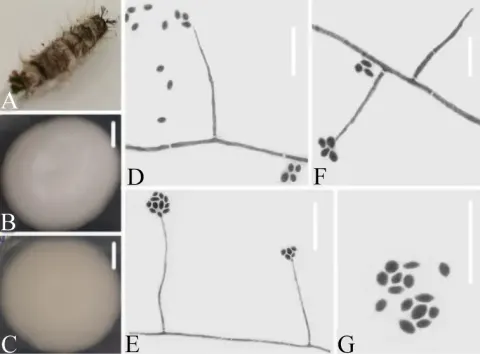
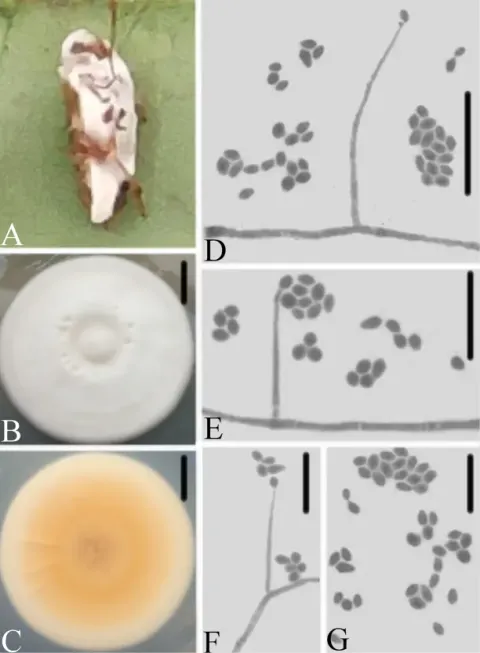
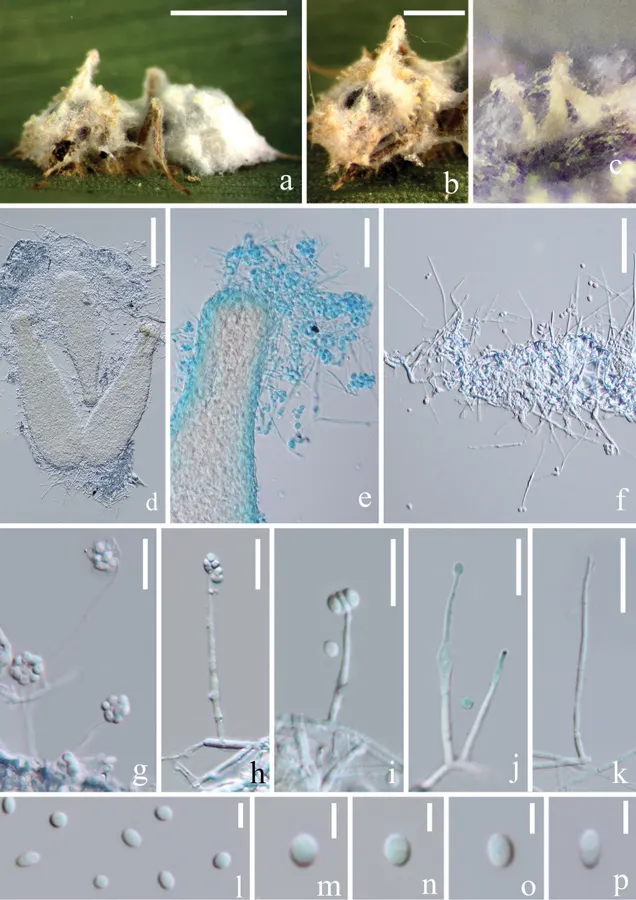
Parasitic on ant (Formicidae). Asexual morph: Hyphomycetous. Mycelium rarely septate, hyaline, smooth-walled, covering the whole body of the ant host. Synnemata 250–350 × 65–100 (xˉ = 300 × 86, n = 10) µm, forming at the head region of ant host in circular arrangement, flask-shaped, hyaline to yellowish, composed of dense hyphae, somehow curved. Phialides 25–100 × 0.5–1.5 (xˉ = 49 × 1.1, n = 20) µm, arising from procumbent hyphae or synnemata, blastic, enteroblastic, phialidic, monophialidic, discrete, terminal, unbranched, solitary, aseptate, hyaline, smooth-walled, slender, occasionally a swollen node present. Conidia 2–3.5 × 1.5–2.5 (xˉ = 2.6 × 2, n = 30) µm, globose to ellipsoidal, hyaline, one-celled, smooth-walled, round at both ends, adhering in slimy head on the tip of phialides. Sexual morph: Undetermined. The colonies were rapid-growing on PDA medium, reaching a diameter of 2.5–3 (xˉ = 2.6, n = 9) cm, in 13 days at 22 °C, entire margin, circular, velvety and white from above, with radial crack and primrose-yellow on reverse. In vitro, Synnemata absent. Phialides 25–75 × 0.4–0.6 (xˉ = 50 × 0.55, n = 10) µm, arising from procumbent hyphae, blastic, enteroblastic, phialidic, discrete, terminal, unbranched, solitary, aseptate, hyaline, smooth-walled, relatively slender and long. Conidia 1.5–3 × 1.5–2.5 (xˉ = 2.3 × 1.7, n = 100) µm, hyaline, globose to ellipsoidal, aseptate, smooth-walled, slightly guttulate, adhering in slimy head on the tip of phialides.
Habitat dan peran ekologis
Parasitic on ant (Formicidae). Asexual morph: Hyphomycetous. Mycelium rarely septate, hyaline, smooth-walled, covering the whole body of the ant host. Synnemata 250–350 × 65–100 (xˉ = 300 × 86, n = 10) µm, forming at the head region of ant host in circular arrangement, flask-shaped, hyaline to yellowish, composed of dense hyphae, somehow curved. Phialides 25–100 × 0.5–1.5 (xˉ = 49 × 1.1, n = 20) µm, arising from procumbent hyphae or synnemata, blastic, enteroblastic, phialidic, monophialidic, discrete, terminal, unbranched, solitary, aseptate, hyaline, smooth-walled, slender, occasionally a swollen node present. Conidia 2–3.5 × 1.5–2.5 (xˉ = 2.6 × 2, n = 30) µm, globose to ellipsoidal, hyaline, one-celled, smooth-walled, round at both ends, adhering in slimy head on the tip of phialides. Sexual morph: Undetermined. The colonies were rapid-growing on PDA medium, reaching a diameter of 2.5–3 (xˉ = 2.6, n = 9) cm, in 13 days at 22 °C, entire margin, circular, velvety and white from above, with radial crack and primrose-yellow on reverse. In vitro, Synnemata absent. Phialides 25–75 × 0.4–0.6 (xˉ = 50 × 0.55, n = 10) µm, arising from procumbent hyphae, blastic, enteroblastic, phialidic, discrete, terminal, unbranched, solitary, aseptate, hyaline, smooth-walled, relatively slender and long.
- Habitat atau konteks temuan
- kultur yang didokumentasikan
- Substrat
- Informasi belum tersedia pada sumber rilis ini.
- Peran atau konteks
- Belum dikategorikan pada rilis ini.
Reproduksi
Parasitic on ant (Formicidae). Asexual morph: Hyphomycetous. Mycelium rarely septate, hyaline, smooth-walled, covering the whole body of the ant host. Synnemata 250–350 × 65–100 (xˉ = 300 × 86, n = 10) µm, forming at the head region of ant host in circular arrangement, flask-shaped, hyaline to yellowish, composed of dense hyphae, somehow curved. Phialides 25–100 × 0.5–1.5 (xˉ = 49 × 1.1, n = 20) µm, arising from procumbent hyphae or synnemata, blastic, enteroblastic, phialidic, monophialidic, discrete, terminal, unbranched, solitary, aseptate, hyaline, smooth-walled, slender, occasionally a swollen node present. Conidia 2–3.5 × 1.5–2.5 (xˉ = 2.6 × 2, n = 30) µm, globose to ellipsoidal, hyaline, one-celled, smooth-walled, round at both ends, adhering in slimy head on the tip of phialides.
Catatan identitas dan cakupan
- Nama diterima mengikuti Catalogue of Life Base2026-09-11; uraian mempertahankan konsep dan nama sumber aslinya.
- Preserve original treatment localities, hosts and substrate scope. Materials examined describe documented specimens, not the full global range.
- Impor dan terjemahan otomatis belum diperiksa editorial per profil. Struktur reproduktif yang disebutkan tidak membuktikan seluruh siklus hidup diketahui.
- Pengukuran pada uraian mengikuti spesimen, kultur, dan metode sumber; angka tidak diperluas ke semua populasi.
Catatan distribusi dalam narasi mengikuti sumbernya. Dokumentasi spesimen atau foto mengikuti catatan sumber. Bukti wilayah Indonesia dan penilaian konservasi tidak disimpulkan dari gambar.
Melihat dengan konteks
Simplicillium formicae (from HKAS 102459, holotype) a superficial hyphae associated with the ant host b–e flask-shaped synnemata f–k phialides bearing conidia l–p conidia. Scale bars: 1000 µm (a); 500 µm (b); 100 µm (d); 30 µm (e, f); 15 µm (j, k); 10 µm (l–p) (e stained with cotton blue solution).
- Jenis
- Pelat ilmiah
- Kredit
- De-Ping Wei, Dhanushka N. Wanasinghe, Kevin D. Hyde, Peter E. Mortimer, Jianchu Xu, Yuan-Pin Xiao, Chitrabhanu S. Bhunjun, Chaiwat To-anun
- Lisensi
- CC BY 4.0
- Sumber media
- Buka entri sumber
Dokumentasi tambahan
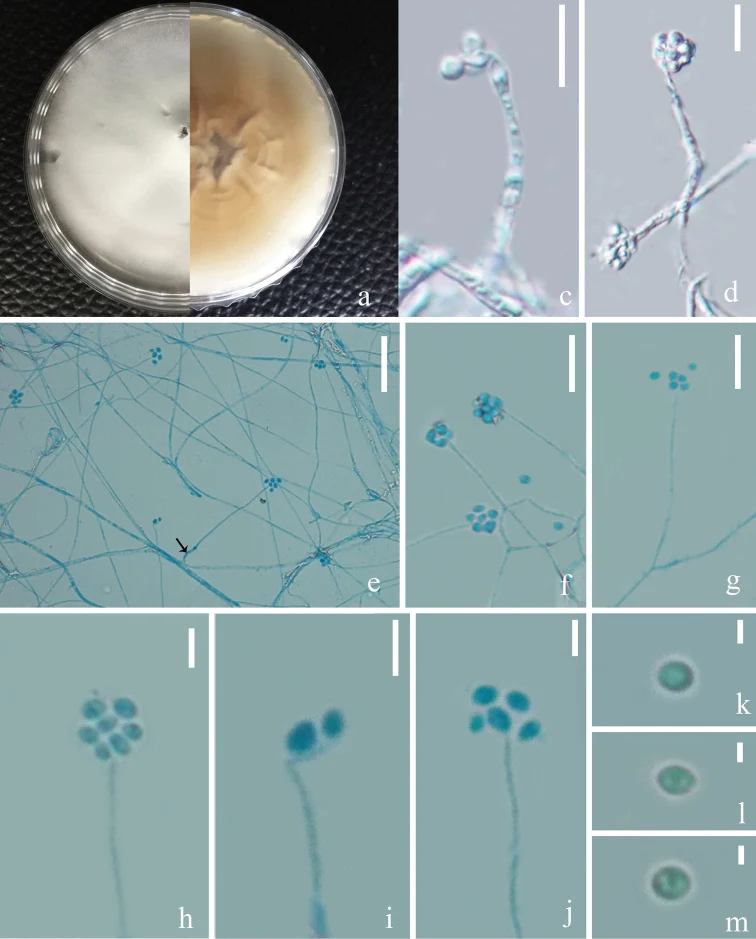
Simplicillium formicae (MFLUCC 18–1379, ex-type living culture) a upper and reverse view of cultures on PDA after 30 days e–g phialides indicated with black arrow c, d, h–j conidial mass on the tip of phialides k–m conidia. Scale bars: 10 µm (c, d, f, g); 20 µm (e); 3 µm (h–j); 1 µm (k–m) (e–j stained with cotton blue solution).
Kredit dan penggunaan
De-Ping Wei, Dhanushka N. Wanasinghe, Kevin D. Hyde, Peter E. Mortimer, Jianchu Xu, Yuan-Pin Xiao, Chitrabhanu S. Bhunjun, Chaiwat To-anun
Ukuran dan format gambar disesuaikan tanpa pemotongan, retus, atau penambahan skala. Lisensi sumber dipertahankan.
Sumber profil
- [1] The genus Simplicillium — Simplicillium formicae
- [2] Catalogue of Life Base2026-09-11 — Simplicillium formicae
- [3] Dokumentasi visual — Simplicillium formicae
- [4] Dokumentasi visual — Simplicillium formicae
Rujukan halaman ini
Fungi. Simplicillium formicae. Rilis data fungi-2026-10-12-expansion-2. https://fungi-atlas.mgadib.chatgpt.site/jamur/simplicillium-formicae/.
Status: impor sumber; pemeriksaan editorial per profil belum selesai. Untuk klaim biologis, gunakan rujukan pada bagian terkait dan periksa konteks sumber aslinya.