Ciri dan struktur
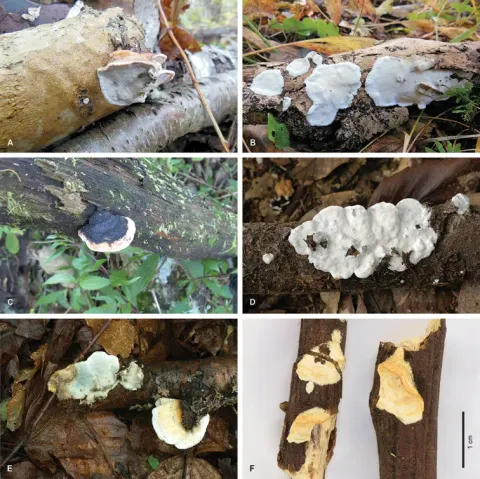
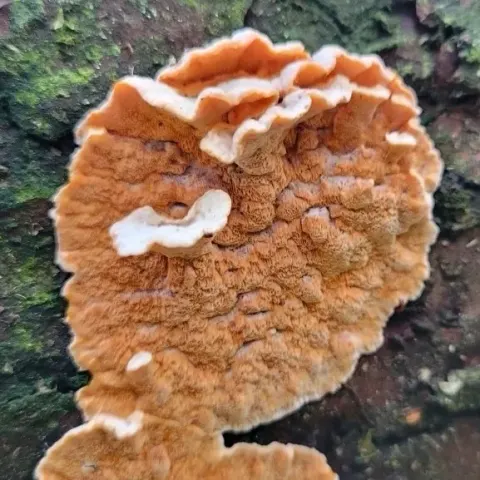
Basidiocarps annual or possibly perennial; half-resupinate to pileate; up to 3 cm wide and (pilei) up to 8 mm thick; hard when dry but easy to break apart; pilei nodulous or thick but steeply sloping, protruding up to 1 cm; margin of pileus curved downwards, blunt, with narrow, woolly, ridge on the underside; upper surface matted to minutely pubescent, white or cream coloured when young, turning ochraceous brown; pore surface cream coloured with ochraceous or sometimes salmon/peach coloured tints, sometimes a greenish-grey tint is visible in the tubes; context and subiculum finally coriaceous but looser and fibrous near cap edge and surface; context faintly zonate in longitudinal section with thin dark lines separating layers of growth; tube layer up to 1 mm thick, sometimes divided by a thin white layer where tubes are filled with arbuscule-like ‘binding hyphae’, otherwise pale buff; pores (6–)7–8(–10) per mm. Hyphal structure: the outer layer of context typically has a loose, fibrous texture composed of radially orientated hyphae. Skeletal hyphae in context / subiculum (1.0–)2.0–3.5(–4.0) µm wide, in trama 2.0–4.6(–6.2) µm wide, generative hyphae in trama 1.0–2.2(–2.9) µm wide. Basidiospores (2.8–)2.9–3.7(–4.0)×0.5–0.8 µm, L=3.1 µm, W=0.67 µm, Q’=3.8–6.0(–7.0), Q=4.65, n=70/3.
Habitat dan peran ekologis
Boreal North America, possibly quite rare, findings from Northern Quebec and Alberta in Canada; growing on fallen Picea logs.
- Habitat atau konteks temuan
- Informasi belum tersedia pada sumber rilis ini.
- Substrat
- Informasi belum tersedia pada sumber rilis ini.
- Peran atau konteks
- Belum dikategorikan pada rilis ini.
Reproduksi
Basidiocarps annual or possibly perennial; half-resupinate to pileate; up to 3 cm wide and (pilei) up to 8 mm thick; hard when dry but easy to break apart; pilei nodulous or thick but steeply sloping, protruding up to 1 cm; margin of pileus curved downwards, blunt, with narrow, woolly, ridge on the underside; upper surface matted to minutely pubescent, white or cream coloured when young, turning ochraceous brown; pore surface cream coloured with ochraceous or sometimes salmon/peach coloured tints, sometimes a greenish-grey tint is visible in the tubes; context and subiculum finally coriaceous but looser and fibrous near cap edge and surface; context faintly zonate in longitudinal section with thin dark lines separating layers of growth; tube layer up to 1 mm thick, sometimes divided by a thin white layer where tubes are filled with arbuscule-like ‘binding hyphae’, otherwise pale buff; pores (6–)7–8(–10) per mm.
Catatan identitas dan cakupan
- Nama diterima mengikuti Catalogue of Life Base2026-09-11; uraian mempertahankan konsep dan nama sumber aslinya.
- Preserve original treatment localities, hosts and substrate scope. Materials examined describe documented specimens, not the full global range.
- Impor dan terjemahan otomatis belum diperiksa editorial per profil. Struktur reproduktif yang disebutkan tidak membuktikan seluruh siklus hidup diketahui.
- Pengukuran pada uraian mengikuti spesimen, kultur, dan metode sumber; angka tidak diperluas ke semua populasi.
Catatan distribusi dalam narasi mengikuti sumbernya. Dokumentasi spesimen atau foto mengikuti catatan sumber. Bukti wilayah Indonesia dan penilaian konservasi tidak disimpulkan dari gambar.
Melihat dengan konteks
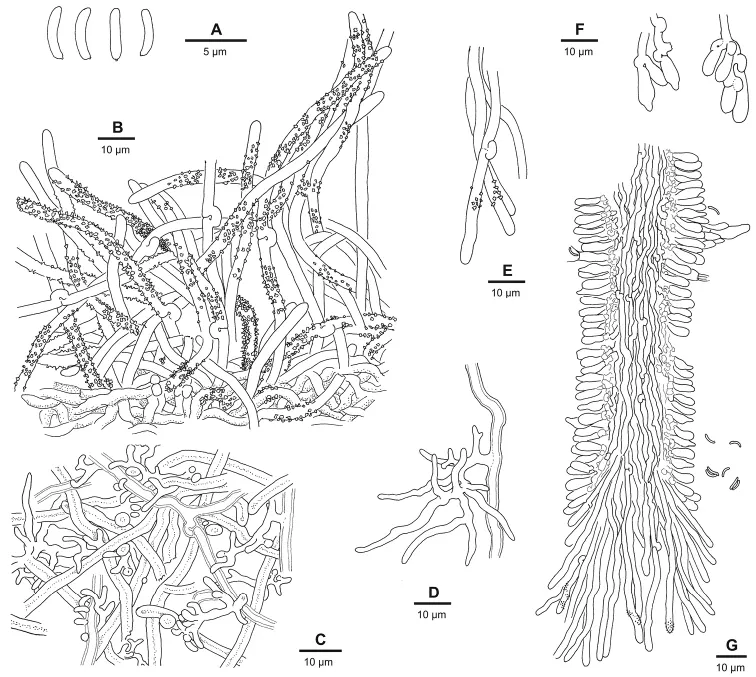
Microscopic structures of Skeletocutis ochroalba (reproduced after Niemelä (1985)). A spores B encrusted tomentum hyphae arising from dense cortical tissue C section through context, showing generative and skeletal hyphae and ramified side-branches resembling binding hyphae D ramified arbuscule-like binding hypha, arising from a generative hypha E dissepiment edge hyphae F cystidioles and basidioles G vertical section through a dissepiment edge, showing trama, hymenium with a hyphal peg and sparsely encrusted dissepiment edge hyphae.
- Jenis
- Pelat ilmiah
- Kredit
- Aku Korhonen, Jaya Seelan Sathiya Seelan, Otto Miettinen
- Lisensi
- CC BY 4.0
- Sumber media
- Buka entri sumber
Sumber profil
- [1] Cryptic species diversity in polypores: the Skeletocutis nivea species complex — Skeletocutis ochroalba
- [2] Catalogue of Life Base2026-09-11 — Skeletocutis ochroalba
- [3] Dokumentasi visual — Skeletocutis ochroalba
Rujukan halaman ini
Fungi. Skeletocutis ochroalba. Rilis data fungi-2026-10-12-expansion-2. https://fungi-atlas.mgadib.chatgpt.site/jamur/skeletocutis-ochroalba/.
Status: impor sumber; pemeriksaan editorial per profil belum selesai. Untuk klaim biologis, gunakan rujukan pada bagian terkait dan periksa konteks sumber aslinya.