01 / Morfologi

Ciri dan struktur

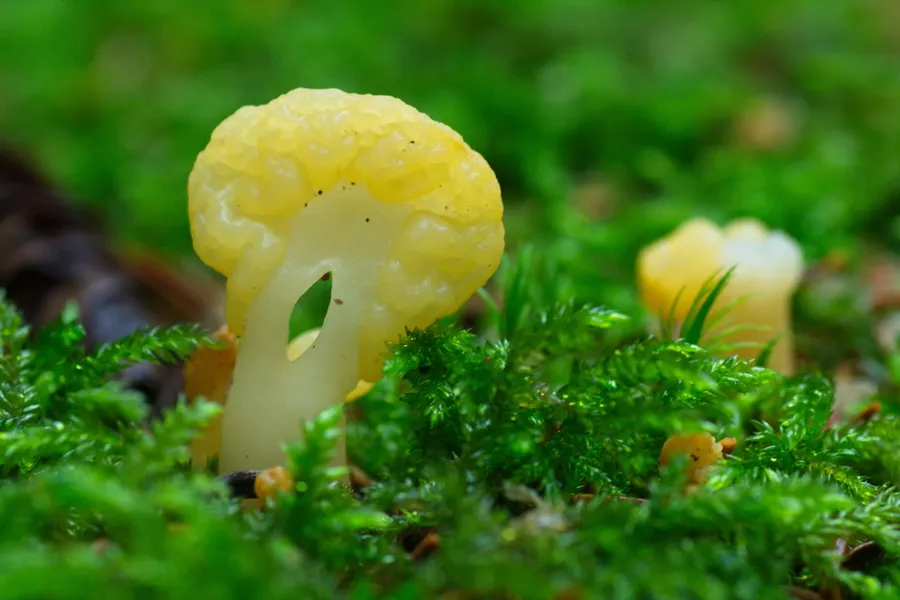
The fan- or spoon-shaped fruit bodies of S. flavida may be up to 8 cm high, although a range between 2–5 cm is more typical. Occasionally, fruit bodies are produced with the "head" split into two separate lobes. The color is light to strong yellow, the flattened fertile area at times paler; the color tends to deepen with the age of the fruit body. The fertile area (the region that produces spores) is often irregularly wrinkled and sometimes notched at apex, and is up to 2 cm wide; it tapers down the length of either side of the stem (i.e., decurrently) from a half to a third of the total stem length. The division between the head and the stem is sharply defined. The stem is hollow, smooth (glabrous), and has a white to yellowish mycelium at its base. The flesh of the fruit body is whitish, but becomes yellowish-brown when dry. In mass, the spores appear yellowish-brown, especially when they are dry. Viewed under the microscope, they appear hyaline (translucent). The spores are variable in size, but typically in the range of 30–95 by 1.5–2.5 μm. They may be non-or several septate, slender and pointed (acicular), and have an outer wall with a gelatinous layer. The asci (the spore-bearing structures) are club-shaped, with dimensions of 85–125 by 8–12 μm. The asci do not have a covering lid known as an operculum. The paraphyses (sterile cells found in the hymenium) are filamentous, and hyaline (translucent); some are ring-shaped (circinate).

Sebagian uraian ditampilkan dalam bahasa sumber; terjemahannya belum tersedia atau belum lolos pemeriksaan.

Rujukan: [1]

Pengukuran mengikuti objek, spesimen atau kultur, dan metode yang disebutkan sumber. Baca uraian asli untuk konteks lengkap.

02 / Kehidupan

Habitat dan peran ekologis

Spesies yang sangat luas dan luas, S. flavida umum di daerah berangin seperti Pasifik Northwest region Amerika Utara, yang membentang ke utara hingga Alaska; namun, tidak diketahui di Meksiko. Di Eropa, telah dikumpulkan dari Inggris, Jerman, Spanyol, Austria, Belgia, Skandinavia, dan Italia; di Asia, telah dilaporkan dari India, Jepang, dan Turki. Di Slowakia, spesies ini dianggap sebagai spesies yang dilindungi. The fruit bodies grow scattered or in groups on forest duff or humus under conifers, summer and fall, and may grow in rings or arcs. Thought to adalah spesies saprobik (yaitu, mendapatkan nutrisi dari mati atau membusuk bahan organik), juga telah ditemukan pada kayu busuk. One field panduan mengatakan tentang spesies ini, "orang cenderung melihat [itu] saat di tanah mencari sesuatu yang lain". Jamur ini mampu melindungi dirinya dari mikofagi dengan springtail Ceratophysella denisana, yang biasa memberi makan jamur, dengan melepaskan senyawa bau yang repellent ketika terluka.

Sebagian uraian ditampilkan dalam bahasa sumber; terjemahannya belum tersedia atau belum lolos pemeriksaan.

Rujukan: [1]

Habitat atau konteks temuan
Informasi belum tersedia pada sumber rilis ini.
Substrat
tanah
Peran atau konteks
Pengurai
Temukan hubungan serupa
03 / Siklus hidup

Reproduksi

The fan- or spoon-shaped fruit bodies of S. flavida may be up to 8 cm high, although a range between 2–5 cm is more typical. Occasionally, fruit bodies are produced with the "head" split into two separate lobes. The color is light to strong yellow, the flattened fertile area at times paler; the color tends to deepen with the age of the fruit body. The fertile area (the region that produces spores) is often irregularly wrinkled and sometimes notched at apex, and is up to 2 cm wide; it tapers down the length of either side of the stem (i.e., decurrently) from a half to a third of the total stem length. The division between the head and the stem is sharply defined. The stem is hollow, smooth (glabrous), and has a white to yellowish mycelium at its base.

Sebagian uraian ditampilkan dalam bahasa sumber; terjemahannya belum tersedia atau belum lolos pemeriksaan.

Rujukan: [1]

Sinonim menurut acuan taksonomi rilis: Clavaria spatulata; Helvella clavata; Helvella spatulata; Mitrula crispata; Spathularia clavata; Spathularia clavata var. alpestris; Spathularia clavata var. crispata; Spathularia clavata var. plicata; Spathularia flava; Spathularia flavida subsp. rufa; Spathularia flavida var. brevispora; Spathularia flavida var. cava; Spathularia flavida var. crispa; Spathularia flavida var. elongata; Spathularia flavida var. laevissima; Spathularia flavida var. longispora; Spathularia flavida var. minima; Spathularia flavida var. neesii; Spathularia flavida var. ramosa; Spathularia flavida var. rugosa; Spathularia flavida var. tortuosa; Spathularia rufa; Spathulea crispata
04 / Batas informasi

Catatan identitas dan cakupan

  • Nama diterima mengikuti Catalogue of Life Base2026-09-11; uraian mempertahankan konsep dan nama sumber aslinya.
  • Original geographic, specimen and life-cycle scope retained; source import awaits individual editorial review.
  • Impor dan terjemahan otomatis belum diperiksa editorial per profil. Struktur reproduktif yang disebutkan tidak membuktikan seluruh siklus hidup diketahui.
  • Pengukuran pada uraian mengikuti spesimen, kultur, dan metode sumber; angka tidak diperluas ke semua populasi.

Catatan distribusi dalam narasi mengikuti sumbernya. Dokumentasi spesimen atau foto mengikuti catatan sumber. Bukti wilayah Indonesia dan penilaian konservasi tidak disimpulkan dari gambar.

05 / Dokumentasi

Melihat dengan konteks

Dokumentasi Spathularia flavida menurut asosiasi foto pada record takson iNaturalist. Kredit: Tatiana Bulyonkova. Identitas mengikuti sumber; bukan penentuan spesimen independen.

Jenis
Fotografi
Kredit
(c) Tatiana Bulyonkova, some rights reserved (CC BY-SA)
Sumber media
Buka entri sumber

Gambar menunjukkan objek menurut identifikasi sumber, bukan verifikasi independen spesimen oleh Fungi. Tidak ada skala baru yang ditambahkan.

06 / Rujukan

Sumber profil

  1. [1] Spathularia flavida — Wikipedia (en)Bagian sumber: Frozen revision 1321928069
    Tanggal penghimpunan sumber: 2026-10-12
    Teks sumber: CC BY-SA4.0 · Wikipedia contributors
  2. [2] Catalogue of Life Base2026-09-11 — Spathularia flavidaBagian sumber: ColDP NameUsage.tsv ID 4YGPM; accepted species; source 2073
    Tanggal penghimpunan sumber: 2026-10-12
  3. [3] Dokumentasi visual — Spathularia flavidaBagian sumber: Individual media record; identification follows the source, not independent determination
    Tanggal penghimpunan sumber: 2026-10-12
    Media sumber: CC BY-SA 4.0 · (c) Tatiana Bulyonkova, some rights reserved (CC BY-SA)

Adaptasi teks: CC BY-SA 4.0. Wikipedia contributors — Spathularia flavida — Wikipedia (en)

Uraian asli dan riwayat sumber

Riwayat atau halaman sumber

Ringkasan sumber

Spathularia flavida, commonly known as the yellow earth tongue, the yellow fan, or the fairy fan, is an ascomycete fungus. It produces a small, fan- or spoon-shaped fruit body with a flat, wavy or lobed cream to yellow colored "head" raised on a white to cream stalk. It is usually 2–5 cm tall. The spores produced by the fungus are needle-like, and up to 95 μm long. Several varieties have been described that differ largely in their microscopic characteristics. The fungus fruits on the ground in mosses, forest duff or humus, and fruit bodies may occur singly, in large groups, or in fairy rings.

Revisi sumber

Morfologi sumber

The fan- or spoon-shaped fruit bodies of S. flavida may be up to 8 cm high, although a range between 2–5 cm is more typical. Occasionally, fruit bodies are produced with the "head" split into two separate lobes. The color is light to strong yellow, the flattened fertile area at times paler; the color tends to deepen with the age of the fruit body. The fertile area (the region that produces spores) is often irregularly wrinkled and sometimes notched at apex, and is up to 2 cm wide; it tapers down the length of either side of the stem (i.e., decurrently) from a half to a third of the total stem length. The division between the head and the stem is sharply defined. The stem is hollow, smooth (glabrous), and has a white to yellowish mycelium at its base. The flesh of the fruit body is whitish, but becomes yellowish-brown when dry. In mass, the spores appear yellowish-brown, especially when they are dry. Viewed under the microscope, they appear hyaline (translucent). The spores are variable in size, but typically in the range of 30–95 by 1.5–2.5 μm. They may be non-or several septate, slender and pointed (acicular), and have an outer wall with a gelatinous layer. The asci (the spore-bearing structures) are club-shaped, with dimensions of 85–125 by 8–12 μm. The asci do not have a covering lid known as an operculum. The paraphyses (sterile cells found in the hymenium) are filamentous, and hyaline (translucent); some are ring-shaped (circinate).

Revisi sumber

Ekologi sumber

A cosmopolitan and widespread species, S. flavida is common in temperate regions such as the Pacific Northwest region of North America, extending north to Alaska; it is, however, unknown in Mexico. In Europe, it has been collected from Britain, Germany, Spain, Austria, Belgium, Scandinavia, and Italy; in Asia, it has been reported from India Japan, and Turkey. It is considered a protected species in Slovakia. The fruit bodies grow scattered or in groups on forest duff or humus under conifers, summer and fall, and may grow in rings or arcs. Thought to be a saprobic species (that is, obtaining nutrients from dead or decomposing organic matter), it has also been found on rotten wood. One field guide says of this species, "that one is apt to see [it] while down on the ground looking for something else." The fungus is able to protect itself from mycophagy by the springtail Ceratophysella denisana, a common mushroom feeder, by releasing repellent odorous compounds when it is injured.

Revisi sumber

Struktur reproduksi sumber

The fan- or spoon-shaped fruit bodies of S. flavida may be up to 8 cm high, although a range between 2–5 cm is more typical. Occasionally, fruit bodies are produced with the "head" split into two separate lobes. The color is light to strong yellow, the flattened fertile area at times paler; the color tends to deepen with the age of the fruit body. The fertile area (the region that produces spores) is often irregularly wrinkled and sometimes notched at apex, and is up to 2 cm wide; it tapers down the length of either side of the stem (i.e., decurrently) from a half to a third of the total stem length. The division between the head and the stem is sharply defined. The stem is hollow, smooth (glabrous), and has a white to yellowish mycelium at its base.

Revisi sumber

Rujukan halaman ini

Fungi. Spathularia flavida. Rilis data fungi-2026-10-12-expansion-2. https://fungi-atlas.mgadib.chatgpt.site/jamur/spathularia-flavida/.

Status: impor sumber; pemeriksaan editorial per profil belum selesai. Untuk klaim biologis, gunakan rujukan pada bagian terkait dan periksa konteks sumber aslinya.