Ciri dan struktur
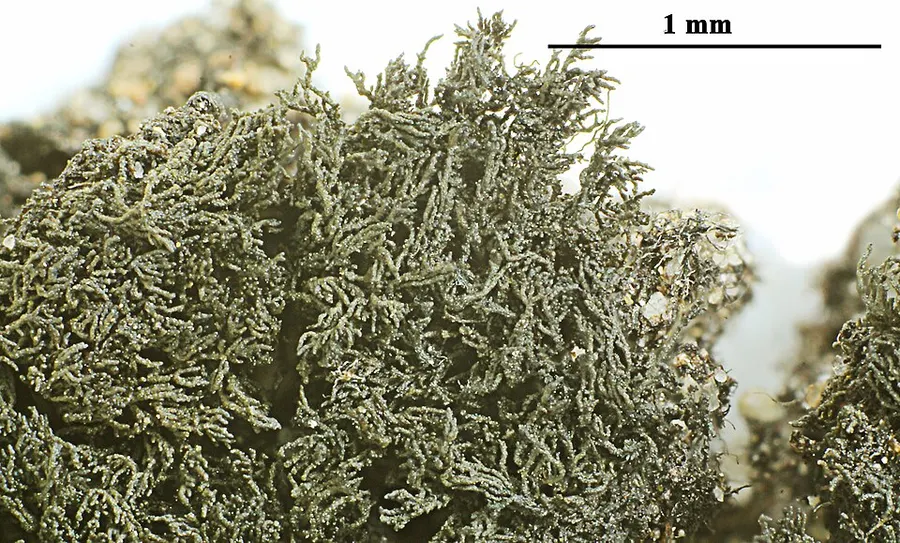
The thallus of Spilonema revertens forms dense cushions composed of minute, dark filaments. These cushions feature a distinctive structure: a dense central mass of rhizine-like filaments supports an outer layer of actively growing lichenized branches, allowing continuous regeneration of the lichen's outer layer. Its growth form varies from somewhat shrub-like (subfruticose) to tree-like (dendroid), consisting of tiny, upright that occasionally spread out along the . These lobules bear numerous minute side branches, forming rounded to angular, convex cushion-like structures. In some cases, the thallus may fragment into small, crust-like () patches, giving it a more encrusting appearance. The lichen attaches to the rock surface via a , a network of interwoven bluish-black fungal filaments, which becomes gelatinous when wet. The upper surface of the thallus is typically dark olive to blackish in colour, often appearing rough or , though it is rarely shiny. Internally, S. revertens has a uniform structure () composed of densely packed thick-walled fungal filaments and lacks a distinct outer protective layer (). Near the base, the tissue may adopt a more organized, (brick-like) arrangement. This lichen forms a symbiotic relationship with a filamentous cyanobacterium, usually from the genera Stigonema or Hyphomorpha, but lacks a secondary algal partner. The lower surface varies in colour from dark blue-green to brownish or dark purple, often appearing nearly black due to the pigmentation of the hypothallus. The reproductive structures (ascomata) of S. revertens are small, disc-shaped fruiting bodies known as apothecia.
Habitat dan peran ekologis
Spilonema revertens has a broad Holarctic distribution, occurring across Europe, Asia, North America, and Greenland. It has also been recorded from the Canary Islands. In Russia, it has been documented in the northern European part of the country, the Northern and Southern Urals, the North Caucasus, Southern and Eastern Siberia, and both the southern and northern regions of the Russian Far East, as well as in Mongolia. In Greenland, it typically occurs in association with Euopsis pulvinata and Lecanora chloroleprosa, especially on moist charnockitic rocks and siliceous gravel. The species generally grows on exposed siliceous rock that undergoes alternating dry and wet periods. It is often encountered in lower mountain zones, particularly in light coniferous forests and stony meadow-steppes, but has also been documented on serpentine rocks and soils derived from peridotite. Such substrates feature low calcium-to-magnesium ratios, elevated concentrations of heavy metals, and nutrient deficiencies; however, S. revertens is not considered serpentine-specific because it is recorded on a variety of rock types. Wave exposure influences its distribution in coastal environments. The species inhabits the middle supralittoral zone in sheltered areas, but retreats to the terrestrial zone in highly exposed sites, likely due to its relatively loose attachment making it vulnerable to wave action.
- Habitat atau konteks temuan
- hutan; padang rumput
- Substrat
- Informasi belum tersedia pada sumber rilis ini.
- Peran atau konteks
- Pembentuk liken
Reproduksi
The reproductive structures (ascomata) of S. revertens are small, disc-shaped fruiting bodies known as apothecia. These sessile structures develop laterally on the lobules, often hidden within the cushion-like formations. They are up to 0.5 mm in diameter, with a black, convex disc from an early stage. The fruiting bodies lack a distinct outer . The surrounding exciple, initially violet in colour, is thin and eventually erodes away. Internally, the hymenium (fertile layer) appears greenish or partially violet and reacts with iodine, indicating an amyloid composition. The paraphyses—sterile filamentous structures among the spores—are robust, distinctly segmented, and have pointed tips. The , located beneath the hymenium, is violet.
Catatan identitas dan cakupan
- Nama diterima mengikuti Catalogue of Life Base2026-09-11; uraian mempertahankan konsep dan nama sumber aslinya.
- Original geographic, specimen and life-cycle scope retained; source import awaits individual editorial review.
- Impor dan terjemahan otomatis belum diperiksa editorial per profil. Struktur reproduktif yang disebutkan tidak membuktikan seluruh siklus hidup diketahui.
- Pengukuran pada uraian mengikuti spesimen, kultur, dan metode sumber; angka tidak diperluas ke semua populasi.
Catatan distribusi dalam narasi mengikuti sumbernya. Dokumentasi spesimen atau foto mengikuti catatan sumber. Bukti wilayah Indonesia dan penilaian konservasi tidak disimpulkan dari gambar.
Melihat dengan konteks
Dokumentasi Spilonema revertens dari Wikimedia Commons. Closeup of the thallus of the microfruticose lichen Spilonema revertens ; specimen collected in Jianchuan Co. Yunnan, China Identifikasi mengikuti record berkas sumber.
- Jenis
- Fotografi
- Kredit
- Felix Schumm
- Lisensi
- CC BY-SA 4.0
- Sumber media
- Buka entri sumber
Sumber profil
- [1] Spilonema revertens — Wikipedia (en)
- [2] Catalogue of Life Base2026-09-11 — Spilonema revertens
- [3] Dokumentasi visual — Spilonema revertens
Rujukan halaman ini
Fungi. Spilonema revertens. Rilis data fungi-2026-10-12-expansion-2. https://fungi-atlas.mgadib.chatgpt.site/jamur/spilonema-revertens/.
Status: impor sumber; pemeriksaan editorial per profil belum selesai. Untuk klaim biologis, gunakan rujukan pada bagian terkait dan periksa konteks sumber aslinya.