Ciri dan struktur
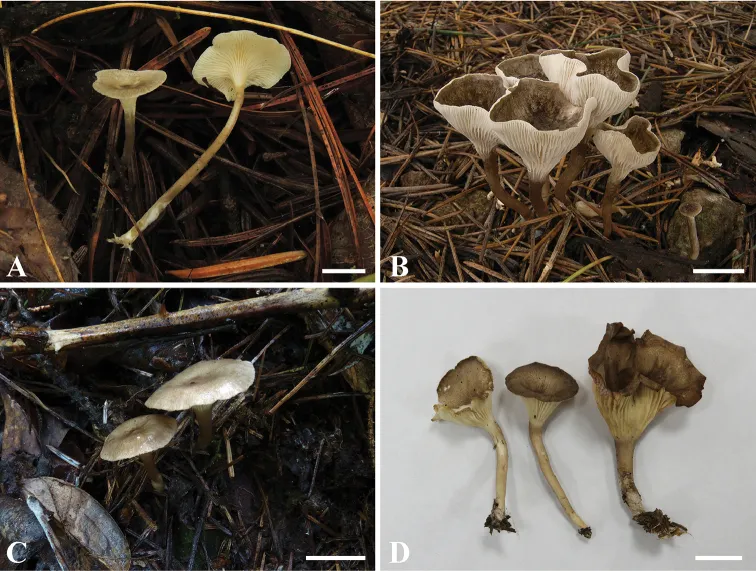
Differs from S. bispora in having a rugose pileus, smaller basidiospores and 4-spored rather than 2-spored basidia. Differs from C. trulliformis in having smaller basidiospores and a rugose rather than felty-squamulose pileus. Basidiomes small, clitocyboid. Pileus 0.5–2 cm in diam, at first nearly applanate, then concave; surface dry and rugose, gray-brown (5E2-4) to gray-black (4F2-4) in the center and gray-brown (5C2-4) or gray (5B1-2) towards margin; center often slightly umbonate; margin straight and undulating; context thin and white (1A1) to cream (1A2). Lamellae deeply decurrent, white (1A1) to cream (1A2), thin (up to 2 mm high), crowded, sometimes forked and intervenose. Stipe 2.5–6 × 0.2–0.4 cm, central, narrowly cylindrical to subcylindrical, sometimes flexuous, hollow; surface dry and nearly smooth, concolorous with pileus; context white (1A1). Basidiospores [60/3/3] 5–6 (6.5) × (2.5)3–3.5(4) μm, Q = (1.38)1.55–1.95(2), Qm = 1.73 ± 0.14, elongate, colorless, hyaline, smooth, thin-walled, inamyloid. Basidia 20–24 × 5–6 μm, clavate, 4-spored, colorless, hyaline, thin-walled; sterigmata up to 4 μm long; ratio of basidia to basidiospore length values about 3–5. Cystidia absent. Lamellar trama subregular; hyphae colorless, hyaline, cylindrical, thin-walled, 3–10 µm wide. Pileipellis a cutis, but in places upright or trichodermial in appearance, made up with thin-walled cylindrical hyphae 3–9 µm wide. Stipitipellis a cutis, composed of thin-walled cylindrical hyphae 3–10 μm wide. Clamp connections present in all parts of basidiome.
Habitat dan peran ekologis
Gregarious or caespitose, growing saprotrophically in forest litter, often under conifers, on the ground, known from subtropical zone of Yunnan, China; from July to October.
- Habitat atau konteks temuan
- hutan
- Substrat
- tanah
- Peran atau konteks
- Pengurai
Reproduksi
Differs from S. bispora in having a rugose pileus, smaller basidiospores and 4-spored rather than 2-spored basidia. Differs from C. trulliformis in having smaller basidiospores and a rugose rather than felty-squamulose pileus. Basidiomes small, clitocyboid. Pileus 0.5–2 cm in diam, at first nearly applanate, then concave; surface dry and rugose, gray-brown (5E2-4) to gray-black (4F2-4) in the center and gray-brown (5C2-4) or gray (5B1-2) towards margin; center often slightly umbonate; margin straight and undulating; context thin and white (1A1) to cream (1A2). Lamellae deeply decurrent, white (1A1) to cream (1A2), thin (up to 2 mm high), crowded, sometimes forked and intervenose. Stipe 2.5–6 × 0.2–0.4 cm, central, narrowly cylindrical to subcylindrical, sometimes flexuous, hollow; surface dry and nearly smooth, concolorous with pileus; context white (1A1).
Catatan identitas dan cakupan
- Nama diterima mengikuti Catalogue of Life Base2026-09-11; uraian mempertahankan konsep dan nama sumber aslinya.
- Preserve original treatment localities, hosts and substrate scope. Materials examined describe documented specimens, not the full global range.
- Impor dan terjemahan otomatis belum diperiksa editorial per profil. Struktur reproduktif yang disebutkan tidak membuktikan seluruh siklus hidup diketahui.
- Pengukuran pada uraian mengikuti spesimen, kultur, dan metode sumber; angka tidak diperluas ke semua populasi.
Catatan distribusi dalam narasi mengikuti sumbernya. Dokumentasi spesimen atau foto mengikuti catatan sumber. Bukti wilayah Indonesia dan penilaian konservasi tidak disimpulkan dari gambar.
Melihat dengan konteks
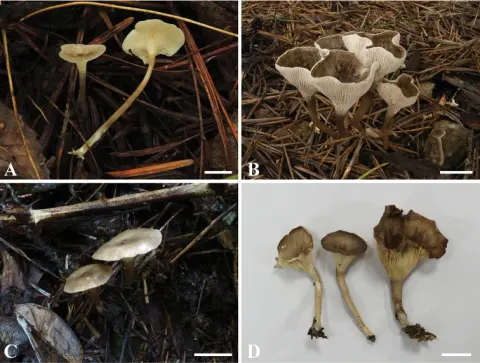
Basidiomes of described Spodocybe species. A, B Spodocybe rugosiceps (KUN-HKAS 112563, KUN-HKAS 112562, respectively) C, D Spodocybe bispora (KUN-HKAS 73332, KUN-HKAS 112562, respectively). Scale bars: 1 cm.
- Jenis
- Pelat ilmiah
- Kredit
- Zheng-Mi He, Zhu L. Yang
- Lisensi
- CC BY 4.0
- Sumber media
- Buka entri sumber
Dokumentasi tambahan
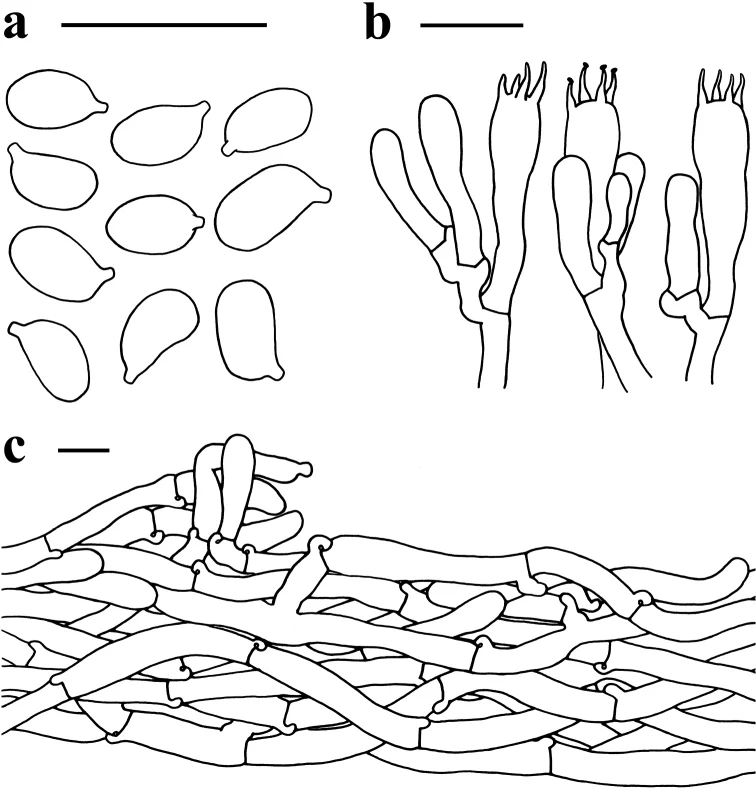
Microscopic features of Spodocybe rugosiceps (KUN-HKAS 112563, holotype) a basidiospores b basidia c pileipellis. Scale bars: 10 μm.
Kredit dan penggunaan
Zheng-Mi He, Zhu L. Yang
Ukuran dan format gambar disesuaikan tanpa pemotongan, retus, atau penambahan skala. Lisensi sumber dipertahankan.
Sumber profil
- [1] A new clitocyboid genus Spodocybe and a new subfamily Cuphophylloideae in the family Hygrophoraceae (Agaricales) — Spodocybe rugosiceps
- [2] Catalogue of Life Base2026-09-11 — Spodocybe rugosiceps
- [3] Dokumentasi visual — Spodocybe rugosiceps
- [4] Dokumentasi visual — Spodocybe rugosiceps
Rujukan halaman ini
Fungi. Spodocybe rugosiceps. Rilis data fungi-2026-10-12-expansion-2. https://fungi-atlas.mgadib.chatgpt.site/jamur/spodocybe-rugosiceps/.
Status: impor sumber; pemeriksaan editorial per profil belum selesai. Untuk klaim biologis, gunakan rujukan pada bagian terkait dan periksa konteks sumber aslinya.