01 / Morfologi

Ciri dan struktur

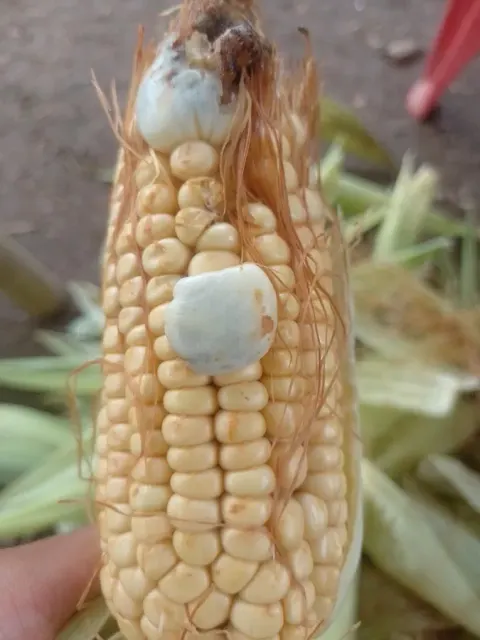
Symptoms of the fungus are expressed on both the tassels of corn and sorghum as well as on the actual ear in the form of large smut galls. When the sorghum tassel is infected, the fragile gall membrane will have a range from just a few black spores to a large mass of black spores covering the tassel. Sporisorium reilianum is noted to have a sexual stage in its disease cycle similar to that of Ustilago maydis. Initial infections occur on roots of young seedlings. The pathogen develops systemically and is found on ear and tassel tissues as the host plant matures. At maturity teliospores can be found in the white sori of the infected heads of corn. These will be easily dispersed by the wind. Favorable nutritive soil and weather conditions around 23-30 °C allows for germination of the teliospores in the soil. Maize head smut occurs in most maize-growing areas, including many regions of North America, Australia, Asia, and southern Europe. It causes tremendous loss of yield during outbreaks due to the replacement of the ear with large smut sori. To infect maize roots, S. reilianum f. sp. zeae must form a dikaryotic parasitic hypha which results for the mating of two compatible haploid strains. The infection always occurs in soil via the root, unlike Ustilago maydis, another maize smut, which infects maize plants via aerial parts. Temperatures of 23-30 °C are optimal for field infection of corn, suspected to be due to maximum teliospore germination. Detection of S. reilianum is a key step toward the development of an effective disease management system. Conventional methods, including pathogen isolation and microscopic morphological study, are labor-intensive and cumbersome, and sometimes yield inconclusive results.

Sebagian uraian ditampilkan dalam bahasa sumber; terjemahannya belum tersedia atau belum lolos pemeriksaan.

Rujukan: [1]

Pengukuran mengikuti objek, spesimen atau kultur, dan metode yang disebutkan sumber. Baca uraian asli untuk konteks lengkap.

02 / Kehidupan

Habitat dan peran ekologis

Sporisorium reilianum menyebabkan penyakit kepala jagung kotor dan kepala sorghum kotor. Jamur kotor tanah ini memiliki dua bentuk khusus. S. reilianum f. sp. reilianum adalah khusus untuk sorga dan S. reilianum f. sp. zeae adalah khusus untuk jagung. Symptoms of jamur diekspresikan pada kedua tasel jagung dan sorga serta di telinga sebenarnya dalam bentuk sarang kotor besar. When the sorghum tassel terinfeksi, membran empedu yang rapuh akan memiliki rentang dari hanya beberapa spora hitam ke massa besar spora hitam yang menutupi tassel.

Rujukan: [1]

Habitat atau konteks temuan
Informasi belum tersedia pada sumber rilis ini.
Substrat
Informasi belum tersedia pada sumber rilis ini.
Peran atau konteks
Belum dikategorikan pada rilis ini.
Temukan hubungan serupa
03 / Siklus hidup

Reproduksi

Sporisorium reilianum (J.G. Kühn) Langdon & Full., (1978), previously known as Sphacelotheca reiliana, and Sporisorium reilianum, is a species of biotrophic fungus in the family Ustilaginaceae. It is a plant pathogen that infects maize and sorghum. Sporisorium reilianum causes the diseases maize head smut and sorghum head smut. This soil borne smut fungus has two formae speciales. S. reilianum f. sp. reilianum is specific to sorghum and S. reilianum f. sp. zeae is specific to maize. Symptoms of the fungus are expressed on both the tassels of corn and sorghum as well as on the actual ear in the form of large smut galls. When the sorghum tassel is infected, the fragile gall membrane will have a range from just a few black spores to a large mass of black spores covering the tassel.

Sebagian uraian ditampilkan dalam bahasa sumber; terjemahannya belum tersedia atau belum lolos pemeriksaan.

Rujukan: [1]

Sinonim menurut acuan taksonomi rilis: Cintractia reiliana; Sorosporium holci-sorghi; Sorosporium holci-sorghi f. zeae; Sorosporium reilianum; Sorosporium reilianum f. zeae; Sphacelotheca holci-sorghi; Sphacelotheca reiliana; Sporisorium holci-sorghi; Ustilago holci-sorghi; Ustilago reiliana
04 / Batas informasi

Catatan identitas dan cakupan

  • Nama diterima mengikuti Catalogue of Life Base2026-09-11; uraian mempertahankan konsep dan nama sumber aslinya.
  • Original geographic, specimen and life-cycle scope retained; source import awaits individual editorial review.
  • Impor dan terjemahan otomatis belum diperiksa editorial per profil. Struktur reproduktif yang disebutkan tidak membuktikan seluruh siklus hidup diketahui.
  • Pengukuran pada uraian mengikuti spesimen, kultur, dan metode sumber; angka tidak diperluas ke semua populasi.

Catatan distribusi dalam narasi mengikuti sumbernya. Dokumentasi spesimen atau foto mengikuti catatan sumber. Bukti wilayah Indonesia dan penilaian konservasi tidak disimpulkan dari gambar.

05 / Dokumentasi

Melihat dengan konteks

Dokumentasi visual yang memenuhi pemeriksaan subjek dan hak penggunaan belum tersedia. Foto gejala, label, dan gambar yang meragukan tidak dihitung.

06 / Rujukan

Sumber profil

  1. [1] Sporisorium reilianum — Wikipedia (en)Bagian sumber: Frozen revision 1374597600
    Tanggal penghimpunan sumber: 2026-10-12
    Teks sumber: CC BY-SA4.0 · Wikipedia contributors
  2. [2] Catalogue of Life Base2026-09-11 — Sporisorium reilianumBagian sumber: ColDP NameUsage.tsv ID 4ZC7R; accepted species; source 2073
    Tanggal penghimpunan sumber: 2026-10-12

Adaptasi teks: CC BY-SA 4.0. Wikipedia contributors — Sporisorium reilianum — Wikipedia (en)

Uraian asli dan riwayat sumber

Riwayat atau halaman sumber

Ringkasan sumber

Sporisorium reilianum (J.G. Kühn) Langdon & Full., (1978), previously known as Sphacelotheca reiliana, and Sporisorium reilianum, is a species of biotrophic fungus in the family Ustilaginaceae. It is a plant pathogen that infects maize and sorghum.

Revisi sumber

Morfologi sumber

Symptoms of the fungus are expressed on both the tassels of corn and sorghum as well as on the actual ear in the form of large smut galls. When the sorghum tassel is infected, the fragile gall membrane will have a range from just a few black spores to a large mass of black spores covering the tassel. Sporisorium reilianum is noted to have a sexual stage in its disease cycle similar to that of Ustilago maydis. Initial infections occur on roots of young seedlings. The pathogen develops systemically and is found on ear and tassel tissues as the host plant matures. At maturity teliospores can be found in the white sori of the infected heads of corn. These will be easily dispersed by the wind. Favorable nutritive soil and weather conditions around 23-30 °C allows for germination of the teliospores in the soil. Maize head smut occurs in most maize-growing areas, including many regions of North America, Australia, Asia, and southern Europe. It causes tremendous loss of yield during outbreaks due to the replacement of the ear with large smut sori. To infect maize roots, S. reilianum f. sp. zeae must form a dikaryotic parasitic hypha which results for the mating of two compatible haploid strains. The infection always occurs in soil via the root, unlike Ustilago maydis, another maize smut, which infects maize plants via aerial parts. Temperatures of 23-30 °C are optimal for field infection of corn, suspected to be due to maximum teliospore germination. Detection of S. reilianum is a key step toward the development of an effective disease management system. Conventional methods, including pathogen isolation and microscopic morphological study, are labor-intensive and cumbersome, and sometimes yield inconclusive results.

Revisi sumber

Ekologi sumber

Sporisorium reilianum causes the diseases maize head smut and sorghum head smut. This soil borne smut fungus has two formae speciales. S. reilianum f. sp. reilianum is specific to sorghum and S. reilianum f. sp. zeae is specific to maize. Symptoms of the fungus are expressed on both the tassels of corn and sorghum as well as on the actual ear in the form of large smut galls. When the sorghum tassel is infected, the fragile gall membrane will have a range from just a few black spores to a large mass of black spores covering the tassel.

Revisi sumber

Struktur reproduksi sumber

Sporisorium reilianum (J.G. Kühn) Langdon & Full., (1978), previously known as Sphacelotheca reiliana, and Sporisorium reilianum, is a species of biotrophic fungus in the family Ustilaginaceae. It is a plant pathogen that infects maize and sorghum. Sporisorium reilianum causes the diseases maize head smut and sorghum head smut. This soil borne smut fungus has two formae speciales. S. reilianum f. sp. reilianum is specific to sorghum and S. reilianum f. sp. zeae is specific to maize. Symptoms of the fungus are expressed on both the tassels of corn and sorghum as well as on the actual ear in the form of large smut galls. When the sorghum tassel is infected, the fragile gall membrane will have a range from just a few black spores to a large mass of black spores covering the tassel.

Revisi sumber

Rujukan halaman ini

Fungi. Sporisorium reilianum. Rilis data fungi-2026-10-12-expansion-2. https://fungi-atlas.mgadib.chatgpt.site/jamur/sporisorium-reilianum/.

Status: impor sumber; pemeriksaan editorial per profil belum selesai. Untuk klaim biologis, gunakan rujukan pada bagian terkait dan periksa konteks sumber aslinya.