01 / Morfologi

Ciri dan struktur

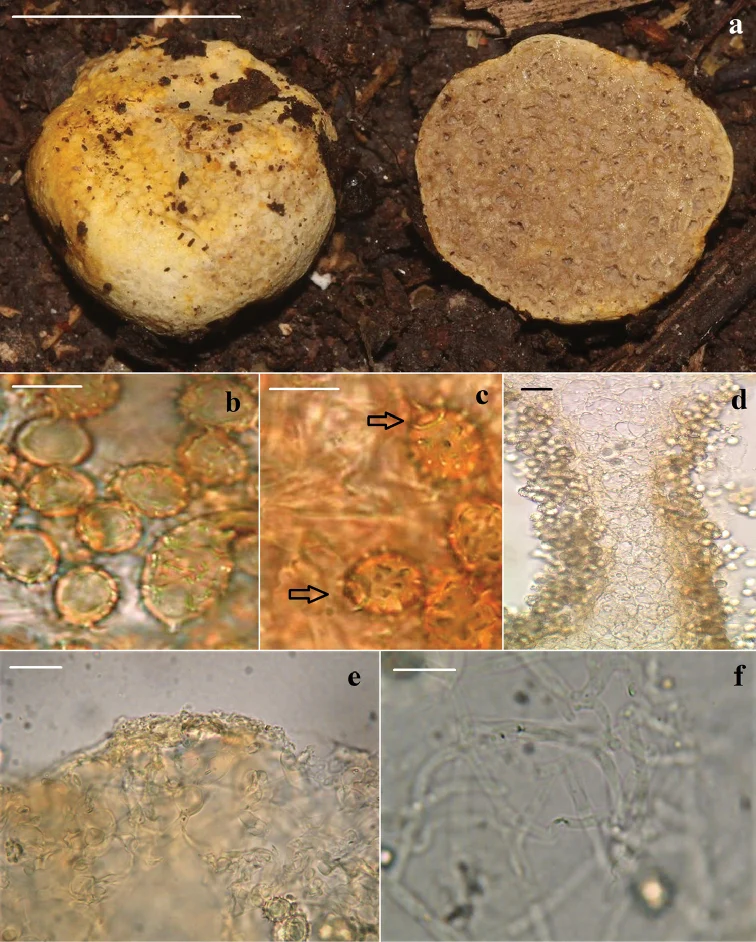
Stephanospora mayana can be distinguished by the yellowish net-like pileus, the variable spore size (8.0–17.0 × 6.0–11.0 µm), thin pileus (21.0–40.0 µm) and the ecological association to lowland forest and pine savanna with H. campechianum, G. floribundum, C. diversifolia, M. brownei, and P. caribaea. Basidiomata hypogeous to subhypogeous, scattered, 3.0–15 × 2.0–6.0 mm, globose to subglobose, without rizomorphs or stipe. Pileus yellowish to slightly orange (5A6-30A3-6), bruising pale orange when touched, wet to dry, sometimes net-like, dehiscent, showing locules inside. Hymenophore brittle, grayish (5C4), with empty rounded to angular locules, reaching 0.5 mm long, sometimes with white short and slender hyphae projecting from pileus to locules, trama sometimes orange (5A7-5B7), odour and taste strongly fruity. Pileus 21.0–40.0 µm thick, composed of loosely interwoven, slender to inflated hyphae, 1.7–4.2 µm in diameter, orange to pale orange-yellow in KOH, thin-walled. Hymenophoral trama irregular, 62.0–100.0 µm wide, composed of irregular, globose, isodiametric and compacted hyphae, 13.5–26.3 µm in diameter, hyaline to slightly yellowish in KOH, thin-walled. Basidia 24.2–30.5 × 9.5–11.1 µm, clavate to subclavate, hyaline in KOH, guttulate, 2-spored, with long sterigmata, reaching 7 µm long, thin-walled, collapsing after basidiospore development. Basidiospores (8.0–) 10.0–16.0 (–17.0) × (6.0–) 8.5–10.5 (–11.0) µm (L = 12.10, W = 9.31, Q = 1.30, N = 90) ellipsoid to subglobose, with truncate to acute spines projecting 2.0 µm long, forming ridges reaching 3.5 µm high, sometimes coalescing, with a complete to partial corona 4.0–6.0 × 1.0–2.5 µm long, sometimes with 2–4 projecting spines, 1.5 µm long, with hilar appendage conspicuous, reaching 3 µm long, bright yellowish in KOH, orange in Meltzer reagent, with greenish to yellowish cell wall, 1.5–2.0 µm thick.

Sebagian uraian ditampilkan dalam bahasa sumber; terjemahannya belum tersedia atau belum lolos pemeriksaan.

Rujukan: [1]

Pengukuran mengikuti objek, spesimen atau kultur, dan metode yang disebutkan sumber. Baca uraian asli untuk konteks lengkap.

02 / Kehidupan

Habitat dan peran ekologis

Known from the Mexican states of Campeche and Quintana Roo where it is associated to lowland forest and pine savanna under G. floribundum, H. campechianum, M. brownei, and P. caribaea.

Sebagian uraian ditampilkan dalam bahasa sumber; terjemahannya belum tersedia atau belum lolos pemeriksaan.

Rujukan: [1]

Habitat atau konteks temuan
hutan
Substrat
Informasi belum tersedia pada sumber rilis ini.
Peran atau konteks
Belum dikategorikan pada rilis ini.
Temukan hubungan serupa
03 / Siklus hidup

Reproduksi

Stephanospora mayana can be distinguished by the yellowish net-like pileus, the variable spore size (8.0–17.0 × 6.0–11.0 µm), thin pileus (21.0–40.0 µm) and the ecological association to lowland forest and pine savanna with H. campechianum, G. floribundum, C. diversifolia, M. brownei, and P. caribaea. Basidiomata hypogeous to subhypogeous, scattered, 3.0–15 × 2.0–6.0 mm, globose to subglobose, without rizomorphs or stipe. Pileus yellowish to slightly orange (5A6-30A3-6), bruising pale orange when touched, wet to dry, sometimes net-like, dehiscent, showing locules inside. Hymenophore brittle, grayish (5C4), with empty rounded to angular locules, reaching 0.5 mm long, sometimes with white short and slender hyphae projecting from pileus to locules, trama sometimes orange (5A7-5B7), odour and taste strongly fruity.

Sebagian uraian ditampilkan dalam bahasa sumber; terjemahannya belum tersedia atau belum lolos pemeriksaan.

Rujukan: [1]

04 / Batas informasi

Catatan identitas dan cakupan

  • Nama diterima mengikuti Catalogue of Life Base2026-09-11; uraian mempertahankan konsep dan nama sumber aslinya.
  • Preserve original treatment localities, hosts and substrate scope. Materials examined describe documented specimens, not the full global range.
  • Impor dan terjemahan otomatis belum diperiksa editorial per profil. Struktur reproduktif yang disebutkan tidak membuktikan seluruh siklus hidup diketahui.
  • Pengukuran pada uraian mengikuti spesimen, kultur, dan metode sumber; angka tidak diperluas ke semua populasi.

Catatan distribusi dalam narasi mengikuti sumbernya. Dokumentasi spesimen atau foto mengikuti catatan sumber. Bukti wilayah Indonesia dan penilaian konservasi tidak disimpulkan dari gambar.

05 / Dokumentasi

Melihat dengan konteks

Stephanospora mayana (JF-397-ITCV-HOLOTYPE). a Basidiomata showing the pileus and hymenophore b basidiospores c corona d hymenophoral trama e pileus hyphae f hyphae from the locules. Scale bars: 10 mm (a); = 10 µm (b, c, e, f); 40 µm (d).

Jenis
Pelat ilmiah
Kredit
Javier Isaac de la Fuente, Gonzalo Guevara-Guerrero, Iván Oros-Ortega, Romeo Sánchez-Zavalegui, Iván Córdova-Lara, Jesús García-Jiménez
Lisensi
CC BY 4.0
Sumber media
Buka entri sumber

Gambar menunjukkan objek menurut identifikasi sumber, bukan verifikasi independen spesimen oleh Fungi. Tidak ada skala baru yang ditambahkan.

06 / Rujukan

Sumber profil

  1. [1] Stephanospora mayana (Stephanosporaceae, Russulales), a new sequestrate fungus from Yucatán Peninsula, Mexico — Stephanospora mayanaBagian sumber: PMC6420478_section_7
    Tanggal penghimpunan sumber: 2026-10-12
    Teks sumber: CC BY 4.0 · de la Fuente JI, Guevara-Guerrero G, Ros-Ortega I, Romeo Sánchez-Zavalegui, Órdova-Lara I, Arcía-Jiménez J.
  2. [2] Catalogue of Life Base2026-09-11 — Stephanospora mayanaBagian sumber: ColDP NameUsage.tsv ID 52CPH; accepted species; source 2073
    Tanggal penghimpunan sumber: 2026-10-12
  3. [3] Dokumentasi visual — Stephanospora mayanaBagian sumber: Identitas mengikuti sumber dokumentasi; bukan penentuan spesimen independen.
    Tanggal penghimpunan sumber: 2026-10-17
    Media sumber: CC BY 4.0 · Javier Isaac de la Fuente, Gonzalo Guevara-Guerrero, Iván Oros-Ortega, Romeo Sánchez-Zavalegui, Iván Córdova-Lara, Jesús García-Jiménez

Adaptasi teks: CC BY 4.0. de la Fuente JI, Guevara-Guerrero G, Ros-Ortega I, Romeo Sánchez-Zavalegui, Órdova-Lara I, Arcía-Jiménez J. — Stephanospora mayana (Stephanosporaceae, Russulales), a new sequestrate fungus from Yucatán Peninsula, Mexico — Stephanospora mayana

Uraian asli dan riwayat sumber

Riwayat atau halaman sumber

Ringkasan sumber

Stephanospora mayana can be distinguished by the yellowish net-like pileus, the variable spore size (8.0–17.0 × 6.0–11.0 µm), thin pileus (21.0–40.0 µm) and the ecological association to lowland forest and pine savanna with H. campechianum, G. floribundum, C. diversifolia, M. brownei, and P. caribaea. Basidiomata hypogeous to subhypogeous, scattered, 3.0–15 × 2.0–6.0 mm, globose to subglobose, without rizomorphs or stipe. Pileus yellowish to slightly orange (5A6-30A3-6), bruising pale orange when touched, wet to dry, sometimes net-like, dehiscent, showing locules inside.

Revisi sumber

Morfologi sumber

Stephanospora mayana can be distinguished by the yellowish net-like pileus, the variable spore size (8.0–17.0 × 6.0–11.0 µm), thin pileus (21.0–40.0 µm) and the ecological association to lowland forest and pine savanna with H. campechianum, G. floribundum, C. diversifolia, M. brownei, and P. caribaea. Basidiomata hypogeous to subhypogeous, scattered, 3.0–15 × 2.0–6.0 mm, globose to subglobose, without rizomorphs or stipe. Pileus yellowish to slightly orange (5A6-30A3-6), bruising pale orange when touched, wet to dry, sometimes net-like, dehiscent, showing locules inside. Hymenophore brittle, grayish (5C4), with empty rounded to angular locules, reaching 0.5 mm long, sometimes with white short and slender hyphae projecting from pileus to locules, trama sometimes orange (5A7-5B7), odour and taste strongly fruity. Pileus 21.0–40.0 µm thick, composed of loosely interwoven, slender to inflated hyphae, 1.7–4.2 µm in diameter, orange to pale orange-yellow in KOH, thin-walled. Hymenophoral trama irregular, 62.0–100.0 µm wide, composed of irregular, globose, isodiametric and compacted hyphae, 13.5–26.3 µm in diameter, hyaline to slightly yellowish in KOH, thin-walled. Basidia 24.2–30.5 × 9.5–11.1 µm, clavate to subclavate, hyaline in KOH, guttulate, 2-spored, with long sterigmata, reaching 7 µm long, thin-walled, collapsing after basidiospore development. Basidiospores (8.0–) 10.0–16.0 (–17.0) × (6.0–) 8.5–10.5 (–11.0) µm (L = 12.10, W = 9.31, Q = 1.30, N = 90) ellipsoid to subglobose, with truncate to acute spines projecting 2.0 µm long, forming ridges reaching 3.5 µm high, sometimes coalescing, with a complete to partial corona 4.0–6.0 × 1.0–2.5 µm long, sometimes with 2–4 projecting spines, 1.5 µm long, with hilar appendage conspicuous, reaching 3 µm long, bright yellowish in KOH, orange in Meltzer reagent, with greenish to yellowish cell wall, 1.5–2.0 µm thick.

Revisi sumber

Ekologi sumber

Known from the Mexican states of Campeche and Quintana Roo where it is associated to lowland forest and pine savanna under G. floribundum, H. campechianum, M. brownei, and P. caribaea.

Revisi sumber

Struktur reproduksi sumber

Stephanospora mayana can be distinguished by the yellowish net-like pileus, the variable spore size (8.0–17.0 × 6.0–11.0 µm), thin pileus (21.0–40.0 µm) and the ecological association to lowland forest and pine savanna with H. campechianum, G. floribundum, C. diversifolia, M. brownei, and P. caribaea. Basidiomata hypogeous to subhypogeous, scattered, 3.0–15 × 2.0–6.0 mm, globose to subglobose, without rizomorphs or stipe. Pileus yellowish to slightly orange (5A6-30A3-6), bruising pale orange when touched, wet to dry, sometimes net-like, dehiscent, showing locules inside. Hymenophore brittle, grayish (5C4), with empty rounded to angular locules, reaching 0.5 mm long, sometimes with white short and slender hyphae projecting from pileus to locules, trama sometimes orange (5A7-5B7), odour and taste strongly fruity.

Revisi sumber

Rujukan halaman ini

Fungi. Stephanospora mayana. Rilis data fungi-2026-10-12-expansion-2. https://fungi-atlas.mgadib.chatgpt.site/jamur/stephanospora-mayana/.

Status: impor sumber; pemeriksaan editorial per profil belum selesai. Untuk klaim biologis, gunakan rujukan pada bagian terkait dan periksa konteks sumber aslinya.
