Ciri dan struktur
Saprobic on mangrove palm Nypa fruticans. Sexual morph: Stromata in vertical section 240–380 µm high, 195–385 µm diameter, (x̄ = 318.2 × 289.0 µm, n = 15), black, scattered, gregarious, immersed beneath host epidermis, and erumpent to superficial, with a papilla or short to long neck up to 550 µm, subglobose or conical, uni-loculate or bi-loculate, coriaceous to carbonaceous, ostiolate, periphysate, papillate and clypeate, glabrous or somewhat interwoven pale brown hyphae or with setae, lying at apex of the neck. Peridium 9–16 µm thin, composed of several pale brown to hyaline angular cells, compressed and pallid inwardly. Wall of the clypeus composed of brown cells of textura epidermoidea and dark brown host tissue. Wall of the neck with thicker and elongated angular cells. Hamathecium 1–2 µm wide, trabeculate pseudoparaphyses, septate, branched, filamentous, anastomosing, embedded in a gelatinous matrix. Asci 64–145 × 8–17 µm, (x̄= 106.3 × 13.8 µm, n = 30), 8-spored, bitunicate, fissitunicate, cylindric-clavate, pedicellate, apically rounded, with an ocular chamber. Ascospores 18–26 × 4–6 µm, (x̄ = 22.2 × 5.3 µm, n = 50), hyaline to brown, uniseriate to biseriate or triseriate, fusiform, 1–3-septate, constricted at the central septum, the upper middle cell slightly swollen towards the central septum, straight or slightly curved, striate, guttulate, end cells slightly paler, surrounded by a mucilaginous sheath. Asexual morph: Undetermined. Colonies on PDA attaining 15 mm diam. within 21 days at 25 °C under natural light, velvety, centrally raised, greenish grey or greyish olivaceous, reverse dull green or grey olivaceous, with a margin of translucent, milky white to hyaline mycelia.
Habitat dan peran ekologis
Saprobic on mangrove palm Nypa fruticans. Sexual morph: Stromata in vertical section 240–380 µm high, 195–385 µm diameter, (x̄ = 318.2 × 289.0 µm, n = 15), black, scattered, gregarious, immersed beneath host epidermis, and erumpent to superficial, with a papilla or short to long neck up to 550 µm, subglobose or conical, uni-loculate or bi-loculate, coriaceous to carbonaceous, ostiolate, periphysate, papillate and clypeate, glabrous or somewhat interwoven pale brown hyphae or with setae, lying at apex of the neck. Peridium 9–16 µm thin, composed of several pale brown to hyaline angular cells, compressed and pallid inwardly. Wall of the clypeus composed of brown cells of textura epidermoidea and dark brown host tissue. Wall of the neck with thicker and elongated angular cells. Hamathecium 1–2 µm wide, trabeculate pseudoparaphyses, septate, branched, filamentous, anastomosing, embedded in a gelatinous matrix. Asci 64–145 × 8–17 µm, (x̄= 106.3 × 13.8 µm, n = 30), 8-spored, bitunicate, fissitunicate, cylindric-clavate, pedicellate, apically rounded, with an ocular chamber. Ascospores 18–26 × 4–6 µm, (x̄ = 22.2 × 5.3 µm, n = 50), hyaline to brown, uniseriate to biseriate or triseriate, fusiform, 1–3-septate, constricted at the central septum, the upper middle cell slightly swollen towards the central septum, straight or slightly curved, striate, guttulate, end cells slightly paler, surrounded by a mucilaginous sheath.
- Habitat atau konteks temuan
- Informasi belum tersedia pada sumber rilis ini.
- Substrat
- Informasi belum tersedia pada sumber rilis ini.
- Peran atau konteks
- Pengurai
Reproduksi
Saprobic on mangrove palm Nypa fruticans. Sexual morph: Stromata in vertical section 240–380 µm high, 195–385 µm diameter, (x̄ = 318.2 × 289.0 µm, n = 15), black, scattered, gregarious, immersed beneath host epidermis, and erumpent to superficial, with a papilla or short to long neck up to 550 µm, subglobose or conical, uni-loculate or bi-loculate, coriaceous to carbonaceous, ostiolate, periphysate, papillate and clypeate, glabrous or somewhat interwoven pale brown hyphae or with setae, lying at apex of the neck. Peridium 9–16 µm thin, composed of several pale brown to hyaline angular cells, compressed and pallid inwardly. Wall of the clypeus composed of brown cells of textura epidermoidea and dark brown host tissue.
Catatan identitas dan cakupan
- Nama diterima mengikuti Catalogue of Life Base2026-09-11; uraian mempertahankan konsep dan nama sumber aslinya.
- Preserve original treatment localities, hosts and substrate scope. Materials examined describe documented specimens, not the full global range.
- Impor dan terjemahan otomatis belum diperiksa editorial per profil. Struktur reproduktif yang disebutkan tidak membuktikan seluruh siklus hidup diketahui.
- Pengukuran pada uraian mengikuti spesimen, kultur, dan metode sumber; angka tidak diperluas ke semua populasi.
Catatan distribusi dalam narasi mengikuti sumbernya. Dokumentasi spesimen atau foto mengikuti catatan sumber. Bukti wilayah Indonesia dan penilaian konservasi tidak disimpulkan dari gambar.
Melihat dengan konteks
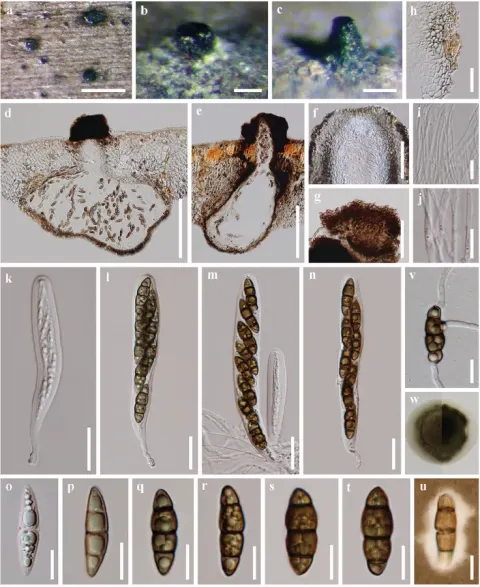
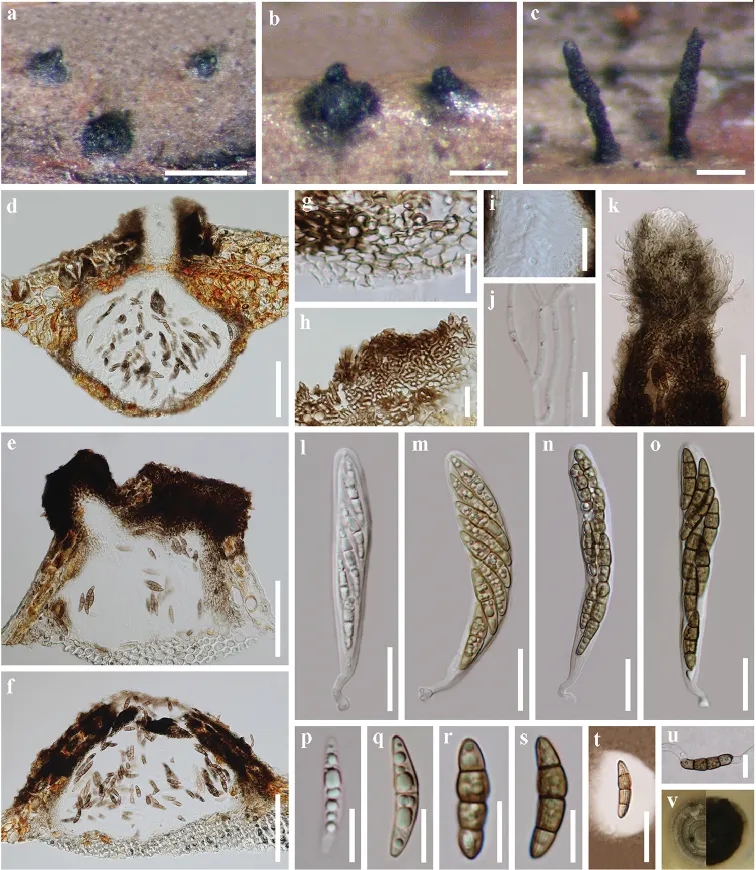
Striatiguttula nypae (holotype MFLU 18–1576, paratype MFLU 18–1578). a–c Appearance of stromata on host surface d–f vertical section through a stroma g structure of peridium h structure of clypeus near the ostiole, composed of epidermoidea cells and host tissue i ostiole with periphyses j pseudoparaphyses k apex of the neck, with somewhat interwoven pale brown hyphae or setae l–o ascus p–s ascospores t ascospore in India ink and presenting a clear mucilaginous sheath u germinating ascospore v colony on PDA. Scale bars: 500 μm (a), 200 μm (b, c), 100 μm (d–f), 10 μm (g, p–s, u), 20 μm (h, i, l–o, t), 50 μm (k).
- Jenis
- Pelat ilmiah
- Kredit
- Sheng-Nan Zhang, Kevin D. Hyde, E.B. Gareth Jones, Rajesh Jeewon, Ratchadawan Cheewangkoon, Jian-Kui Liu
- Lisensi
- CC BY 4.0
- Sumber media
- Buka entri sumber
Sumber profil
- [1] Striatiguttulaceae, a new pleosporalean family to accommodate Longicorpus and Striatiguttula gen. nov. from palms — Striatiguttula nypae
- [2] Catalogue of Life Base2026-09-11 — Striatiguttula nypae
- [3] Dokumentasi visual — Striatiguttula nypae
Rujukan halaman ini
Fungi. Striatiguttula nypae. Rilis data fungi-2026-10-12-expansion-2. https://fungi-atlas.mgadib.chatgpt.site/jamur/striatiguttula-nypae/.
Status: impor sumber; pemeriksaan editorial per profil belum selesai. Untuk klaim biologis, gunakan rujukan pada bagian terkait dan periksa konteks sumber aslinya.