01 / Morfologi

Ciri dan struktur

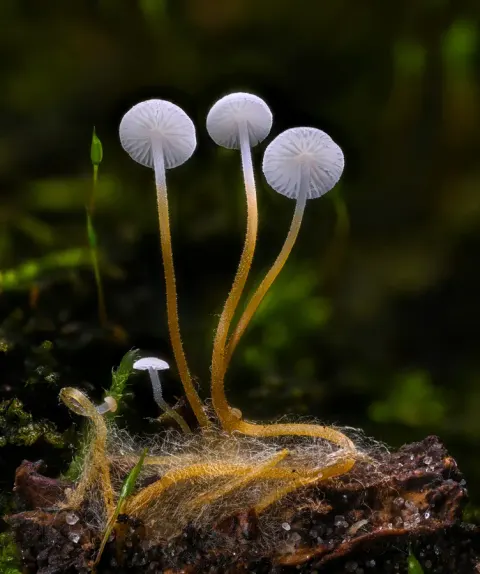
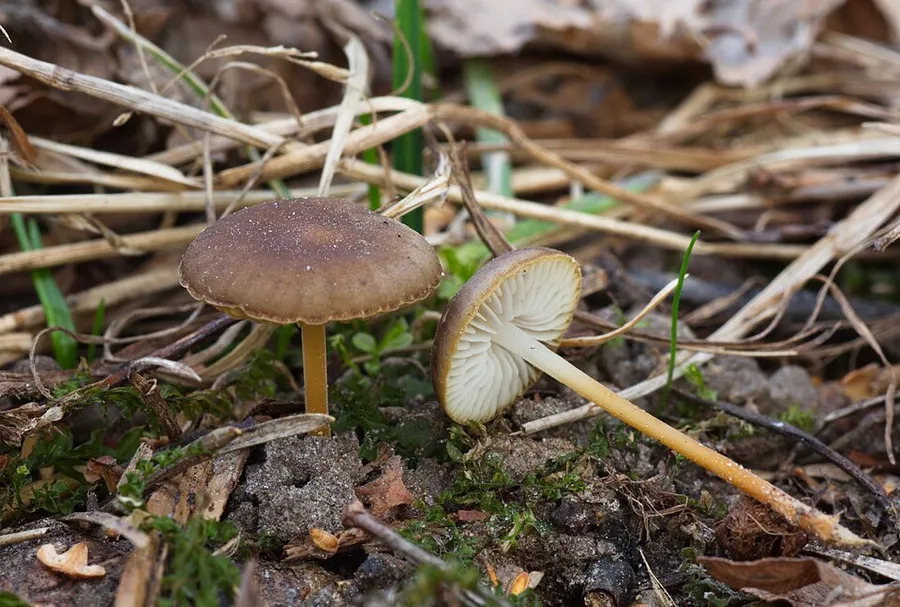
The cap is initially convex before flattening out, sometimes retaining a small central papilla, and sometimes developing a central depression; the cap diameter reaches 5 – 15 mm. The smooth cap is hygrophanous (i.e., it changes colour as it loses or absorbs moisture), and has shallow radial grooves extending about halfway up the cap. Its colour is reddish to brownish, and is often paler in the center than the margin; when dry, the colour fades to greyish. The greyish-white gills have a free to deeply emarginate (notched) attachment to the cap. They are somewhat crowded together, numbering 20–25 gills with 1 to 7 tiers of interspersed lamellulae (short gills that do not extend fully from the cap margin to the stipe). The cylindrical stipe measures 4 – 7.5 cm long by 0.5–2 mm thick, and has at its base a root-like pseudorrhiza that extends into the substrate. The upper stipe is yellowish brown, while lower it is dark orange-brown to reddish brown. The flesh has no odour and usually has a bitter taste. While the fruit bodies are sometimes described as are edible, they are too small to be of culinary interest. The spore print is white. Spores are roughly elliptical to tear-shaped, with dimensions of 5.0–7.5 by 2.4–4.0 μm. The basidia (spore-bearing cells) are four-spored, and measure 20–40 by 7–11 μm. Cheilocystidia (cystidia on the gill edge) are thin walled, plentiful, spindle-shaped to somewhat flask-shaped with a sharp tip, and measure 30–70 by 3–10 μm. The pleurocystidia (on the gill face) are similar in shape and size to the cheilocystidia, although usually not quite as numerous.

Sebagian uraian ditampilkan dalam bahasa sumber; terjemahannya belum tersedia atau belum lolos pemeriksaan.

Rujukan: [1]

Pengukuran mengikuti objek, spesimen atau kultur, dan metode yang disebutkan sumber. Baca uraian asli untuk konteks lengkap.

02 / Kehidupan

Habitat dan peran ekologis

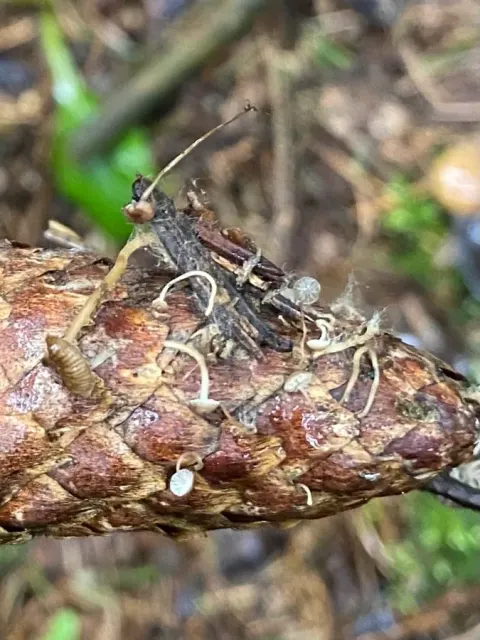
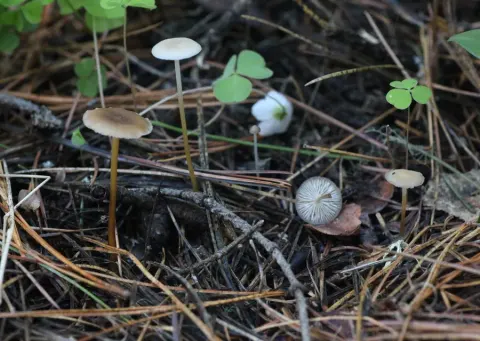
Strobilurus tenacellus is a saprobic wood-rotting fungus. It fruits singly or in small groups on fallen and often partially buried cones of Scots pine (Pinus sylvestris), European black pine (Pinus nigra) and sometimes spruce (Picea) in coniferous and mixed forests. It is found in Europe and Asia, where it has been recorded in Japan and Jordan. In Europe, the fungus usually fruits from March to June. Its occurrence is occasional.

Sebagian uraian ditampilkan dalam bahasa sumber; terjemahannya belum tersedia atau belum lolos pemeriksaan.

Rujukan: [1]

Habitat atau konteks temuan
hutan
Substrat
Informasi belum tersedia pada sumber rilis ini.
Peran atau konteks
Pengurai
Temukan hubungan serupa
03 / Siklus hidup

Reproduksi

The spore print is white. Spores are roughly elliptical to tear-shaped, with dimensions of 5.0–7.5 by 2.4–4.0 μm. The basidia (spore-bearing cells) are four-spored, and measure 20–40 by 7–11 μm. Cheilocystidia (cystidia on the gill edge) are thin walled, plentiful, spindle-shaped to somewhat flask-shaped with a sharp tip, and measure 30–70 by 3–10 μm. The pleurocystidia (on the gill face) are similar in shape and size to the cheilocystidia, although usually not quite as numerous. The cap cuticle is made of a hymeniderm of club-shaped to somewhat spherical cells measuring 8–25 by 7–20 μm, mixed with flask-shaped pileocystidia (cystidia on the cap) that are 20–45 by 5–11 μm. Hyphae lack clamp connections.

Sebagian uraian ditampilkan dalam bahasa sumber; terjemahannya belum tersedia atau belum lolos pemeriksaan.

Rujukan: [1]

Sinonim menurut acuan taksonomi rilis: Agaricus stolonifer; Agaricus tenacellus; Agaricus tenacellus var. eumeces; Collybia conigena var. tenacella; Collybia esculenta var. stolonifera; Collybia esculenta var. tenacella; Collybia stolonifera; Collybia tenacella; Collybia tenacella var. stolonifera; Marasmius esculentus var. tenacellus; Marasmius tenacellus; Pseudohiatula esculenta subsp. tenacella; Pseudohiatula tenacella; Strobilurus tenacellus f. lacteus
04 / Batas informasi

Catatan identitas dan cakupan

  • Nama diterima mengikuti Catalogue of Life Base2026-09-11; uraian mempertahankan konsep dan nama sumber aslinya.
  • Original geographic, specimen and life-cycle scope retained; source import awaits individual editorial review.
  • Impor dan terjemahan otomatis belum diperiksa editorial per profil. Struktur reproduktif yang disebutkan tidak membuktikan seluruh siklus hidup diketahui.
  • Pengukuran pada uraian mengikuti spesimen, kultur, dan metode sumber; angka tidak diperluas ke semua populasi.

Catatan distribusi dalam narasi mengikuti sumbernya. Dokumentasi spesimen atau foto mengikuti catatan sumber. Bukti wilayah Indonesia dan penilaian konservasi tidak disimpulkan dari gambar.

05 / Dokumentasi

Melihat dengan konteks

Dokumentasi Strobilurus tenacellus dari Wikimedia Commons. Strobilurus tenacellus (Pers.) Singer Identifikasi mengikuti record berkas sumber.

Jenis
Fotografi
Kredit
This image was created by user Tatiana Bulyonkova (ressaure) at Mushroom Observer , a source for mycological images. You can contact this user here .
Sumber media
Buka entri sumber

Gambar menunjukkan objek menurut identifikasi sumber, bukan verifikasi independen spesimen oleh Fungi. Tidak ada skala baru yang ditambahkan.

06 / Rujukan

Sumber profil

  1. [1] Strobilurus tenacellus — Wikipedia (en)Bagian sumber: Frozen revision 1329855754
    Tanggal penghimpunan sumber: 2026-10-12
    Teks sumber: CC BY-SA4.0 · Wikipedia contributors
  2. [2] Catalogue of Life Base2026-09-11 — Strobilurus tenacellusBagian sumber: ColDP NameUsage.tsv ID 533GD; accepted species; source 2073
    Tanggal penghimpunan sumber: 2026-10-12
  3. [3] Dokumentasi visual — Strobilurus tenacellusBagian sumber: Individual media record; identification follows the source, not independent determination
    Tanggal penghimpunan sumber: 2026-10-12
    Media sumber: CC BY-SA 3.0 · This image was created by user Tatiana Bulyonkova (ressaure) at Mushroom Observer , a source for mycological images. You can contact this user here .

Adaptasi teks: CC BY-SA 4.0. Wikipedia contributors — Strobilurus tenacellus — Wikipedia (en)

Uraian asli dan riwayat sumber

Riwayat atau halaman sumber

Ringkasan sumber

Strobilurus tenacellus, commonly known as the pinecone cap, is a species of agaric fungus in the family Physalacriaceae. It is found throughout Asia and Europe, where it grows on the fallen cones of pine and spruce trees. The fruit bodies (mushrooms) are small, with convex to flat, reddish to brownish caps up to 15 mm in diameter, set atop thin cylindrical stems up to 4 – 7.5 cm long with a rooting base. A characteristic microscopic feature of the mushroom is the sharp, thin-walled cystidia found on the stipe, gills, and cap.

Revisi sumber

Morfologi sumber

The cap is initially convex before flattening out, sometimes retaining a small central papilla, and sometimes developing a central depression; the cap diameter reaches 5 – 15 mm. The smooth cap is hygrophanous (i.e., it changes colour as it loses or absorbs moisture), and has shallow radial grooves extending about halfway up the cap. Its colour is reddish to brownish, and is often paler in the center than the margin; when dry, the colour fades to greyish. The greyish-white gills have a free to deeply emarginate (notched) attachment to the cap. They are somewhat crowded together, numbering 20–25 gills with 1 to 7 tiers of interspersed lamellulae (short gills that do not extend fully from the cap margin to the stipe). The cylindrical stipe measures 4 – 7.5 cm long by 0.5–2 mm thick, and has at its base a root-like pseudorrhiza that extends into the substrate. The upper stipe is yellowish brown, while lower it is dark orange-brown to reddish brown. The flesh has no odour and usually has a bitter taste. While the fruit bodies are sometimes described as are edible, they are too small to be of culinary interest. The spore print is white. Spores are roughly elliptical to tear-shaped, with dimensions of 5.0–7.5 by 2.4–4.0 μm. The basidia (spore-bearing cells) are four-spored, and measure 20–40 by 7–11 μm. Cheilocystidia (cystidia on the gill edge) are thin walled, plentiful, spindle-shaped to somewhat flask-shaped with a sharp tip, and measure 30–70 by 3–10 μm. The pleurocystidia (on the gill face) are similar in shape and size to the cheilocystidia, although usually not quite as numerous.

Revisi sumber

Ekologi sumber

Strobilurus tenacellus is a saprobic wood-rotting fungus. It fruits singly or in small groups on fallen and often partially buried cones of Scots pine (Pinus sylvestris), European black pine (Pinus nigra) and sometimes spruce (Picea) in coniferous and mixed forests. It is found in Europe and Asia, where it has been recorded in Japan and Jordan. In Europe, the fungus usually fruits from March to June. Its occurrence is occasional.

Revisi sumber

Struktur reproduksi sumber

The spore print is white. Spores are roughly elliptical to tear-shaped, with dimensions of 5.0–7.5 by 2.4–4.0 μm. The basidia (spore-bearing cells) are four-spored, and measure 20–40 by 7–11 μm. Cheilocystidia (cystidia on the gill edge) are thin walled, plentiful, spindle-shaped to somewhat flask-shaped with a sharp tip, and measure 30–70 by 3–10 μm. The pleurocystidia (on the gill face) are similar in shape and size to the cheilocystidia, although usually not quite as numerous. The cap cuticle is made of a hymeniderm of club-shaped to somewhat spherical cells measuring 8–25 by 7–20 μm, mixed with flask-shaped pileocystidia (cystidia on the cap) that are 20–45 by 5–11 μm. Hyphae lack clamp connections.

Revisi sumber

Rujukan halaman ini

Fungi. Strobilurus tenacellus. Rilis data fungi-2026-10-12-expansion-2. https://fungi-atlas.mgadib.chatgpt.site/jamur/strobilurus-tenacellus/.

Status: impor sumber; pemeriksaan editorial per profil belum selesai. Untuk klaim biologis, gunakan rujukan pada bagian terkait dan periksa konteks sumber aslinya.