Ciri dan struktur
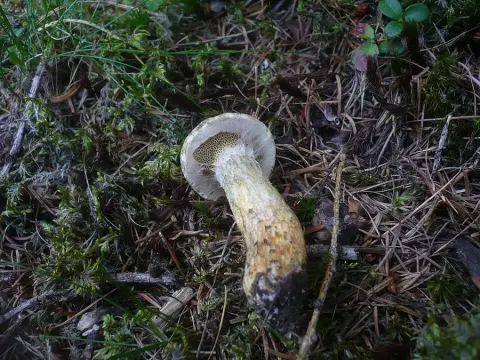
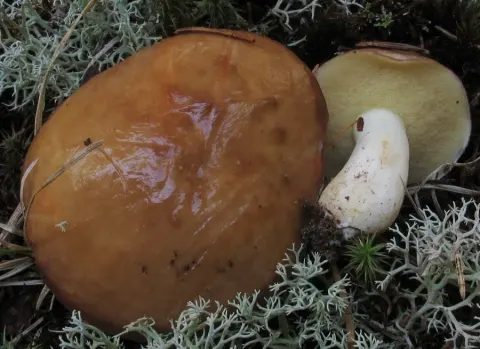
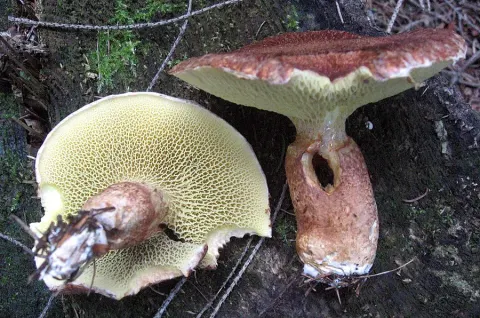
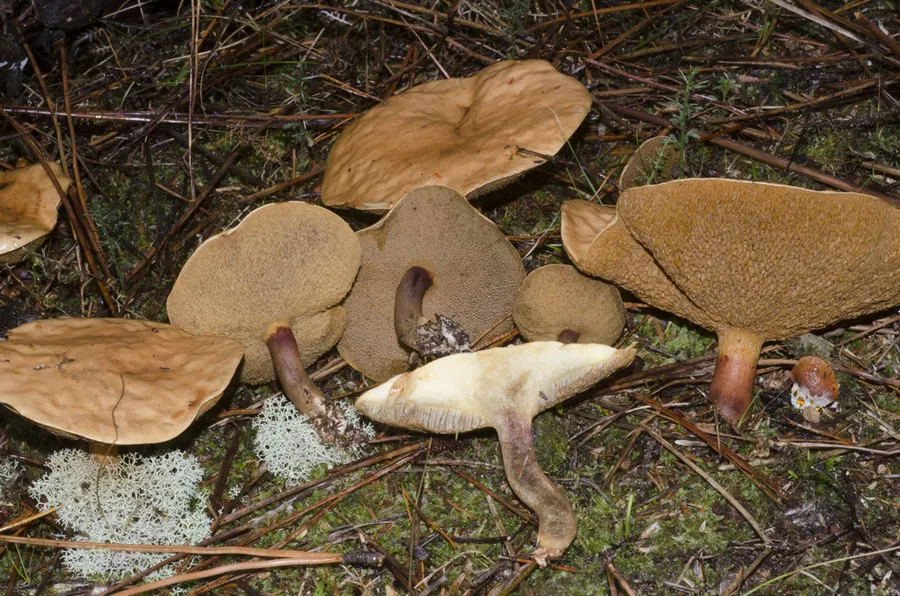
The fruit body—colloquially called a mushroom—of Suillus bovinus is a basidiocarp which is smaller and daintier than most other boletes. The cap is initially convex, then flat with a wavy margin and a grey-yellow or ochre with pink tinge in some specimens. It ranges from 3-10 cm in diameter and has a sticky skin. The flesh is whitish, yellowish or clay-coloured and has a fruity smell. Sometimes turning a pink tinge when bruised, the flesh is spongy and rubbery. Like other boletes, it has pores instead of gills that make up the hymenophore on the underside of the cap. Suillus bovinus has a characteristic compound pore layer, consisting of an outer layer of coarse, angular pores overlaying an inner layer of finer pores. The pores are grey- to olive-yellow and generally decurrent, comprising yellow to olive-yellow tubes that measure 0.3–1 cm long. The stipe is 4-6 cm tall, similar in colour to the cap, and tends to be narrower towards the base. With a diameter of 0.5–0.8 cm, it is more slender than those of other boletes. The spore print is an olive-brown colour. The oval to spindle-shaped spores have dimensions of 8–10 by 3.5–4.5 μm. Basidia (spore-bearing cells) are cylindrical to narrowly club-shaped, measuring 22.4–33.4 by 5.8–8.0 μm. They bear four sterigmata (each holding a single spore), which are up to 6.8 μm long. Cystidia are present on both the tube ends (cheilocystidia) and tube faces (pleurocystidia). There are no clamp connections in the hyphae of Suillus bovinus. The cap cuticle comprises filamentous, gelatinized hyphae with a diameter of 2.6–5.0 μm. The mycelium has a pink tinge.
Habitat dan peran ekologis
Suillus bovinus is found in conifer woods and plantations across Europe, including subalpine regions in the Alps, up to altitudes of 800 m (2500 ft). It is common in Lithuania, where it associates with Scots pine (Pinus sylvestris), the only naturally occurring pine in that country. Preferred soils of S. bovinus are often acidic, sand-based, or sometimes calcareous (chalky) and moraine. In Asia, it has been recorded in Taiwan, and in Japan, where it associates with Japanese red pine (Pinus densiflora). In China, it has been recorded from provinces Anhui, Fujian, Guangdong, Hunan, Jiangxi, and Zhejiang. Suillus bovinus has been introduced into other areas. In North America, where it is thought to have been introduced with Scots pine, it is found in the eastern United States, including North Carolina, Pennsylvania, Vermont, and the Adirondack Mountains of New York. It has been recorded infrequently under Scots pine in Australia, where it has been found as far north as southern Queensland, and in more southerly locations including New South Wales and Kuitpo Forest. It has been recorded in New Zealand. In South Africa, it grows with Pinus radiata. Suillus bovinus is mycorrhizal, forming symbiotic associations with living trees by enveloping the tree's underground roots with sheaths of fungal tissue.
- Habitat atau konteks temuan
- hutan
- Substrat
- Informasi belum tersedia pada sumber rilis ini.
- Peran atau konteks
- Mitra tumbuhan
Reproduksi
The fruit body—colloquially called a mushroom—of Suillus bovinus is a basidiocarp which is smaller and daintier than most other boletes. The cap is initially convex, then flat with a wavy margin and a grey-yellow or ochre with pink tinge in some specimens. It ranges from 3-10 cm in diameter and has a sticky skin. The flesh is whitish, yellowish or clay-coloured and has a fruity smell. Sometimes turning a pink tinge when bruised, the flesh is spongy and rubbery. Like other boletes, it has pores instead of gills that make up the hymenophore on the underside of the cap. Suillus bovinus has a characteristic compound pore layer, consisting of an outer layer of coarse, angular pores overlaying an inner layer of finer pores.
Catatan identitas dan cakupan
- Nama diterima mengikuti Catalogue of Life Base2026-09-11; uraian mempertahankan konsep dan nama sumber aslinya.
- Original geographic, specimen and life-cycle scope retained; source import awaits individual editorial review.
- Impor dan terjemahan otomatis belum diperiksa editorial per profil. Struktur reproduktif yang disebutkan tidak membuktikan seluruh siklus hidup diketahui.
- Pengukuran pada uraian mengikuti spesimen, kultur, dan metode sumber; angka tidak diperluas ke semua populasi.
Catatan distribusi dalam narasi mengikuti sumbernya. Dokumentasi spesimen atau foto mengikuti catatan sumber. Bukti wilayah Indonesia dan penilaian konservasi tidak disimpulkan dari gambar.
Melihat dengan konteks
Dokumentasi Suillus bovinus menurut asosiasi foto pada record takson iNaturalist. Kredit: Jerry Cooper. Identitas mengikuti sumber; bukan penentuan spesimen independen.
- Jenis
- Fotografi
- Kredit
- (c) Jerry Cooper, some rights reserved (CC BY), uploaded by Jerry Cooper
- Lisensi
- CC BY 4.0
- Sumber media
- Buka entri sumber
Dokumentasi tambahan
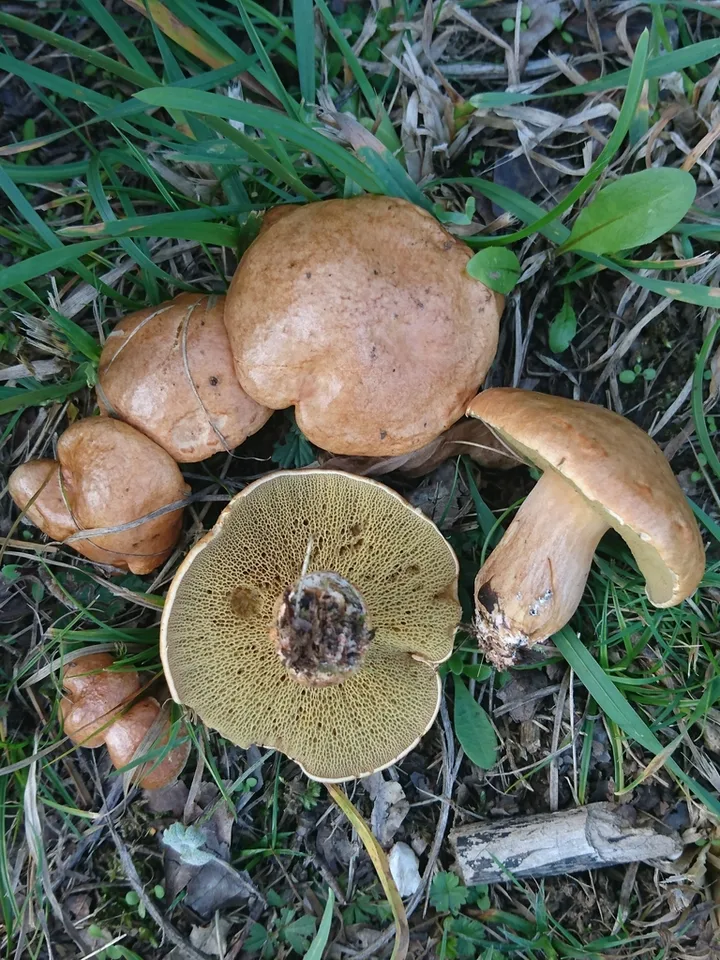
Foto yang diasosiasikan dengan Suillus bovinus pada iNaturalist. Identifikasi mengikuti sumber; bukan penentuan spesimen independen.
Kredit dan penggunaan
(c) Jose Castro, some rights reserved (CC BY), uploaded by Jose Castro
Ukuran dan format gambar disesuaikan tanpa pemotongan, retus, atau penambahan skala. Lisensi sumber dipertahankan.
Sumber profil
- [1] Suillus bovinus — Wikipedia (en)
- [2] Catalogue of Life Base2026-09-11 — Suillus bovinus
- [3] Dokumentasi visual — Suillus bovinus
- [4] Dokumentasi visual — Suillus bovinus
Rujukan halaman ini
Fungi. Suillus bovinus. Rilis data fungi-2026-10-12-expansion-2. https://fungi-atlas.mgadib.chatgpt.site/jamur/suillus-bovinus/.
Status: impor sumber; pemeriksaan editorial per profil belum selesai. Untuk klaim biologis, gunakan rujukan pada bagian terkait dan periksa konteks sumber aslinya.