Ciri dan struktur
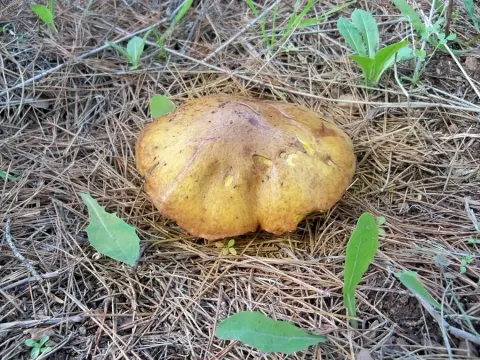
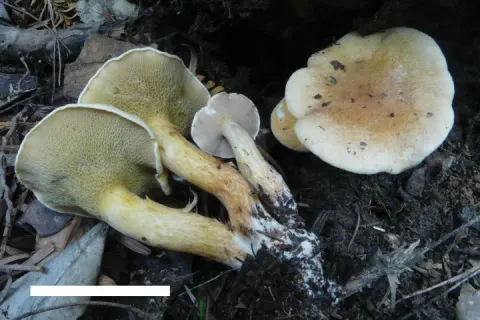
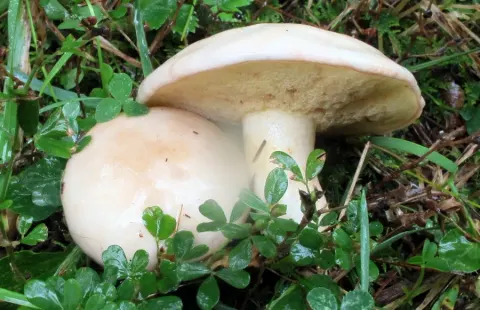
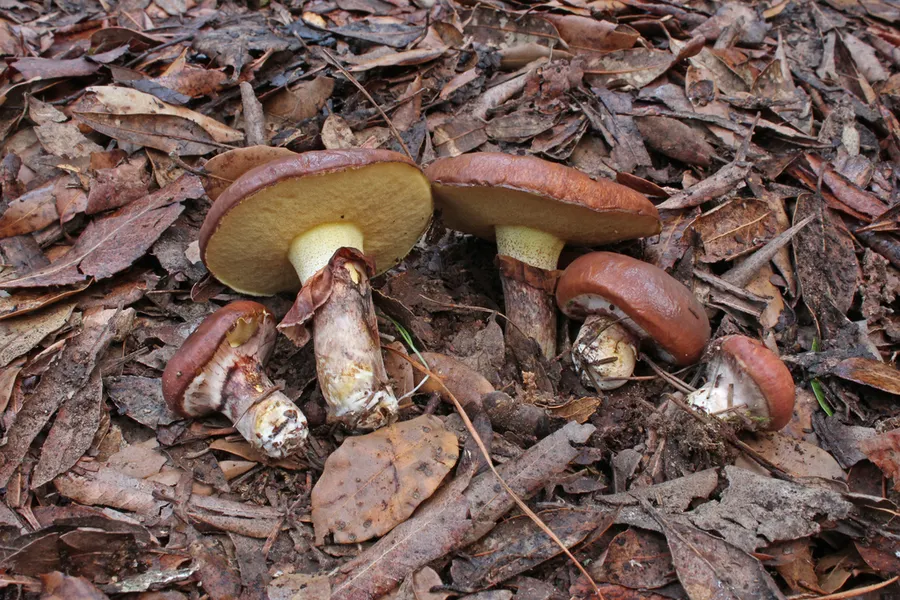
PILEUS: convex to plano-convex, 6-12 cm diam., mucilaginous, glabrous, sometimes faintly and innately radiately fibrillose, typically dull reddish brown or chocolate brown, occasionally golden brown, tawny, or with greyish or purplish overtones imparted by the thick mucilage layer; cuticle an ixotrichodermium, readily separable; margin often lacerate. HYMENOPHORE: tubes 5-10 mm long, adnate to sub-decurrent, whitish to pallid yellow when young, becoming deep ochre yellow at maturity; pores at first concolorous with tubes, becoming spotted dark reddish brown, irregularly angular, 0.5-(l) mm diam. STIPE: 4-9 cm long, more or less equal, 1-2.5 cm diam., solid, pallid yellow above annulus, brownish below; glandulae numerous apically, yellow to reddish brown, fewer and more scattered basally; flesh white to pallid yellow: annulus conspicuous, occasionally disintegrating with age, superior, broadly sheathing, upper surface sordid white, lower surface with purplish tints. SPORES: spore print yellowish brown, (Clay Color); spores pallid melleous, elliptic-subfusiform, 7.4-9-(10) X 2.5-3.2 µm, smooth. HYMENIUM: basidia hyaline, clavate, 14-26 X 4.5-7.5 µm, 4-spored; cystidia often crowded in groups, hyaline or encrusted with brown, resinous material, cylindrical to clavate, occasionally lageniform, 25-65 X 6-12 µm. HYMENOPHORAL TRAMA: bilateral, of the Boletus subtype; clamp connections absent. CONTEXT OF PILEUS: white to pallid yellow, unchanging on exposure to air. TASTE: mild. SMELL: not distinctive. CHEMICAL REACTIONS: KOH on pileus—dark grey; on context of pileus—immediate red flush turning lilac; NH4OH on pileus—dark grey; on context—immediate red flush turning deep lilac to purplish.
Habitat dan peran ekologis
Suillus luteus is an introduced species indigenous to the temperate zone of the northern hemisphere. Singer (1945b) considered that in its natural habitat, S. luteus was associated with 2-needle pines belonging to sect. Lariciones of the genus Pinus, but later (Singer, 1965) added Picea abies and possibly Larix decidua to the list of mycorrhizal partners. Smith and Thiers (1964) commented that Suillus luteus occurred with Pinus and Picea in North America and remarked that its distribution in native coniferous forests was yet to be ascertained. It seems likely that over its natural geographical range Suillus luteus shows a preference for certain species of 2-needle pines, but in New Zealand is capable of forming associations in the field with species of 2-, 3-, and 5-needle pines in the absence of its preferred partners. Experimental data support this conclusion, for in pure culture S. luteus has been shown to form mycorrhizas with a number of 2-, 3-, and 5-needle pines as well as Picea abies, Larix decidua, and L. occidentalis (Slipp and Snell, 1944). Birch (1937) has proved experimentally that Suillus luteus forms mycorrhizas with Pinus radiata in New Zealand. Suillus luteus is an excellent edible fungus.
- Habitat atau konteks temuan
- hutan; kultur yang didokumentasikan
- Substrat
- Informasi belum tersedia pada sumber rilis ini.
- Peran atau konteks
- Mitra tumbuhan
Reproduksi
PILEUS: convex to plano-convex, 6-12 cm diam., mucilaginous, glabrous, sometimes faintly and innately radiately fibrillose, typically dull reddish brown or chocolate brown, occasionally golden brown, tawny, or with greyish or purplish overtones imparted by the thick mucilage layer; cuticle an ixotrichodermium, readily separable; margin often lacerate. HYMENOPHORE: tubes 5-10 mm long, adnate to sub-decurrent, whitish to pallid yellow when young, becoming deep ochre yellow at maturity; pores at first concolorous with tubes, becoming spotted dark reddish brown, irregularly angular, 0.5-(l) mm diam. STIPE: 4-9 cm long, more or less equal, 1-2.5 cm diam., solid, pallid yellow above annulus, brownish below; glandulae numerous apically, yellow to reddish brown, fewer and more scattered basally; flesh white to pallid yellow: annulus conspicuous, occasionally disintegrating with age, superior, broadly sheathing, upper surface sordid white, lower surface with purplish tints.
Catatan identitas dan cakupan
- Nama diterima mengikuti Catalogue of Life Base2026-09-11; uraian mempertahankan konsep dan nama sumber aslinya.
- Historical description as cited by BiotaNZ. Preserve explicit New Zealand/locality, host and specimen qualifiers. Distribution is the cited source scope, not a current global range.
- Impor dan terjemahan otomatis belum diperiksa editorial per profil. Struktur reproduktif yang disebutkan tidak membuktikan seluruh siklus hidup diketahui.
- Pengukuran pada uraian mengikuti spesimen, kultur, dan metode sumber; angka tidak diperluas ke semua populasi.
Catatan distribusi dalam narasi mengikuti sumbernya. Dokumentasi spesimen atau foto mengikuti catatan sumber. Bukti wilayah Indonesia dan penilaian konservasi tidak disimpulkan dari gambar.
Melihat dengan konteks
Dokumentasi Suillus luteus menurut asosiasi foto pada record takson iNaturalist. Kredit: Davide Puddu. Identitas mengikuti sumber; bukan penentuan spesimen independen.
- Jenis
- Fotografi
- Kredit
- (c) Davide Puddu, some rights reserved (CC BY), uploaded by Davide Puddu
- Lisensi
- CC BY 4.0
- Sumber media
- Buka entri sumber
Dokumentasi tambahan
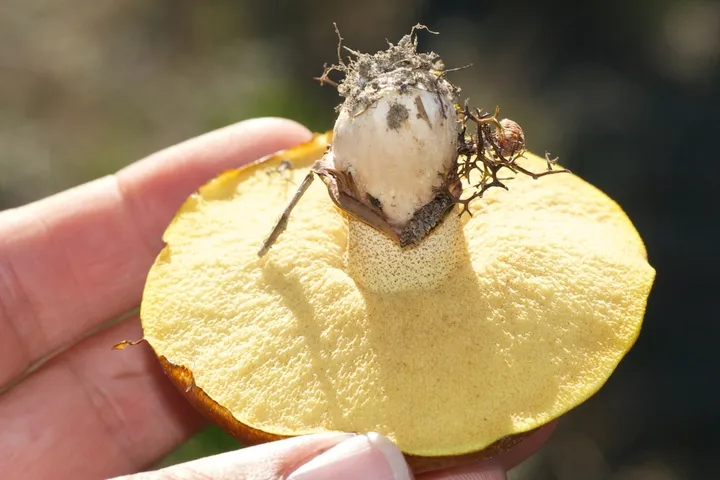
Foto yang diasosiasikan dengan Suillus luteus pada iNaturalist. Identifikasi mengikuti sumber; bukan penentuan spesimen independen.
Kredit dan penggunaan
(c) Jon Sullivan, some rights reserved (CC BY)
Ukuran dan format gambar disesuaikan tanpa pemotongan, retus, atau penambahan skala. Lisensi sumber dipertahankan.
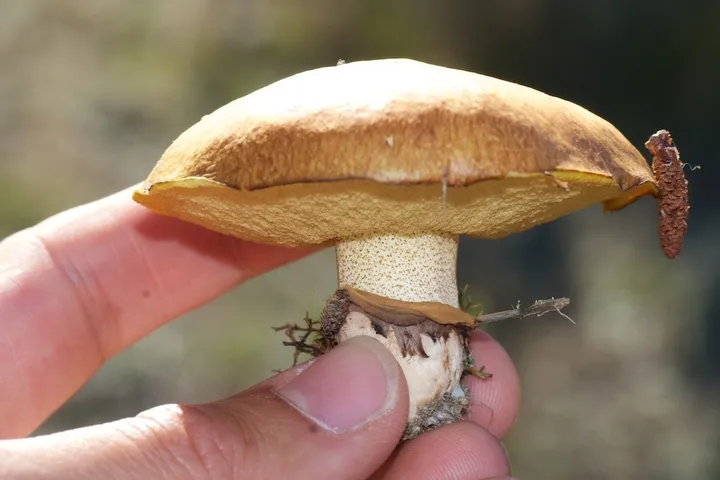
Foto yang diasosiasikan dengan Suillus luteus pada iNaturalist. Identifikasi mengikuti sumber; bukan penentuan spesimen independen.
Kredit dan penggunaan
(c) Jon Sullivan, some rights reserved (CC BY)
Ukuran dan format gambar disesuaikan tanpa pemotongan, retus, atau penambahan skala. Lisensi sumber dipertahankan.
Sumber profil
- [1] McNabb, R.F.R. 1968: The Boletaceae of New Zealand. New Zealand Journal of Botany 6(2): 137-176. — Suillus luteus
- [2] Catalogue of Life Base2026-09-11 — Suillus luteus
- [3] Dokumentasi visual — Suillus luteus
- [4] Dokumentasi visual — Suillus luteus
- [5] Dokumentasi visual — Suillus luteus
Rujukan halaman ini
Fungi. Suillus luteus. Rilis data fungi-2026-10-12-expansion-2. https://fungi-atlas.mgadib.chatgpt.site/jamur/suillus-luteus/.
Status: impor sumber; pemeriksaan editorial per profil belum selesai. Untuk klaim biologis, gunakan rujukan pada bagian terkait dan periksa konteks sumber aslinya.