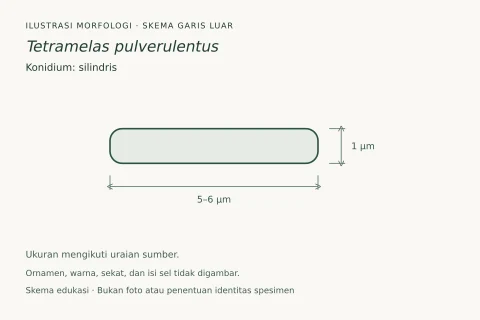
01 / Morfologi

Ciri dan struktur

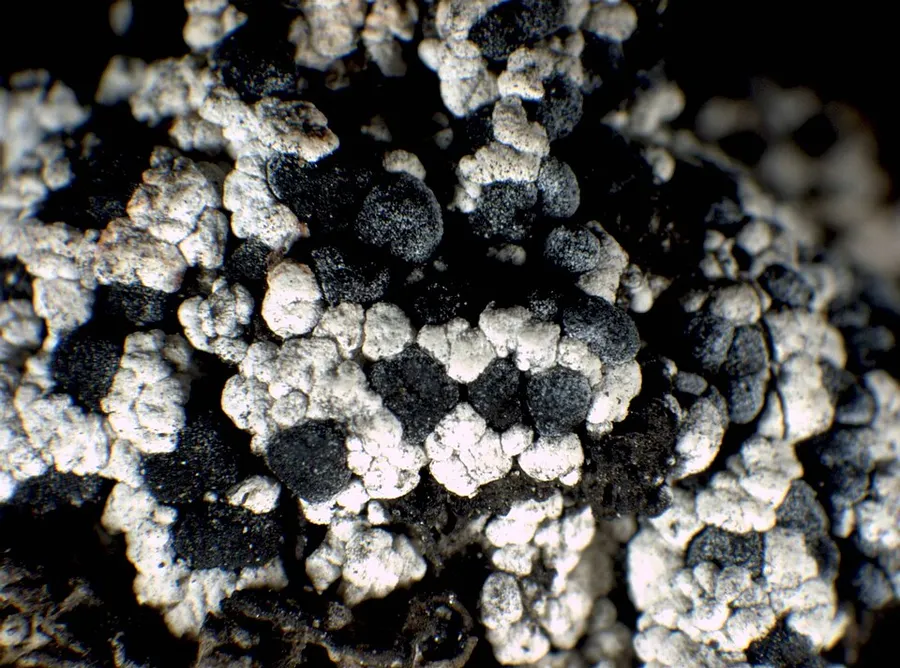
The thallus of Tetramelas papillatus is white to grey-white and breaks into low, rounded plates () that can become distinctly blistered (convex- to ). The fruiting bodies (apothecia) are small, up to about 1 mm across, and sit directly on the thallus (). They occur singly or may merge (discrete to confluent), are sometimes covered with a fine, frosty bloom (), and soon become strongly convex and lack a distinct rim (). When young they may show a rim formed by the thallus itself (a ). The apothecial wall () is dark-pigmented; the thin surface film () is brown; the spore-bearing layer (hymenium) shows no visible oil droplets; and the tissue beneath it () is brown. The ascospores are ellipsoid, with uniformly thickened, finely warted walls, measuring (15–)18–22(–25) × 7–10 μm. Asexual fruiting bodies (pycnidia) have not been observed to occur in this species. Standard spot tests on the thallus give C–, K+ (pale yellow), Pd–, and UV– reactions, consistent with the presence of atranorin.

Sebagian uraian ditampilkan dalam bahasa sumber; terjemahannya belum tersedia atau belum lolos pemeriksaan.

Rujukan: [1]

Pengukuran mengikuti objek, spesimen atau kultur, dan metode yang disebutkan sumber. Baca uraian asli untuk konteks lengkap.

02 / Kehidupan

Habitat dan peran ekologis

Tetramelas papillatus has a bipolar range, occurring in both polar regions with outliers on high mountains. In the Northern Hemisphere it is widespread in Arctic–alpine habitats, recorded from central and northern Europe (including Scandinavia), West Greenland, Novaya Zemlya, the East Caucasus, arctic Asia, and arctic and alpine North America. It also reaches high elevations in the Himalayas. In Nepal, it has been reported at 4,650 m elevation in a compilation of published records; this reported range lies above the tree line used in the study. In the Southern Hemisphere it is known from New Zealand and has scattered Antarctic records (James Ross Island off the north-east coast of Graham Land, and King George Island in the South Shetlands). There are no verified records from Australia or Chile. In Fennoscandia, T. papillatus is rare and confined to subalpine and alpine belts.

Sebagian uraian ditampilkan dalam bahasa sumber; terjemahannya belum tersedia atau belum lolos pemeriksaan.

Rujukan: [1]

Habitat atau konteks temuan
Informasi belum tersedia pada sumber rilis ini.
Substrat
Informasi belum tersedia pada sumber rilis ini.
Peran atau konteks
Pembentuk liken
Temukan hubungan serupa
03 / Siklus hidup

Reproduksi

The thallus of Tetramelas papillatus is white to grey-white and breaks into low, rounded plates () that can become distinctly blistered (convex- to ). The fruiting bodies (apothecia) are small, up to about 1 mm across, and sit directly on the thallus (). They occur singly or may merge (discrete to confluent), are sometimes covered with a fine, frosty bloom (), and soon become strongly convex and lack a distinct rim (). When young they may show a rim formed by the thallus itself (a ). The apothecial wall () is dark-pigmented; the thin surface film () is brown; the spore-bearing layer (hymenium) shows no visible oil droplets; and the tissue beneath it () is brown. The ascospores are ellipsoid, with uniformly thickened, finely warted walls, measuring (15–)18–22(–25) × 7–10 μm.

Sebagian uraian ditampilkan dalam bahasa sumber; terjemahannya belum tersedia atau belum lolos pemeriksaan.

Rujukan: [1]

Sinonim menurut acuan taksonomi rilis: Abacina papillata; Buellia disciformis var. papillata; Buellia insignis var. papillata; Buellia papillata; Buellia parasema subsp. papillata; Buellia parasema var. papillata; Buelliopsis papillata; Diplotomma papillatum; Lecidea papillata
04 / Batas informasi

Catatan identitas dan cakupan

  • Nama diterima mengikuti Catalogue of Life Base2026-09-11; uraian mempertahankan konsep dan nama sumber aslinya.
  • Original geographic, specimen and life-cycle scope retained; source import awaits individual editorial review.
  • Impor dan terjemahan otomatis belum diperiksa editorial per profil. Struktur reproduktif yang disebutkan tidak membuktikan seluruh siklus hidup diketahui.
  • Pengukuran pada uraian mengikuti spesimen, kultur, dan metode sumber; angka tidak diperluas ke semua populasi.

Catatan distribusi dalam narasi mengikuti sumbernya. Dokumentasi spesimen atau foto mengikuti catatan sumber. Bukti wilayah Indonesia dan penilaian konservasi tidak disimpulkan dari gambar.

05 / Dokumentasi

Melihat dengan konteks

Dokumentasi Tetramelas papillatus dari Wikimedia Commons. The crustose lichen Tetramelas papillatus Identifikasi mengikuti record berkas sumber.

Jenis
Fotografi
Kredit
Pier Luigi Nimis
Sumber media
Buka entri sumber

Gambar menunjukkan objek menurut identifikasi sumber, bukan verifikasi independen spesimen oleh Fungi. Tidak ada skala baru yang ditambahkan.

06 / Rujukan

Sumber profil

  1. [1] Tetramelas papillatus — Wikipedia (en)Bagian sumber: Frozen revision 1342676777
    Tanggal penghimpunan sumber: 2026-10-12
    Teks sumber: CC BY-SA4.0 · Wikipedia contributors
  2. [2] Catalogue of Life Base2026-09-11 — Tetramelas papillatusBagian sumber: ColDP NameUsage.tsv ID 55P5H; accepted species; source 2073
    Tanggal penghimpunan sumber: 2026-10-12
  3. [3] Dokumentasi visual — Tetramelas papillatusBagian sumber: Individual media record; identification follows the source, not independent determination
    Tanggal penghimpunan sumber: 2026-10-12
    Media sumber: CC BY-SA 4.0 · Pier Luigi Nimis

Adaptasi teks: CC BY-SA 4.0. Wikipedia contributors — Tetramelas papillatus — Wikipedia (en)

Uraian asli dan riwayat sumber

Riwayat atau halaman sumber

Ringkasan sumber

Tetramelas papillatus is a species of crustose lichen in the family Caliciaceae. It was first described in 1826 by the Norwegian botanist Søren Christian Sommerfelt from specimens collected in northern Norway. The lichen forms a white, granular crust with small wart-like bumps and tiny black fruiting bodies. It grows primarily on rocks among mosses in regions with arctic and alpine climates, with a bipolar distribution spanning both polar regions and high mountains. The species has been transferred between several genera over nearly two centuries before being reclassified in Tetramelas in 2004.

Revisi sumber

Morfologi sumber

The thallus of Tetramelas papillatus is white to grey-white and breaks into low, rounded plates () that can become distinctly blistered (convex- to ). The fruiting bodies (apothecia) are small, up to about 1 mm across, and sit directly on the thallus (). They occur singly or may merge (discrete to confluent), are sometimes covered with a fine, frosty bloom (), and soon become strongly convex and lack a distinct rim (). When young they may show a rim formed by the thallus itself (a ). The apothecial wall () is dark-pigmented; the thin surface film () is brown; the spore-bearing layer (hymenium) shows no visible oil droplets; and the tissue beneath it () is brown. The ascospores are ellipsoid, with uniformly thickened, finely warted walls, measuring (15–)18–22(–25) × 7–10 μm. Asexual fruiting bodies (pycnidia) have not been observed to occur in this species. Standard spot tests on the thallus give C–, K+ (pale yellow), Pd–, and UV– reactions, consistent with the presence of atranorin.

Revisi sumber

Ekologi sumber

Tetramelas papillatus has a bipolar range, occurring in both polar regions with outliers on high mountains. In the Northern Hemisphere it is widespread in Arctic–alpine habitats, recorded from central and northern Europe (including Scandinavia), West Greenland, Novaya Zemlya, the East Caucasus, arctic Asia, and arctic and alpine North America. It also reaches high elevations in the Himalayas. In Nepal, it has been reported at 4,650 m elevation in a compilation of published records; this reported range lies above the tree line used in the study. In the Southern Hemisphere it is known from New Zealand and has scattered Antarctic records (James Ross Island off the north-east coast of Graham Land, and King George Island in the South Shetlands). There are no verified records from Australia or Chile. In Fennoscandia, T. papillatus is rare and confined to subalpine and alpine belts.

Revisi sumber

Struktur reproduksi sumber

The thallus of Tetramelas papillatus is white to grey-white and breaks into low, rounded plates () that can become distinctly blistered (convex- to ). The fruiting bodies (apothecia) are small, up to about 1 mm across, and sit directly on the thallus (). They occur singly or may merge (discrete to confluent), are sometimes covered with a fine, frosty bloom (), and soon become strongly convex and lack a distinct rim (). When young they may show a rim formed by the thallus itself (a ). The apothecial wall () is dark-pigmented; the thin surface film () is brown; the spore-bearing layer (hymenium) shows no visible oil droplets; and the tissue beneath it () is brown. The ascospores are ellipsoid, with uniformly thickened, finely warted walls, measuring (15–)18–22(–25) × 7–10 μm.

Revisi sumber

Rujukan halaman ini

Fungi. Tetramelas papillatus. Rilis data fungi-2026-10-12-expansion-2. https://fungi-atlas.mgadib.chatgpt.site/jamur/tetramelas-papillatus/.

Status: impor sumber; pemeriksaan editorial per profil belum selesai. Untuk klaim biologis, gunakan rujukan pada bagian terkait dan periksa konteks sumber aslinya.