Ciri dan struktur
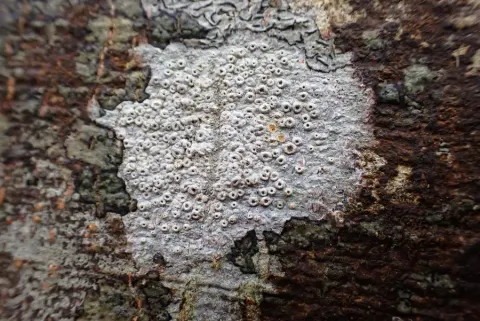
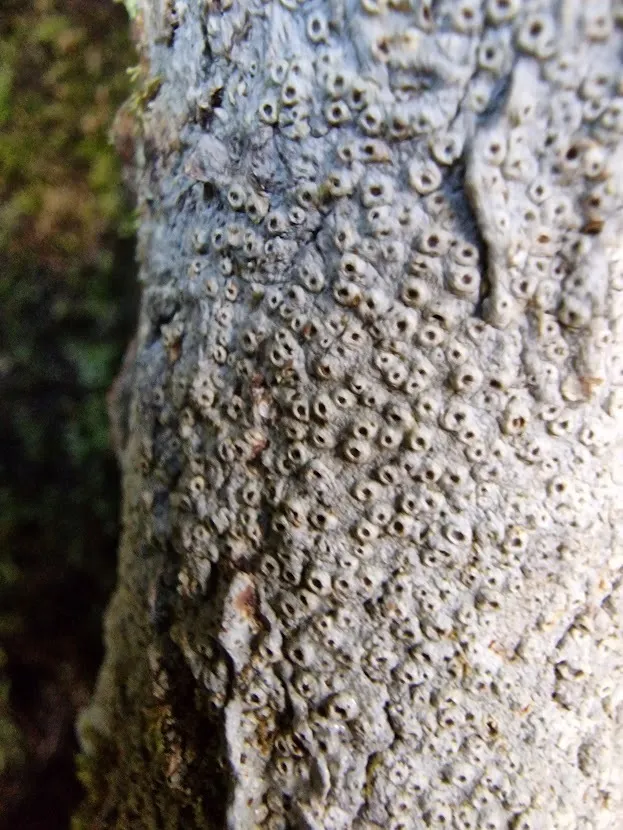
The thallus of Thelotrema lepadinum forms a thin to rather thick crust, reaching up to about 2 mm in thickness. It is usually smooth but can be slightly uneven, and tends to be continuous rather than patchy. The surface is greyish fawn to pale ochre and lies mainly on the surface of the substrate. In vertical section, the medulla contains numerous calcium oxalate crystals, which are especially abundant in the thalline margin surrounding the apothecia. The apothecia are usually very numerous and more or less evenly scattered, typically 1–2 mm in diameter but occasionally as small as about 0.6 mm, and are immersed in small, hemispherical warts of the thallus. They are (urn-shaped), with a white ostiolar opening up to about 0.5 mm across and an entire . The is free from the surrounding thallus and can often be seen through the opening as a colourless, non-striate ring. The itself is blackish and frequently covered by a whitish to greyish , and is generally visible through an irregular opening in the inner exciple. The hymenium is relatively tall, usually 140–190 micrometres (μm) high but occasionally ranging from about 120 to 200 μm. The asci usually contain two to four ascospores, but in some cases may have only one or as many as eight. The ascospores are broadly spindle-shaped (), typically 60–135 × 15–25 μm but occasionally as small as about 30 × 10 μm or as large as about 150 × 33 μm, remain colourless at maturity, and usually have 10–15 transverse septa (sometimes as few as 8 or as many as 19) together with 1–3 longitudinal septa (occasionally up to 5). They show a weakly purple iodine reaction (I±) and are surrounded by a thick gelatinous sheath.
Habitat dan peran ekologis
In his revision of the Thelotrema lepadinum group, Salisbury regarded Thelotrema lepadinum as likely to be cosmopolitan in distribution. He cited type or other authentic material referable to this species from a range of regions, including South Carolina in the United States (Santee Canal), Sri Lanka (Peradeniya), New Zealand (Rangitoto Island, on Metrosideros tomentosa), and New South Wales in Australia (Katoomba). He also mentioned a morphologically similar collection from Tjibodas in Java whose spores showed a strong iodine reaction, and which he suggested might represent a different species. The 2001 work Lichens of North America suggests that the lichen's northern North American distribution is largely limited to the coastal areas; despite this restricted range, it is the most common Thelotrema species on the continent. In Europe, particularly in Britain and Ireland, Thelotrema lepadinum typically grows on smooth or slightly rough bark of deciduous trees, and only rarely on siliceous rock. In long-undisturbed, continuous woodland it can become very abundant, with more than 400 occupied trees per hectare recorded, and it is therefore used as a indicator of ancient woodland. Within this region it is scattered in suitable sites throughout Britain and Ireland.
- Habitat atau konteks temuan
- hutan
- Substrat
- Informasi belum tersedia pada sumber rilis ini.
- Peran atau konteks
- Pembentuk liken
Reproduksi
The asci usually contain two to four ascospores, but in some cases may have only one or as many as eight. The ascospores are broadly spindle-shaped (), typically 60–135 × 15–25 μm but occasionally as small as about 30 × 10 μm or as large as about 150 × 33 μm, remain colourless at maturity, and usually have 10–15 transverse septa (sometimes as few as 8 or as many as 19) together with 1–3 longitudinal septa (occasionally up to 5). They show a weakly purple iodine reaction (I±) and are surrounded by a thick gelatinous sheath. Standard spot tests on the thallus and medulla are negative (C−, K−, KC−, Pd−, UV−), and thin-layer chromatography has not detected lichen substances; however, internal crystals may sometimes give a K+ reaction, turning from yellow to red.
Catatan identitas dan cakupan
- Nama diterima mengikuti Catalogue of Life Base2026-09-11; uraian mempertahankan konsep dan nama sumber aslinya.
- Original geographic, specimen and life-cycle scope retained; source import awaits individual editorial review.
- Impor dan terjemahan otomatis belum diperiksa editorial per profil. Struktur reproduktif yang disebutkan tidak membuktikan seluruh siklus hidup diketahui.
- Pengukuran pada uraian mengikuti spesimen, kultur, dan metode sumber; angka tidak diperluas ke semua populasi.
Catatan distribusi dalam narasi mengikuti sumbernya. Dokumentasi spesimen atau foto mengikuti catatan sumber. Bukti wilayah Indonesia dan penilaian konservasi tidak disimpulkan dari gambar.
Melihat dengan konteks
Dokumentasi Thelotrema lepadinum menurut asosiasi foto pada record takson iNaturalist. Kredit: Sim Elliott. Identitas mengikuti sumber; bukan penentuan spesimen independen.
- Jenis
- Fotografi
- Kredit
- no rights reserved, uploaded by Sim Elliott
- Lisensi
- CC0 1.0
- Sumber media
- Buka entri sumber
Dokumentasi tambahan
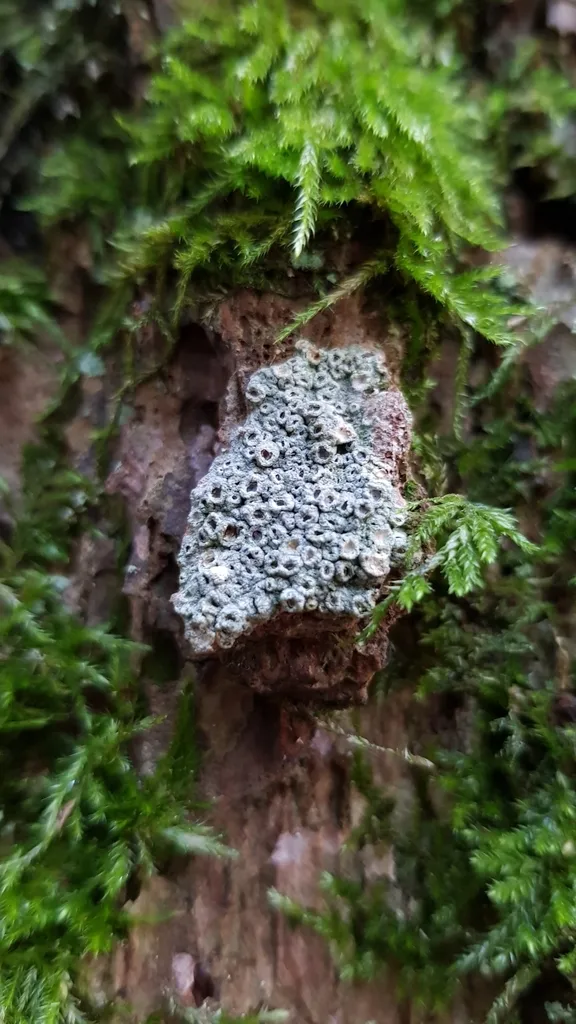
Foto yang diasosiasikan dengan Thelotrema lepadinum pada iNaturalist. Identifikasi mengikuti sumber; bukan penentuan spesimen independen.
Kredit dan penggunaan
(c) Aurelijus Narbutas, some rights reserved (CC BY), uploaded by Aurelijus Narbutas
Ukuran dan format gambar disesuaikan tanpa pemotongan, retus, atau penambahan skala. Lisensi sumber dipertahankan.
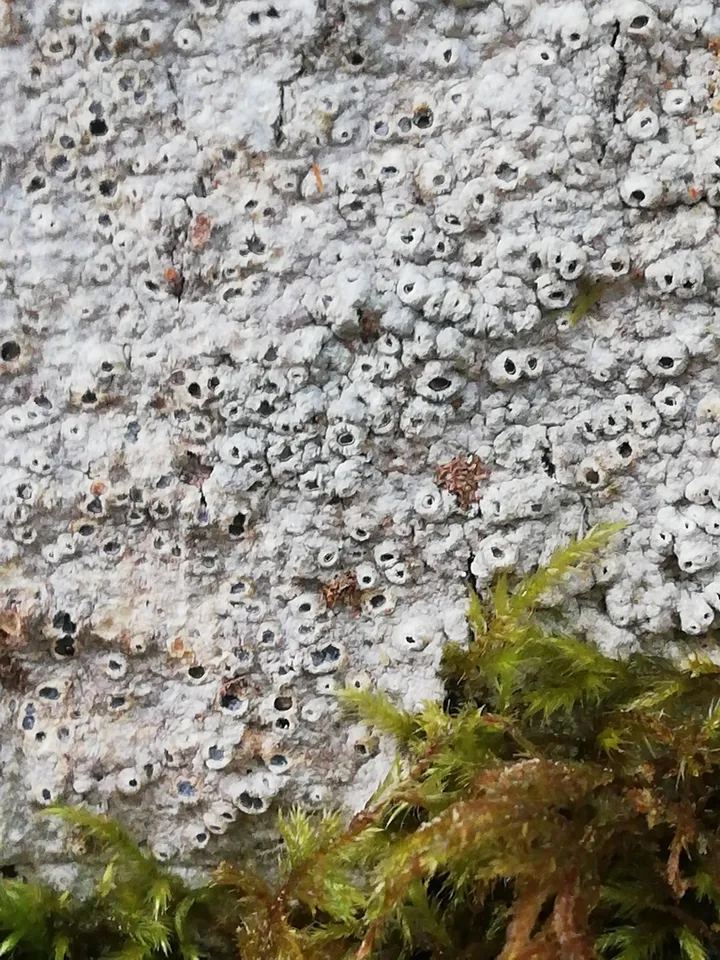
Foto yang diasosiasikan dengan Thelotrema lepadinum pada iNaturalist. Identifikasi mengikuti sumber; bukan penentuan spesimen independen.
Kredit dan penggunaan
(c) Ditte Grube Barild, some rights reserved (CC BY), uploaded by Ditte Grube Barild
Ukuran dan format gambar disesuaikan tanpa pemotongan, retus, atau penambahan skala. Lisensi sumber dipertahankan.
Sumber profil
- [1] Thelotrema lepadinum — Wikipedia (en)
- [2] Catalogue of Life Base2026-09-11 — Thelotrema lepadinum
- [3] Dokumentasi visual — Thelotrema lepadinum
- [4] Dokumentasi visual — Thelotrema lepadinum
- [5] Dokumentasi visual — Thelotrema lepadinum
Rujukan halaman ini
Fungi. Thelotrema lepadinum. Rilis data fungi-2026-10-12-expansion-2. https://fungi-atlas.mgadib.chatgpt.site/jamur/thelotrema-lepadinum/.
Status: impor sumber; pemeriksaan editorial per profil belum selesai. Untuk klaim biologis, gunakan rujukan pada bagian terkait dan periksa konteks sumber aslinya.