Ciri dan struktur
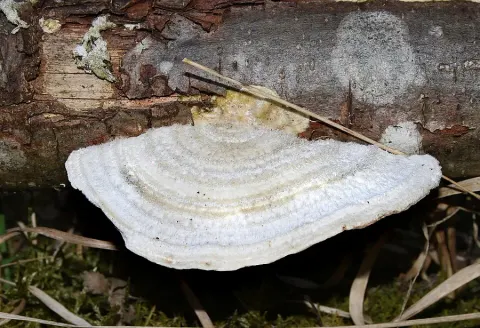
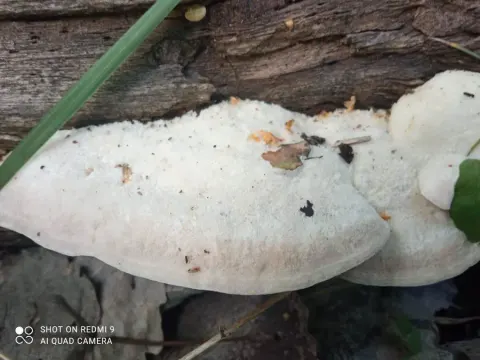
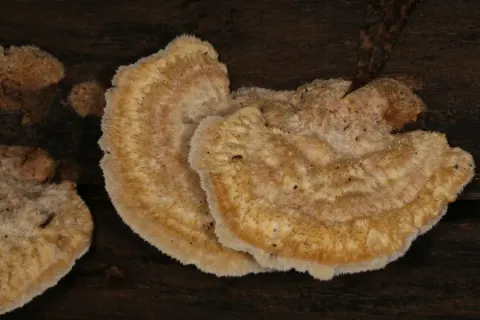
Trametes parvispora differs from known species of Trametes in the combination of the following characteristics: daedaleoid hymenophore, context whitish, thin 1–1.5 mm, homogeneous, without black lines, small spores 3.2–4.6 × 2.1–2.8 μm, regular hyphal pegs 25–30 μm long, cystidia absent, abundance of basidioles, and basidia 12–15 × 3–5 μm. Basidiomata probably perennial, sessile, pileate, applanate, semicircular, up to 13 cm long and 8 cm wide, up to 2.5 cm thick at the base, coriaceous to woody and hard when dry, without odour or taste when fresh. Pileus surface dull, glabrous, and whitish, zonate, margin thick, obtuse. Pore surface whitish, daedaleoid. Context whitish, thin (1–1.5 mm), homogeneous, without black lines. Hyphal system trimitic, generative hyphae hyaline branched with clamp connections, thin-walled, 1.5–2.0 μm in diameter, acyanophilous; skeletal hyphae solid to thick-walled, hyaline, non-septate, 3–4 μm in diameter, totally dominating in the context, acyanophilous, tissues unchanged in KOH, unbranched; binding hyphae very common in both the context and trama, hyaline, thick-walled, acyanophilous, and much branched. Cystidia absent, but the branches of the binding hyphae may easily be mistaken for thick-walled cystidia in the hymenium unless a careful examination is undertaken. Hyphal pegs present, especially at the base of pores, and regular, 25–30 μm long. Basidia 12–15 × 3–5 μm, clavate, tetrasterigmatic, sterigmata 3 μm long; Basidioles numerous, similar in shape to basidia but slightly smaller than basidia, up to 4 μm in diameter. Basidiospores broadly ellipsoid, hyaline, thin-walled, smooth, usually with one guttule each, negative in Melzer’s reagent, acyanophilous, (2.9)3.2–4.6(4.9) × 2.1–2.8(2.9) μm, L = 3.88 μm, W = 2.48 μm; Q = (1.17)1.24–1.91(2.05), Q = 1.57.
Habitat dan peran ekologis
Saprotrophic, on dead part of living tree Dialium guineense and only known from dry dense forest of Pahou in southern Benin.
- Habitat atau konteks temuan
- hutan
- Substrat
- Informasi belum tersedia pada sumber rilis ini.
- Peran atau konteks
- Pengurai
Reproduksi
Trametes parvispora differs from known species of Trametes in the combination of the following characteristics: daedaleoid hymenophore, context whitish, thin 1–1.5 mm, homogeneous, without black lines, small spores 3.2–4.6 × 2.1–2.8 μm, regular hyphal pegs 25–30 μm long, cystidia absent, abundance of basidioles, and basidia 12–15 × 3–5 μm. Basidiomata probably perennial, sessile, pileate, applanate, semicircular, up to 13 cm long and 8 cm wide, up to 2.5 cm thick at the base, coriaceous to woody and hard when dry, without odour or taste when fresh. Pileus surface dull, glabrous, and whitish, zonate, margin thick, obtuse. Pore surface whitish, daedaleoid. Context whitish, thin (1–1.5 mm), homogeneous, without black lines.
Catatan identitas dan cakupan
- Nama diterima mengikuti Catalogue of Life Base2026-09-11; uraian mempertahankan konsep dan nama sumber aslinya.
- Preserve original treatment localities, hosts and substrate scope. Materials examined describe documented specimens, not the full global range.
- Impor dan terjemahan otomatis belum diperiksa editorial per profil. Struktur reproduktif yang disebutkan tidak membuktikan seluruh siklus hidup diketahui.
- Pengukuran pada uraian mengikuti spesimen, kultur, dan metode sumber; angka tidak diperluas ke semua populasi.
Catatan distribusi dalam narasi mengikuti sumbernya. Dokumentasi spesimen atau foto mengikuti catatan sumber. Bukti wilayah Indonesia dan penilaian konservasi tidak disimpulkan dari gambar.
Melihat dengan konteks
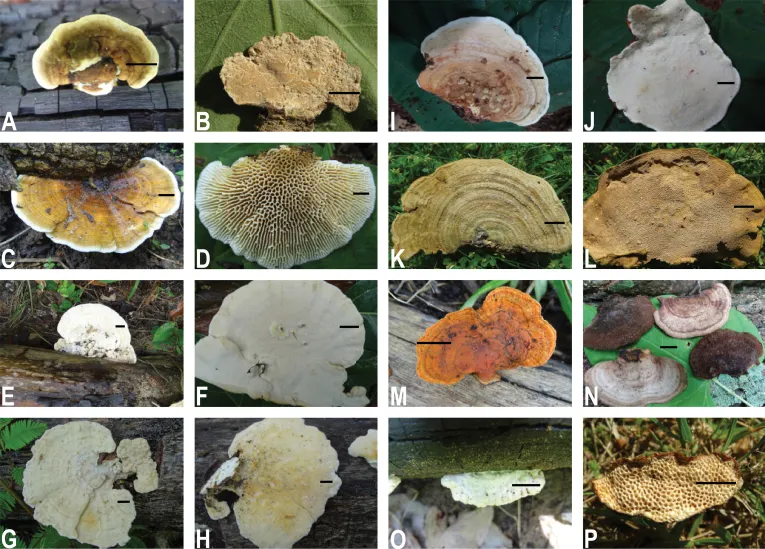
Macromorphology of Trametes species in Benin and specimen numbers in parentheses. A Trametes cingulata B hymenophore of Trametes cingulata (10) C Trametes flavida D hymenophore of Trametes flavida (05) E Trametes lactinea F hymenophore of Trametes lactinea (01) G Trametes palisotii H hymenophore of Trametes palisotii (04) I Trametes parvispora J hymenophore of Trametes parvispora (04) K Trametes polyzona L hymenophore of Trametes polyzona (06) M Trametes sanguinea (04) N Trametes aff. versicolor (01) O Trametes socotrana P hymenophore of Trametes socotrana (02). Scale bar corresponds to 1cm except in E, F where it corresponds to 2 cm.
- Jenis
- Pelat ilmiah
- Kredit
- Boris Armel Olou, Franz-Sebastian Krah, Meike Piepenbring, Nourou Soulemane Yorou, Ewald Langer
- Lisensi
- CC BY 4.0
- Sumber media
- Buka entri sumber
Dokumentasi tambahan
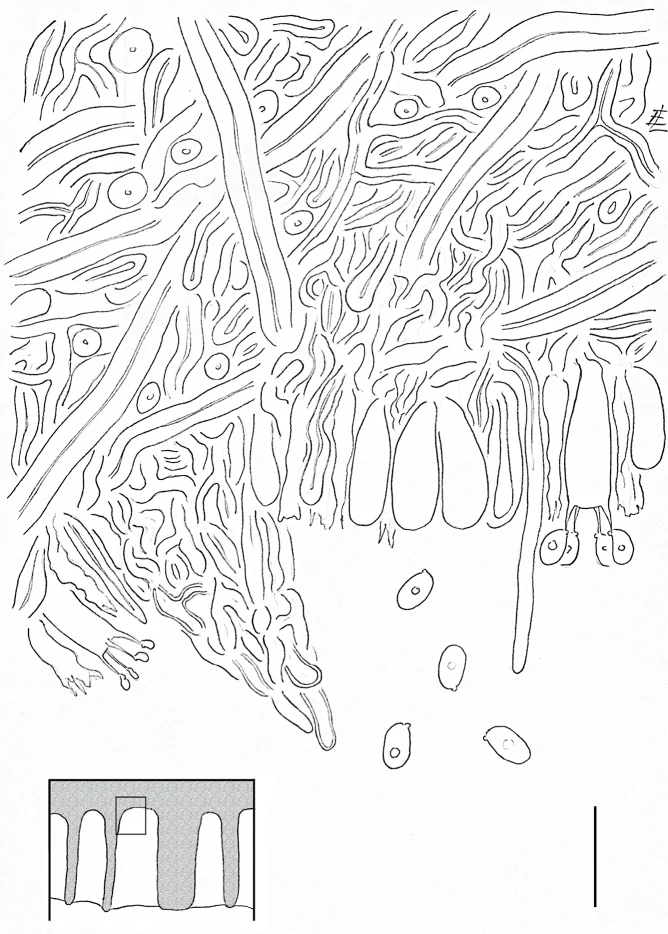
Crossection of the hymenium at the base of a pore of Trametes parvispora. Basidiospores, hyphae, basidia, basidioles, and a hyphal peg are showing. The box (lower left corner) shows the location (small rectangle) of the line drawing in the cross-section of the hymenophore. Scale bar = 10 μm
Kredit dan penggunaan
Boris Armel Olou, Franz-Sebastian Krah, Meike Piepenbring, Nourou Soulemane Yorou, Ewald Langer
Ukuran dan format gambar disesuaikan tanpa pemotongan, retus, atau penambahan skala. Lisensi sumber dipertahankan.
Sumber profil
- [1] Diversity of Trametes (Polyporales, Basidiomycota) in tropical Benin and description of new species Trametes parvispora — Trametes parvispora
- [2] Catalogue of Life Base2026-09-11 — Trametes parvispora
- [3] Dokumentasi visual — Trametes parvispora
- [4] Dokumentasi visual — Trametes parvispora
Rujukan halaman ini
Fungi. Trametes parvispora. Rilis data fungi-2026-10-12-expansion-2. https://fungi-atlas.mgadib.chatgpt.site/jamur/trametes-parvispora/.
Status: impor sumber; pemeriksaan editorial per profil belum selesai. Untuk klaim biologis, gunakan rujukan pada bagian terkait dan periksa konteks sumber aslinya.