Ciri dan struktur
Asexual morph: colonies yellowish, smooth, shiny, and slimy, with an entire margin. Pseudohyphae and hyphae are not formed on corn meal agar. Conidia hyaline, smooth, globose to subglobose, 3.0–6.0 × 2.5–5.0 μm, L = 4.8 ± 0.9 μm, W = 3.9 ± 0.8 μm, Q = 1.0–1.7 (n = 30). Ballistoconidia, globose to subglobose on CMA agar, 5.0–7.0 × 3.5–6.0 μm, L = 6.0 ± 0.6 μm, W = 5.1 ± 0. 6 μm (n = 30). The comparison of physiological properties between this new species and its related taxa were listed in Suppl. material 1. Sexual morph: undetermined.
Habitat dan peran ekologis
CHINA, Fujian Province, on the basidioma of Tremella fuciformis, July 2017, X.Z. Liu, CGMCC 2.5725 = CBS 15262; Japan, isolated from Mori Ind. Co., Ltd, 1968, T. Suda, NBRC 8990 = CBS 8225. Three strains representing T. basidiomaticola clustered in a well-supported clade that closely related to T. yokohamensis, T. flava, and T. fuciformis. Tremella basidiomaticola CGMCC 2.5724 T differed from T. yokohamensis, T. flava, and T. fuciformis by 97.4%, 94.4%–95.1%, and 97.8%–98.1% sequence identities in D1/D2 domain and 96.3%–96.6%, 94.4%–95.7%, and 96.6%–97.5% sequence identities in ITS region. Physiologically, the ability to assimilate lactose, melibiose, raffinose, inulin, soluble starch, L-rhamnose, ethanol, glycerol, DL-lactic acid, and inositol were different between T. basidiomaticola and closely related taxa (Suppl. material 1: Table S1). Moreover, the novel species can grow in vitamin-free medium but not for its sister species.
- Habitat atau konteks temuan
- Informasi belum tersedia pada sumber rilis ini.
- Substrat
- Informasi belum tersedia pada sumber rilis ini.
- Peran atau konteks
- Belum dikategorikan pada rilis ini.
Reproduksi
Asexual morph: colonies yellowish, smooth, shiny, and slimy, with an entire margin. Pseudohyphae and hyphae are not formed on corn meal agar. Conidia hyaline, smooth, globose to subglobose, 3.0–6.0 × 2.5–5.0 μm, L = 4.8 ± 0.9 μm, W = 3.9 ± 0.8 μm, Q = 1.0–1.7 (n = 30). Ballistoconidia, globose to subglobose on CMA agar, 5.0–7.0 × 3.5–6.0 μm, L = 6.0 ± 0.6 μm, W = 5.1 ± 0. 6 μm (n = 30). The comparison of physiological properties between this new species and its related taxa were listed in Suppl. material 1. Sexual morph: undetermined.
Catatan identitas dan cakupan
- Nama diterima mengikuti Catalogue of Life Base2026-09-11; uraian mempertahankan konsep dan nama sumber aslinya.
- Preserve original treatment localities, hosts and substrate scope. Materials examined describe documented specimens, not the full global range.
- Impor dan terjemahan otomatis belum diperiksa editorial per profil. Struktur reproduktif yang disebutkan tidak membuktikan seluruh siklus hidup diketahui.
- Pengukuran pada uraian mengikuti spesimen, kultur, dan metode sumber; angka tidak diperluas ke semua populasi.
Catatan distribusi dalam narasi mengikuti sumbernya. Dokumentasi spesimen atau foto mengikuti catatan sumber. Bukti wilayah Indonesia dan penilaian konservasi tidak disimpulkan dari gambar.
Melihat dengan konteks
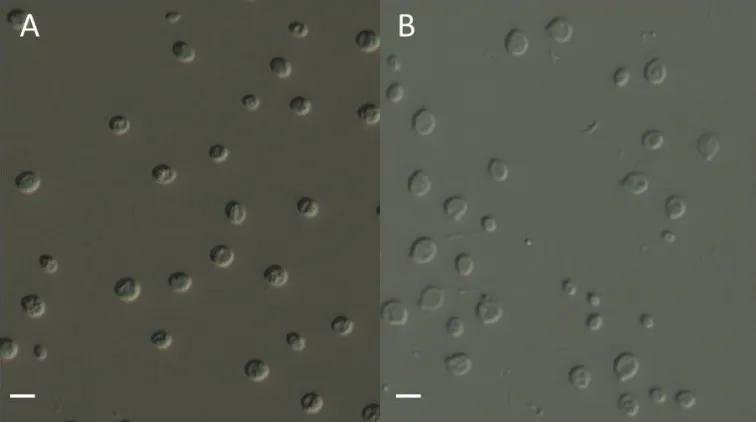
Tremella basidiomaticola CGMCC 2.5724 T A Vegetative cells grown in YM agar for 7 days at 17 °C B B allistoconidia produced on CMA agar for 7 days at 17 °C. Scale bars: 5 μm.
- Jenis
- Pelat ilmiah
- Kredit
- Ying Zhao, Xin-zhan Liu, Feng-yan Bai
- Lisensi
- CC BY 4.0
- Sumber media
- Buka entri sumber
Sumber profil
- [1] Four new species of Tremella (Tremellales, Basidiomycota) based on morphology and DNA sequence data — Tremella basidiomaticola
- [2] Catalogue of Life Base2026-09-11 — Tremella basidiomaticola
- [3] Dokumentasi visual — Tremella basidiomaticola
Rujukan halaman ini
Fungi. Tremella basidiomaticola. Rilis data fungi-2026-10-12-expansion-2. https://fungi-atlas.mgadib.chatgpt.site/jamur/tremella-basidiomaticola/.
Status: impor sumber; pemeriksaan editorial per profil belum selesai. Untuk klaim biologis, gunakan rujukan pada bagian terkait dan periksa konteks sumber aslinya.