01 / Morfologi

Ciri dan struktur

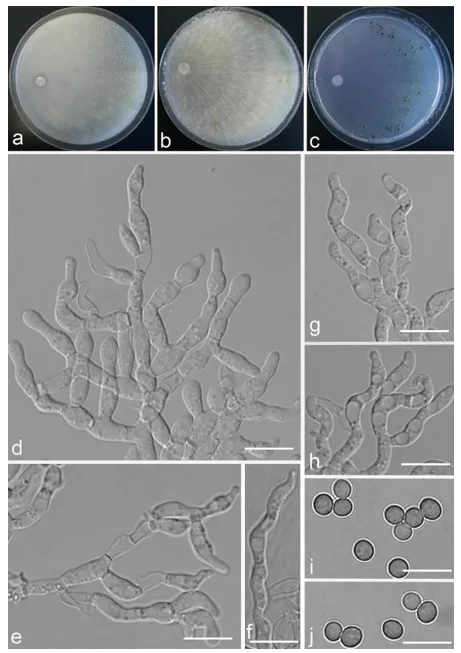
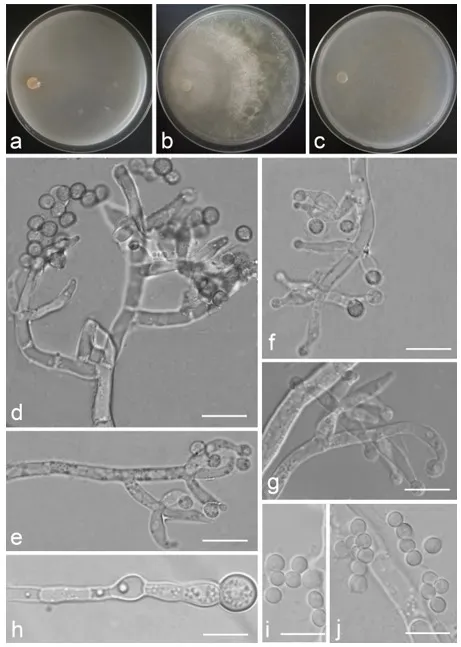
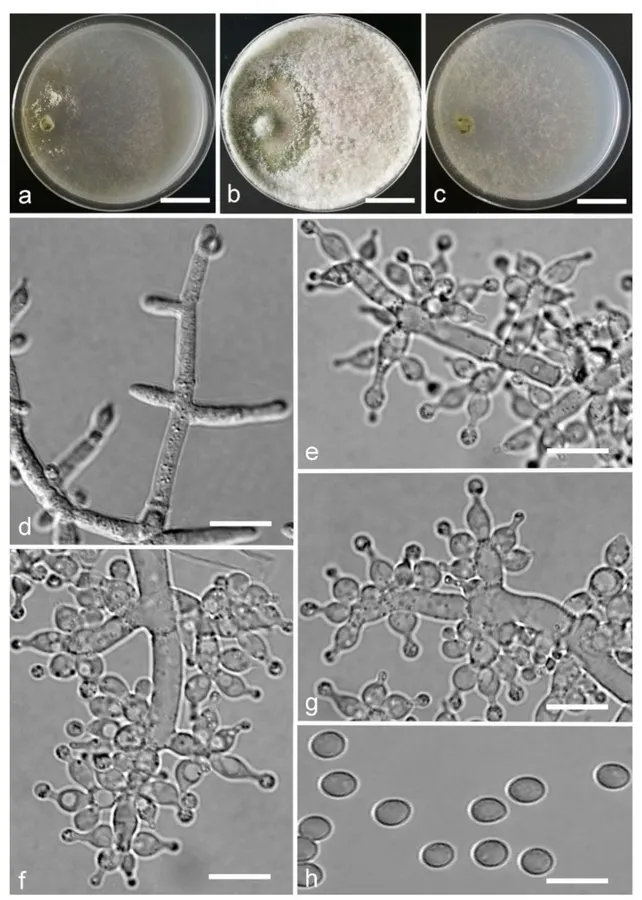
Culture characteristics: Optimum temperature for growth 25 °C. Colony radius on CMD after 72 h: 55 mm at 25 °C, 30–35 mm at 30 °C, 9–13 mm at 35 °C, covering the plate after 4 days at 25 °C. Colonies hyaline, outline distinct, fan-shaped. Aerial hyphae loose, sparse, radial and arachnoid, branched distinctly. Pustules white, minute, distributed in a scattered fashion around the point of inoculation, turning green after 5 days. Chlamydospores unobserved. Light yellow pigments noted. No distinct odor noted. Colony radius on PDA after 72 h: 54 mm at 30 °C, 12 mm at 35 °C, covering the plate after 3 days at 25 °C. Colonies thick and dense, the zone around the central part of colony forms a distinct circular and green part. Aerial hyphae whitish, partly green, abundant, floccose to cottony, zonate distinctly. Chlamydospores unobserved. No diffusing pigment noted, odor indistinct. Colony radius on SNA after 72 h: 58–65 mm at 25 °C, 37 mm at 30 °C, 7 mm at 35 °C, covering the plate after 4 days at 25 °C. Colonies similar to that on CMD, regular and distinct outline, but translucent and round-like. Aerial hyphae branched, loose and sparse, radial and arachnoid. Pustules white, minute, scattered around the point of inoculation, gradually turning green after 3 days. Chlamydospores unobserved. Light yellow pigments noted. No distinct odor noted.

Sebagian uraian ditampilkan dalam bahasa sumber; terjemahannya belum tersedia atau belum lolos pemeriksaan.

Rujukan: [1]

Pengukuran mengikuti objek, spesimen atau kultur, dan metode yang disebutkan sumber. Baca uraian asli untuk konteks lengkap.

02 / Kehidupan

Habitat dan peran ekologis

Culture characteristics: Optimum temperature for growth 25 °C. Colony radius on CMD after 72 h: 55 mm at 25 °C, 30–35 mm at 30 °C, 9–13 mm at 35 °C, covering the plate after 4 days at 25 °C. Colonies hyaline, outline distinct, fan-shaped. Aerial hyphae loose, sparse, radial and arachnoid, branched distinctly. Pustules white, minute, distributed in a scattered fashion around the point of inoculation, turning green after 5 days. Chlamydospores unobserved. Light yellow pigments noted. No distinct odor noted. Colony radius on PDA after 72 h: 54 mm at 30 °C, 12 mm at 35 °C, covering the plate after 3 days at 25 °C. Colonies thick and dense, the zone around the central part of colony forms a distinct circular and green part. Aerial hyphae whitish, partly green, abundant, floccose to cottony, zonate distinctly. Chlamydospores unobserved. No diffusing pigment noted, odor indistinct. Colony radius on SNA after 72 h: 58–65 mm at 25 °C, 37 mm at 30 °C, 7 mm at 35 °C, covering the plate after 4 days at 25 °C. Colonies similar to that on CMD, regular and distinct outline, but translucent and round-like. Aerial hyphae branched, loose and sparse, radial and arachnoid. Pustules white, minute, scattered around the point of inoculation, gradually turning green after 3 days.

Sebagian uraian ditampilkan dalam bahasa sumber; terjemahannya belum tersedia atau belum lolos pemeriksaan.

Rujukan: [1]

Habitat atau konteks temuan
kultur yang didokumentasikan
Substrat
Informasi belum tersedia pada sumber rilis ini.
Peran atau konteks
Belum dikategorikan pada rilis ini.
Temukan hubungan serupa
03 / Siklus hidup

Reproduksi

Notes: T richoderma asiaticum is a member of the Harzianum clade. Phylogenetically, T. asiaticum is closely related to T. afroharzianum Chaverri & Jaklitsch and T. atrobrunneum Chaverri & Jaklitsch, but the branch base of the two species are narrower [(1.0–)1.5–2.2(–3.5) and 1.0–2.7 mm, respectively][ 56 ]. In addition, some phialides of T. asiaticum are somewhat shorter than those of T. afroharzianum [(3.0–)4.0–6.0(–7.0) vs. (3.5–)5.2–10.2(–17.5) mm]. For the T. atrobrunneum, the base of the branch is narrower than that of T. asiaticum and the conidia of the T. atrobrunneum are subglobose to ovoid [ 56 ], which significantly differs from the globose and smaller conidia of T. asiaticum [(2.3–)2.4–3.0(–3.1) × (2.0–)2.1–2.7(–2.8) μm].

Sebagian uraian ditampilkan dalam bahasa sumber; terjemahannya belum tersedia atau belum lolos pemeriksaan.

Rujukan: [1]

04 / Batas informasi

Catatan identitas dan cakupan

  • Nama diterima mengikuti Catalogue of Life Base2026-09-11; uraian mempertahankan konsep dan nama sumber aslinya.
  • Preserve original treatment localities, hosts and substrate scope. Materials examined describe documented specimens, not the full global range.
  • Impor dan terjemahan otomatis belum diperiksa editorial per profil. Struktur reproduktif yang disebutkan tidak membuktikan seluruh siklus hidup diketahui.
  • Pengukuran pada uraian mengikuti spesimen, kultur, dan metode sumber; angka tidak diperluas ke semua populasi.

Catatan distribusi dalam narasi mengikuti sumbernya. Dokumentasi spesimen atau foto mengikuti catatan sumber. Bukti wilayah Indonesia dan penilaian konservasi tidak disimpulkan dari gambar.

05 / Dokumentasi

Melihat dengan konteks

Trichoderma asiaticum (YMF 1.00352). (a – c) Cultures after 7 d at 25 °C (a) on CMD; (b) on PDA; (c) on SNA). (d) Conidiophores formed on SNA. (e – g) Conidiophores, phialides and conidia formed on SNA. (h) Conidia. Scale bars: (a – c) = 2.5 cm, (d – h) = 10 μm.

Jenis
Pelat ilmiah
Kredit
© 2021 by the authors.
Lisensi
CC BY 4.0
Sumber media
Buka entri sumber

Gambar menunjukkan objek menurut identifikasi sumber, bukan verifikasi independen spesimen oleh Fungi. Tidak ada skala baru yang ditambahkan.

06 / Rujukan

Sumber profil

  1. [1] New Species of Trichoderma Isolated as Endophytes and Saprobes from Southwest China — Trichoderma asiaticumBagian sumber: sec3dot2-jof-07-00467_paragraph_40
    Tanggal penghimpunan sumber: 2026-10-12
    Teks sumber: CC BY 4.0 · Zheng H, Qiao M, Lv Y, Du X, Zhang KQ, Yu Z.
  2. [2] Catalogue of Life Base2026-09-11 — Trichoderma asiaticumBagian sumber: ColDP NameUsage.tsv ID 9ZGRN; accepted species; source 2073
    Tanggal penghimpunan sumber: 2026-10-12
  3. [3] Dokumentasi visual — Trichoderma asiaticumBagian sumber: Individual media record; identification follows the source, not independent determination
    Tanggal penghimpunan sumber: 2026-10-12
    Media sumber: CC BY 4.0 · © 2021 by the authors.

Adaptasi teks: CC BY 4.0. Zheng H, Qiao M, Lv Y, Du X, Zhang KQ, Yu Z. — New Species of Trichoderma Isolated as Endophytes and Saprobes from Southwest China — Trichoderma asiaticum

Uraian asli dan riwayat sumber

Riwayat atau halaman sumber

Ringkasan sumber

Culture characteristics: Optimum temperature for growth 25 °C. Colony radius on CMD after 72 h: 55 mm at 25 °C, 30–35 mm at 30 °C, 9–13 mm at 35 °C, covering the plate after 4 days at 25 °C. Colonies hyaline, outline distinct, fan-shaped. Aerial hyphae loose, sparse, radial and arachnoid, branched distinctly. Pustules white, minute, distributed in a scattered fashion around the point of inoculation, turning green after 5 days. Chlamydospores unobserved. Light yellow pigments noted. No distinct odor noted.

Revisi sumber

Morfologi sumber

Culture characteristics: Optimum temperature for growth 25 °C. Colony radius on CMD after 72 h: 55 mm at 25 °C, 30–35 mm at 30 °C, 9–13 mm at 35 °C, covering the plate after 4 days at 25 °C. Colonies hyaline, outline distinct, fan-shaped. Aerial hyphae loose, sparse, radial and arachnoid, branched distinctly. Pustules white, minute, distributed in a scattered fashion around the point of inoculation, turning green after 5 days. Chlamydospores unobserved. Light yellow pigments noted. No distinct odor noted. Colony radius on PDA after 72 h: 54 mm at 30 °C, 12 mm at 35 °C, covering the plate after 3 days at 25 °C. Colonies thick and dense, the zone around the central part of colony forms a distinct circular and green part. Aerial hyphae whitish, partly green, abundant, floccose to cottony, zonate distinctly. Chlamydospores unobserved. No diffusing pigment noted, odor indistinct. Colony radius on SNA after 72 h: 58–65 mm at 25 °C, 37 mm at 30 °C, 7 mm at 35 °C, covering the plate after 4 days at 25 °C. Colonies similar to that on CMD, regular and distinct outline, but translucent and round-like. Aerial hyphae branched, loose and sparse, radial and arachnoid. Pustules white, minute, scattered around the point of inoculation, gradually turning green after 3 days. Chlamydospores unobserved. Light yellow pigments noted. No distinct odor noted.

Revisi sumber

Ekologi sumber

Culture characteristics: Optimum temperature for growth 25 °C. Colony radius on CMD after 72 h: 55 mm at 25 °C, 30–35 mm at 30 °C, 9–13 mm at 35 °C, covering the plate after 4 days at 25 °C. Colonies hyaline, outline distinct, fan-shaped. Aerial hyphae loose, sparse, radial and arachnoid, branched distinctly. Pustules white, minute, distributed in a scattered fashion around the point of inoculation, turning green after 5 days. Chlamydospores unobserved. Light yellow pigments noted. No distinct odor noted. Colony radius on PDA after 72 h: 54 mm at 30 °C, 12 mm at 35 °C, covering the plate after 3 days at 25 °C. Colonies thick and dense, the zone around the central part of colony forms a distinct circular and green part. Aerial hyphae whitish, partly green, abundant, floccose to cottony, zonate distinctly. Chlamydospores unobserved. No diffusing pigment noted, odor indistinct. Colony radius on SNA after 72 h: 58–65 mm at 25 °C, 37 mm at 30 °C, 7 mm at 35 °C, covering the plate after 4 days at 25 °C. Colonies similar to that on CMD, regular and distinct outline, but translucent and round-like. Aerial hyphae branched, loose and sparse, radial and arachnoid. Pustules white, minute, scattered around the point of inoculation, gradually turning green after 3 days.

Revisi sumber

Struktur reproduksi sumber

Notes: T richoderma asiaticum is a member of the Harzianum clade. Phylogenetically, T. asiaticum is closely related to T. afroharzianum Chaverri & Jaklitsch and T. atrobrunneum Chaverri & Jaklitsch, but the branch base of the two species are narrower [(1.0–)1.5–2.2(–3.5) and 1.0–2.7 mm, respectively][ 56 ]. In addition, some phialides of T. asiaticum are somewhat shorter than those of T. afroharzianum [(3.0–)4.0–6.0(–7.0) vs. (3.5–)5.2–10.2(–17.5) mm]. For the T. atrobrunneum, the base of the branch is narrower than that of T. asiaticum and the conidia of the T. atrobrunneum are subglobose to ovoid [ 56 ], which significantly differs from the globose and smaller conidia of T. asiaticum [(2.3–)2.4–3.0(–3.1) × (2.0–)2.1–2.7(–2.8) μm].

Revisi sumber

Rujukan halaman ini

Fungi. Trichoderma asiaticum. Rilis data fungi-2026-10-12-expansion-2. https://fungi-atlas.mgadib.chatgpt.site/jamur/trichoderma-asiaticum/.

Status: impor sumber; pemeriksaan editorial per profil belum selesai. Untuk klaim biologis, gunakan rujukan pada bagian terkait dan periksa konteks sumber aslinya.