Ciri dan struktur
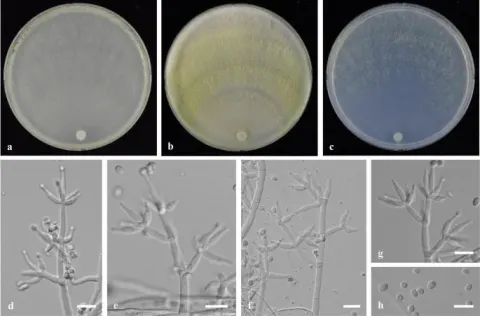
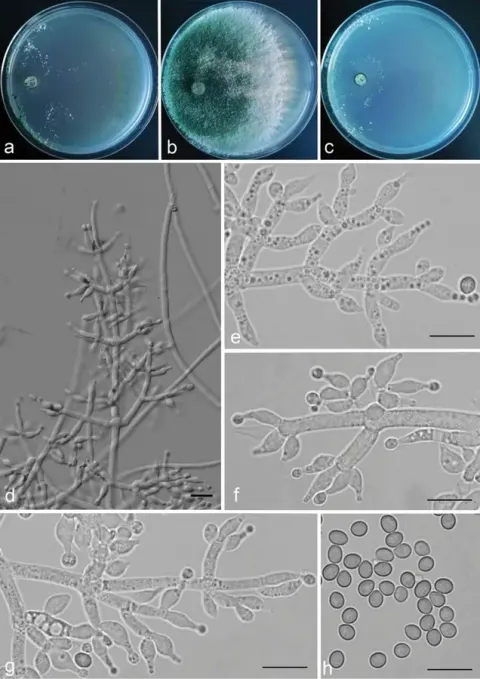
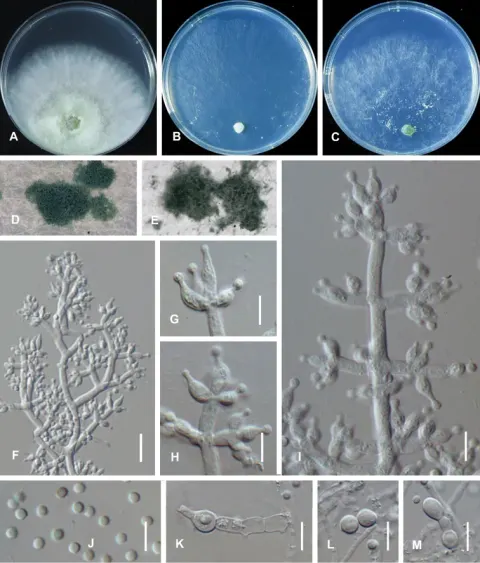
The conidiophores of T. koningii are branched and organized in a pyramidal structure with longer branches at the base that progressively shortens as it nears the tip. Primary and secondary branches arise in a right-angle degree and are often symmetrical on either side of the node along the main axis. Phialides are usually in 3–4 whorls that arise from the tip of the main branch and from lateral branches at intercalary positions on the conidiophore. Some phialides on widely-spaced branches are flask-shaped, resembling a wine bottle, whereas some tend to have a very swollen middle when in dense clusters or "pseudo-whorls". T. koningii typically produces smooth and ellipsoidal (egg-shaped) conidia, with a mean length of 4.1–4.3 μm, that aggregates in a slimy green mass at the tip of the phialides. The chlamydospores are pale brown, globe-like in shape, and are located at terminal and intercalary positions on the hyphae. In culture, colonies display rapid growth on potato dextrose agar (PDA), as cream-coloured in the beginning but later turns green because of sporulation. T. koningii grows at an optimum temperature of 25 °C in darkness, producing white mycelium with a radius of 50–60 mm. During conidial production, colouration first begins at the centre then later spreads outward in dark or dull green concentric rings that are vague to noticeable. Maximum temperature for growth is observed at 33 °C, which reduces their pathogenic potential in humans. Like most Trichoderma species, this fungus has a sexual state. The teleomorph, Hypocrea koningii, is characterized by cushion-shaped stromata (sing. stroma) that are broadly attached to the surface of a substrate but are free at the margins.
Habitat dan peran ekologis
Typical of Trichoderma, T. koningii is a good colonizer of its habitat. Saprophytic growth occurs in acidified soils and soils with high water content (i.e. chernozem, podzol). It is often isolated from under pine and coniferous trees, vegetation, plantations, grasslands, marshes, swamps, and peats. T. koningii also thrives in other environments, including growing on decaying wood, in marine species, estuarine sediments, and in mines and caves. The fruiting bodies commonly grow on tree bark and stromata tend to be scattered, often solitary than in clusters. It is distributed widely in Europe, the United States, and Canada. Recent surveys have reported that some strains of T. koningii are also found to be present in New Zealand and South Africa.
- Habitat atau konteks temuan
- Informasi belum tersedia pada sumber rilis ini.
- Substrat
- kayu
- Peran atau konteks
- Belum dikategorikan pada rilis ini.
Reproduksi
The conidiophores of T. koningii are branched and organized in a pyramidal structure with longer branches at the base that progressively shortens as it nears the tip. Primary and secondary branches arise in a right-angle degree and are often symmetrical on either side of the node along the main axis. Phialides are usually in 3–4 whorls that arise from the tip of the main branch and from lateral branches at intercalary positions on the conidiophore. Some phialides on widely-spaced branches are flask-shaped, resembling a wine bottle, whereas some tend to have a very swollen middle when in dense clusters or "pseudo-whorls". T. koningii typically produces smooth and ellipsoidal (egg-shaped) conidia, with a mean length of 4.1–4.3 μm, that aggregates in a slimy green mass at the tip of the phialides.
Catatan identitas dan cakupan
- Nama diterima mengikuti Catalogue of Life Base2026-09-11; uraian mempertahankan konsep dan nama sumber aslinya.
- Original geographic, specimen and life-cycle scope retained; source import awaits individual editorial review.
- Impor dan terjemahan otomatis belum diperiksa editorial per profil. Struktur reproduktif yang disebutkan tidak membuktikan seluruh siklus hidup diketahui.
- Pengukuran pada uraian mengikuti spesimen, kultur, dan metode sumber; angka tidak diperluas ke semua populasi.
Catatan distribusi dalam narasi mengikuti sumbernya. Dokumentasi spesimen atau foto mengikuti catatan sumber. Bukti wilayah Indonesia dan penilaian konservasi tidak disimpulkan dari gambar.
Melihat dengan konteks
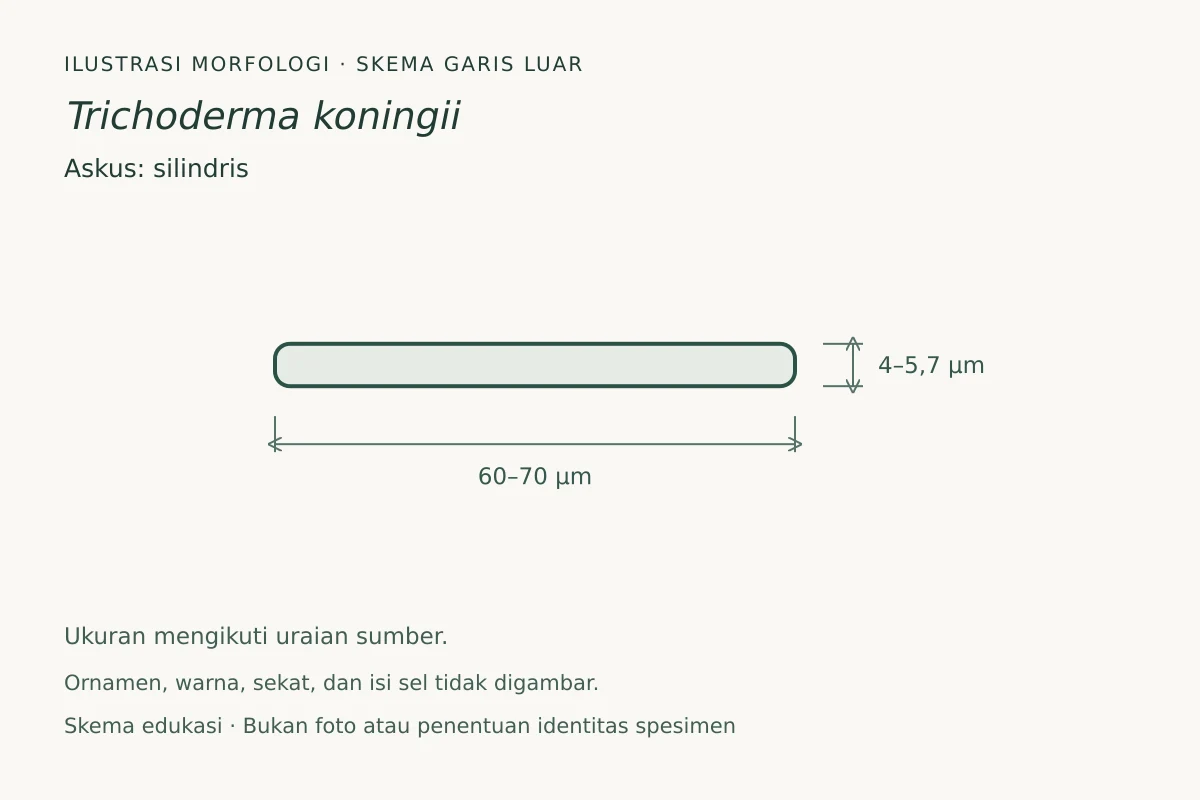
Ilustrasi skematis garis luar askus Trichoderma koningii, berdasarkan uraian sumber; ukuran yang dilaporkan 60–70 × 4–5,7 µm. Proporsi disederhanakan, bukan salinan satu spesimen. Ornamen permukaan, warna, sekat, dan isi sel tidak direkonstruksi. Skema askus silindris 60–70 × 4–5,7 µm; penebalan apeks dan askospora di dalamnya tidak direkonstruksi. Bukan skema peritesium berleher atau konidium.
- Jenis
- Ilustrasi skematis
- Kredit
- Fungi, ilustrasi orisinal (2026); fakta morfologi berdasarkan Wikipedia contributors
- Lisensi
- CC BY-SA 4.0
- Sumber media
- Buka entri sumber
Sumber profil
- [1] Trichoderma koningii — Wikipedia (en)
- [2] Catalogue of Life Base2026-09-11 — Trichoderma koningii
Rujukan halaman ini
Fungi. Trichoderma koningii. Rilis data fungi-2026-10-12-expansion-2. https://fungi-atlas.mgadib.chatgpt.site/jamur/trichoderma-koningii/.
Status: impor sumber; pemeriksaan editorial per profil belum selesai. Untuk klaim biologis, gunakan rujukan pada bagian terkait dan periksa konteks sumber aslinya.