01 / Morfologi

Ciri dan struktur

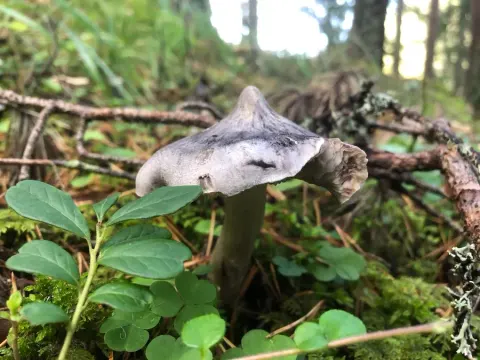
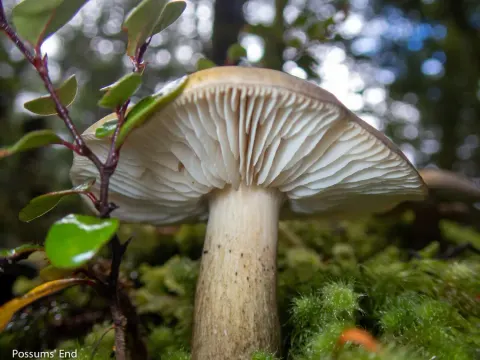
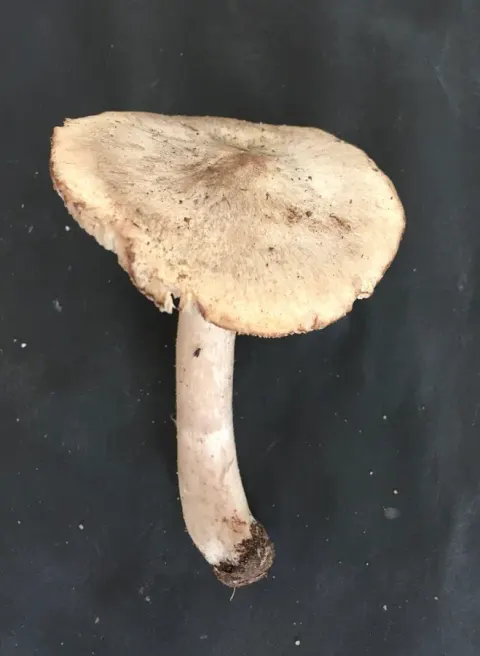
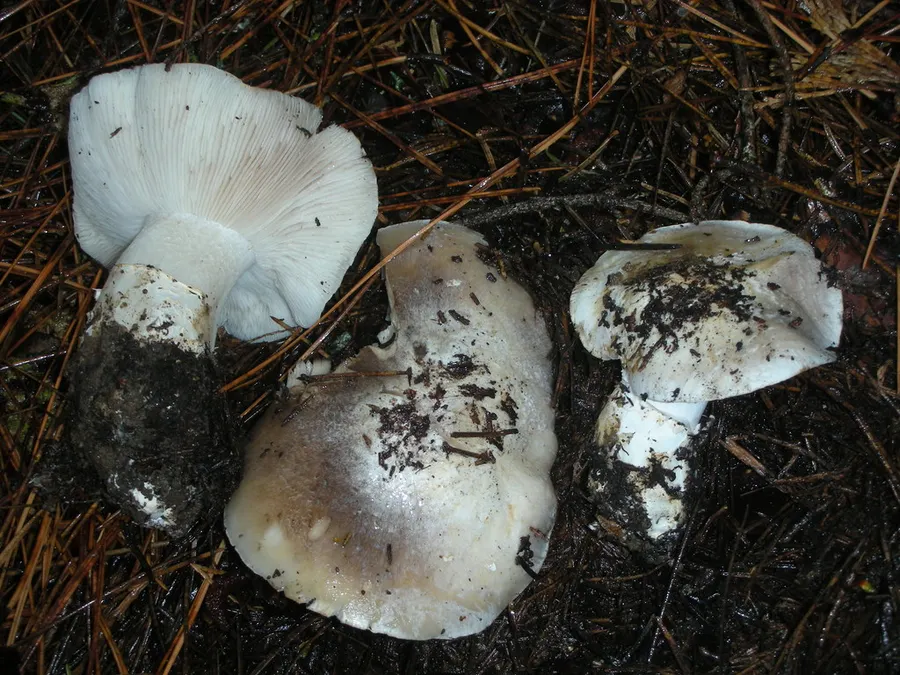
The cap is convex to broadly convex before flattening out in age, and reaches diameters between 6 and 15 cm wide. The surface is smooth, dry to moist, and in maturity may have white patches of veil remnant. As the mushroom ages, the cap color changes from white to fuscous (dusky brownish grey) or brown, usually with olive, grayish or pale tan regions. The cap margin, initially curved downward, lifts up and becomes lobed or irregular with age. The flesh is thick and white, with a strongly farinaceous odor similar to cucumber or watermelon rind. The gills initially have an emarginate (notched) to adnate attachment to the stipe, but pull away as the mushroom matures to become seceding or almost free from attachment. They are thick, closely spaced, and whitish in color, sometimes developing pale pink tints. The solid stipe measures 4–14 cm long by 1.3–4 cm thick, and is either equal in width through its length or bulged at the base. The dry surface has a texture that is smooth to silky fibrillose above the ring and appressed fibrillose to scaly below. The ring, located in the middle to upper half of the stem, is sometimes inconspicuous. The edibility of the mushroom is unknown with certainty, but it has been noted to have a strongly farinaceous taste, and an unpleasant odor "strongly reminiscent of rotting white potatoes". The spore print is white. The spores are elliptic (or narrowly so), and measure 8–12 by 4.8–6.2 μm. There are clamp connections present in the hyphae. The basidia (spore-bearing cells) are four-spored, club-shaped, and measure 23–30 by 8–10 μm. The hymenium lacks cystidia.

Sebagian uraian ditampilkan dalam bahasa sumber; terjemahannya belum tersedia atau belum lolos pemeriksaan.

Rujukan: [1]

Pengukuran mengikuti objek, spesimen atau kultur, dan metode yang disebutkan sumber. Baca uraian asli untuk konteks lengkap.

02 / Kehidupan

Habitat dan peran ekologis

The fruit bodies grow singly or in groups under conifers in late spring and early summer. A fairly common species throughout its range, it is found at high elevations in California north to Oregon and Washington. It is a snowbank fungus, meaning it is commonly found at the edge of melting snowbanks. Fruit bodies are often buried under humus, forming hardly visible "mushrumps", apparent only as cracked bumps on the ground.

Sebagian uraian ditampilkan dalam bahasa sumber; terjemahannya belum tersedia atau belum lolos pemeriksaan.

Rujukan: [1]

Habitat atau konteks temuan
Informasi belum tersedia pada sumber rilis ini.
Substrat
tanah
Peran atau konteks
Belum dikategorikan pada rilis ini.
Temukan hubungan serupa
03 / Siklus hidup

Reproduksi

The spore print is white. The spores are elliptic (or narrowly so), and measure 8–12 by 4.8–6.2 μm. There are clamp connections present in the hyphae. The basidia (spore-bearing cells) are four-spored, club-shaped, and measure 23–30 by 8–10 μm. The hymenium lacks cystidia. The cap flesh comprises homogenous, interwoven hyphae that are 3–5 μm in diameter, while the cap cuticle is a layer between 200 and 300 μm thick comprising interwoven, gelatinous hyphae up to 4 μm in diameter.

Sebagian uraian ditampilkan dalam bahasa sumber; terjemahannya belum tersedia atau belum lolos pemeriksaan.

Rujukan: [1]

Sinonim menurut acuan taksonomi rilis: Armillaria olida
04 / Batas informasi

Catatan identitas dan cakupan

  • Nama diterima mengikuti Catalogue of Life Base2026-09-11; uraian mempertahankan konsep dan nama sumber aslinya.
  • Original geographic, specimen and life-cycle scope retained; source import awaits individual editorial review.
  • Impor dan terjemahan otomatis belum diperiksa editorial per profil. Struktur reproduktif yang disebutkan tidak membuktikan seluruh siklus hidup diketahui.
  • Pengukuran pada uraian mengikuti spesimen, kultur, dan metode sumber; angka tidak diperluas ke semua populasi.

Catatan distribusi dalam narasi mengikuti sumbernya. Dokumentasi spesimen atau foto mengikuti catatan sumber. Bukti wilayah Indonesia dan penilaian konservasi tidak disimpulkan dari gambar.

05 / Dokumentasi

Melihat dengan konteks

Dokumentasi Tricholoma vernaticum menurut asosiasi foto pada record takson iNaturalist. Kredit: Ron Pastorino (Ronpast). Identitas mengikuti sumber; bukan penentuan spesimen independen.

Jenis
Fotografi
Kredit
(c) Ron Pastorino (Ronpast), some rights reserved (CC BY-SA)
Sumber media
Buka entri sumber

Gambar menunjukkan objek menurut identifikasi sumber, bukan verifikasi independen spesimen oleh Fungi. Tidak ada skala baru yang ditambahkan.

06 / Rujukan

Sumber profil

  1. [1] Tricholoma vernaticum — Wikipedia (en)Bagian sumber: Frozen revision 1292735134
    Tanggal penghimpunan sumber: 2026-10-12
    Teks sumber: CC BY-SA4.0 · Wikipedia contributors
  2. [2] Catalogue of Life Base2026-09-11 — Tricholoma vernaticumBagian sumber: ColDP NameUsage.tsv ID 7CRHQ; accepted species; source 2073
    Tanggal penghimpunan sumber: 2026-10-12
  3. [3] Dokumentasi visual — Tricholoma vernaticumBagian sumber: Individual media record; identification follows the source, not independent determination
    Tanggal penghimpunan sumber: 2026-10-12
    Media sumber: CC BY-SA 4.0 · (c) Ron Pastorino (Ronpast), some rights reserved (CC BY-SA)

Adaptasi teks: CC BY-SA 4.0. Wikipedia contributors — Tricholoma vernaticum — Wikipedia (en)

Uraian asli dan riwayat sumber

Riwayat atau halaman sumber

Ringkasan sumber

Tricholoma vernaticum is an agaric fungus of the genus Tricholoma. It was originally described in 1976 as a species of Armillaria when that genus was more inclusive; it received its current name twenty years later. The stout fruit bodies (mushrooms) have moist white to grayish caps (later becoming grayish-brown with age), a membranous ring on the stipe, and an odor resembling cucumbers. The species is native to the Pacific Northwest region of the United States. Mycorrhizal with conifers, it fruits in the spring or early summer, appearing on the ground singly or in groups at high elevations, often at the edge of melting snowbanks.

Revisi sumber

Morfologi sumber

The cap is convex to broadly convex before flattening out in age, and reaches diameters between 6 and 15 cm wide. The surface is smooth, dry to moist, and in maturity may have white patches of veil remnant. As the mushroom ages, the cap color changes from white to fuscous (dusky brownish grey) or brown, usually with olive, grayish or pale tan regions. The cap margin, initially curved downward, lifts up and becomes lobed or irregular with age. The flesh is thick and white, with a strongly farinaceous odor similar to cucumber or watermelon rind. The gills initially have an emarginate (notched) to adnate attachment to the stipe, but pull away as the mushroom matures to become seceding or almost free from attachment. They are thick, closely spaced, and whitish in color, sometimes developing pale pink tints. The solid stipe measures 4–14 cm long by 1.3–4 cm thick, and is either equal in width through its length or bulged at the base. The dry surface has a texture that is smooth to silky fibrillose above the ring and appressed fibrillose to scaly below. The ring, located in the middle to upper half of the stem, is sometimes inconspicuous. The edibility of the mushroom is unknown with certainty, but it has been noted to have a strongly farinaceous taste, and an unpleasant odor "strongly reminiscent of rotting white potatoes". The spore print is white. The spores are elliptic (or narrowly so), and measure 8–12 by 4.8–6.2 μm. There are clamp connections present in the hyphae. The basidia (spore-bearing cells) are four-spored, club-shaped, and measure 23–30 by 8–10 μm. The hymenium lacks cystidia.

Revisi sumber

Ekologi sumber

The fruit bodies grow singly or in groups under conifers in late spring and early summer. A fairly common species throughout its range, it is found at high elevations in California north to Oregon and Washington. It is a snowbank fungus, meaning it is commonly found at the edge of melting snowbanks. Fruit bodies are often buried under humus, forming hardly visible "mushrumps", apparent only as cracked bumps on the ground.

Revisi sumber

Struktur reproduksi sumber

The spore print is white. The spores are elliptic (or narrowly so), and measure 8–12 by 4.8–6.2 μm. There are clamp connections present in the hyphae. The basidia (spore-bearing cells) are four-spored, club-shaped, and measure 23–30 by 8–10 μm. The hymenium lacks cystidia. The cap flesh comprises homogenous, interwoven hyphae that are 3–5 μm in diameter, while the cap cuticle is a layer between 200 and 300 μm thick comprising interwoven, gelatinous hyphae up to 4 μm in diameter.

Revisi sumber

Rujukan halaman ini

Fungi. Tricholoma vernaticum. Rilis data fungi-2026-10-12-expansion-2. https://fungi-atlas.mgadib.chatgpt.site/jamur/tricholoma-vernaticum/.

Status: impor sumber; pemeriksaan editorial per profil belum selesai. Untuk klaim biologis, gunakan rujukan pada bagian terkait dan periksa konteks sumber aslinya.