Ciri dan struktur
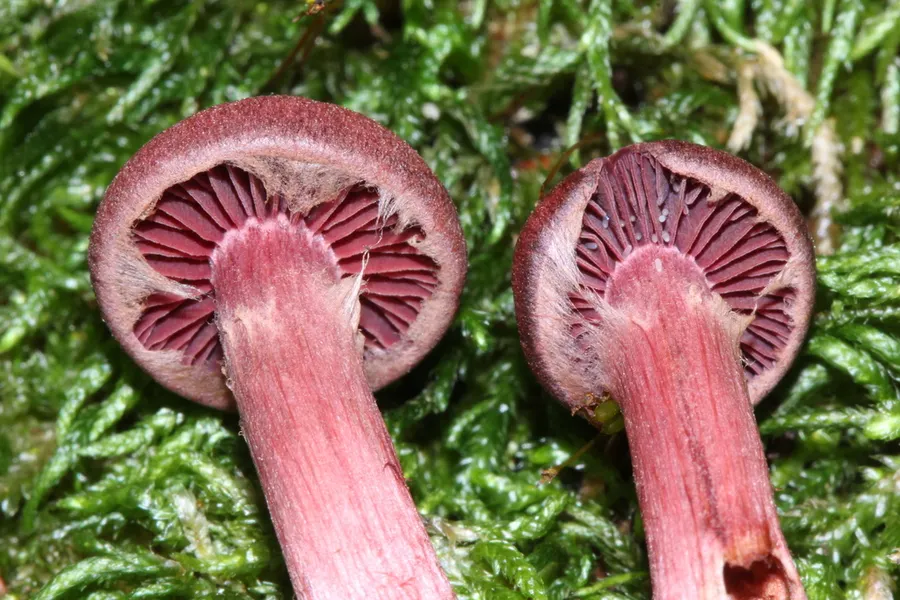
Fruit bodies have caps that are initially hemispherical to convex, but later become flattened, sometimes developing a low, broad umbo; the cap diameter is 1 – 5 cm. Its surface is dry, and its color vinaceous, with lighter margins. The cap margin is curved downward, and has faint radial grooves. It may be irregular in instances where fruit bodies have grown together in clusters. The gills have an adnate to somewhat decurrent attachment to the stipe. They are somewhat closely spaced. Initially deep vinaceous, they become brownish with a reddish tinge after the spores mature. The stipe measures 2 – 9 cm long by 2.6 – 6 mm thick, and the same width throughout its length, or slightly thicker at the base. It has a fibrillose surface texture, and, in mature specimens, faint longitudinal grooves. It is wine-red with a whitish base. Young individuals have a silky white partial veil that later becomes fibrillose (as if made of threadlike fibers) and vinaceous in color. The flesh is reddish brown and lacks any discernible odor. The spore print is cinnamon brown. Due to its rarity, the edibility of the mushroom has not been definitively established, but one report suggests that it is "harmless", with a flavor of "bland beef". Spores are typically 7.2–7.8 by 4.6–5.1 μm with a shape ranging from somewhat phaseoliform (bean-shaped) to elliptical to egg-shaped. The basidia (spore-bearing cells) are narrowly club-shaped to somewhat cylindrical, one-, two- or four-spored, and measure 26–30 by 5–9 μm. There are some cystidia scattered in the hymenium, and they measure 20–33 by 3–5 μm. On the gill edge, the cheilocystidia are arranged in clusters; they are club-shaped to egg-shaped, and measure 30–65 by 4–12 μm.
Habitat dan peran ekologis
Tubaria punicea is a saprobic species, and grows on the rotting wood of Arbutus. Fruit bodies are commonly encountered in the hollowed bases of large trees. Usual habitats include mixed forests containing Pseudotsuga, Arbutus, or Quercus. A rare species, the fungus is distributed on the west coast of North America from British Columbia, Canada, to Marin County, California.
- Habitat atau konteks temuan
- hutan
- Substrat
- Informasi belum tersedia pada sumber rilis ini.
- Peran atau konteks
- Pengurai
Reproduksi
Fruit bodies have caps that are initially hemispherical to convex, but later become flattened, sometimes developing a low, broad umbo; the cap diameter is 1 – 5 cm. Its surface is dry, and its color vinaceous, with lighter margins. The cap margin is curved downward, and has faint radial grooves. It may be irregular in instances where fruit bodies have grown together in clusters. The gills have an adnate to somewhat decurrent attachment to the stipe. They are somewhat closely spaced. Initially deep vinaceous, they become brownish with a reddish tinge after the spores mature. The stipe measures 2 – 9 cm long by 2.6 – 6 mm thick, and the same width throughout its length, or slightly thicker at the base.
Catatan identitas dan cakupan
- Nama diterima mengikuti Catalogue of Life Base2026-09-11; uraian mempertahankan konsep dan nama sumber aslinya.
- Original geographic, specimen and life-cycle scope retained; source import awaits individual editorial review.
- Impor dan terjemahan otomatis belum diperiksa editorial per profil. Struktur reproduktif yang disebutkan tidak membuktikan seluruh siklus hidup diketahui.
- Pengukuran pada uraian mengikuti spesimen, kultur, dan metode sumber; angka tidak diperluas ke semua populasi.
Catatan distribusi dalam narasi mengikuti sumbernya. Dokumentasi spesimen atau foto mengikuti catatan sumber. Bukti wilayah Indonesia dan penilaian konservasi tidak disimpulkan dari gambar.
Melihat dengan konteks
Dokumentasi Tubaria punicea menurut asosiasi foto pada record takson iNaturalist. Kredit: Alan Rockefeller. Identitas mengikuti sumber; bukan penentuan spesimen independen.
- Jenis
- Fotografi
- Kredit
- (c) Alan Rockefeller, some rights reserved (CC BY), uploaded by Alan Rockefeller
- Lisensi
- CC BY 4.0
- Sumber media
- Buka entri sumber
Sumber profil
- [1] Tubaria punicea — Wikipedia (en)
- [2] Catalogue of Life Base2026-09-11 — Tubaria punicea
- [3] Dokumentasi visual — Tubaria punicea
Rujukan halaman ini
Fungi. Tubaria punicea. Rilis data fungi-2026-10-12-expansion-2. https://fungi-atlas.mgadib.chatgpt.site/jamur/tubaria-punicea/.
Status: impor sumber; pemeriksaan editorial per profil belum selesai. Untuk klaim biologis, gunakan rujukan pada bagian terkait dan periksa konteks sumber aslinya.