01 / Morfologi

Ciri dan struktur

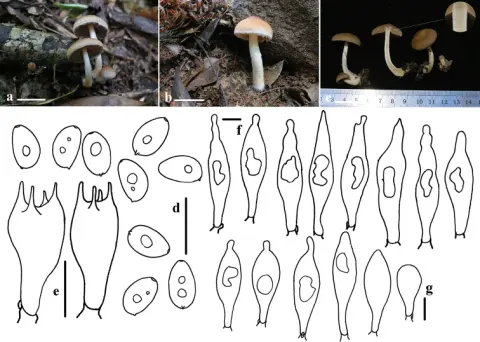
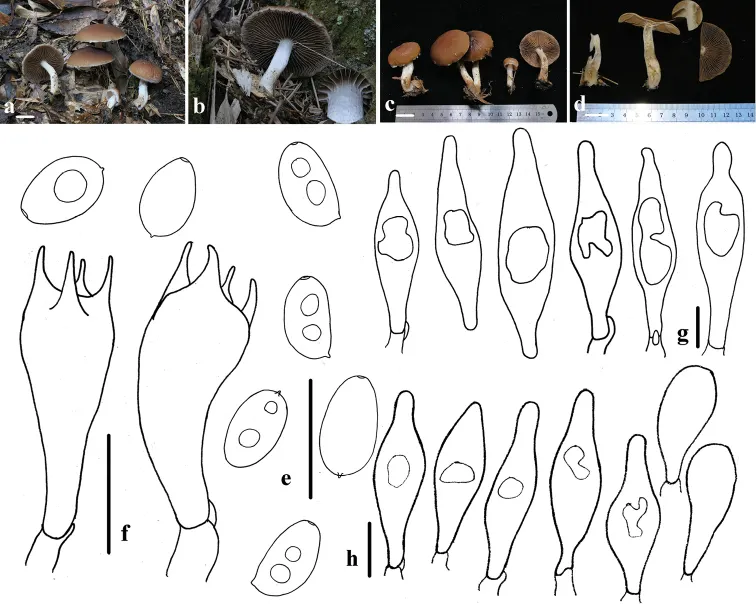
Differs from Typhrasa polycystis by having two types of long gills and rarely rostrum can be found in fusiform pleurocystidia. Pileus 35–55 mm, spreading hemispherically to oblate with a slight umbo, surface with distinct ridge-like folds, hygrophanous, reddish-brown (8E5–8F6), pale brown (6D7–6C7) at the margin, drying tawny (7D6–7E6), striate, sometimes faintly, at margin. Veil distinct, fibrous or fluffy, white (7C1), markedly appendiculate at margin, falling off easily. Context thin and fragile, hygrophanous, about 2.5 mm at the centre. Gills 5.0–7.0 mm broad, moderately close; when young, dirty white (7B1), becoming cinnamon (7C6–7D5) with a white edge (7C1); two types of long gills arranged at intervals: A: adnate to slightly decurrent, B: emarginate- adnexed. Stipe 40–60 mm long, 5.0–10 mm thick, white (7C1), hollow, pulverulent at apex, with fibrils and fluffy from pellicular veil remnants below, falling off easily. Spores (6.5)6.8–7.9(8.3) × 4.5–5.2(5.4) μm, Q = (1.3)1.4–1.7, ellipsoid to oblong-ellipsoid, profile flattened on one side, 4.1–5.0(5.2) μm broad, smooth, reddish-brown (8C6–8C7) in water, yellow-brown (7D6–7D7) in 5% KOH or 10% NH 3 ·H 2 O, becoming darker (7E4–7E5) in 5% KOH, germ pore small and indistinct, 1–2 guttulate, inamyloid. Basidia 18–23 × 7.0–8.0 μm, 4-spored, clavate, hyaline. Pleurocystidia 42–68 × 13–17 μm, thin-walled, fusiform, apex obtuse to subacute, rarely cystiform with a short rostrum, with one or two large internal oily drops, oily drops colourless and distinct or indistinct in 5% KOH, glassy-yellow (5B6–5B7) and very distinct in Melzer’s Reagent.

Sebagian uraian ditampilkan dalam bahasa sumber; terjemahannya belum tersedia atau belum lolos pemeriksaan.

Rujukan: [1]

Pengukuran mengikuti objek, spesimen atau kultur, dan metode yang disebutkan sumber. Baca uraian asli untuk konteks lengkap.

02 / Kehidupan

Habitat dan peran ekologis

Differs from Typhrasa polycystis by having two types of long gills and rarely rostrum can be found in fusiform pleurocystidia. Saprotrophic, solitary or gregarious on soil or humus in broad-leaved forests.

Sebagian uraian ditampilkan dalam bahasa sumber; terjemahannya belum tersedia atau belum lolos pemeriksaan.

Rujukan: [1]

Habitat atau konteks temuan
hutan
Substrat
tanah
Peran atau konteks
Pengurai
Temukan hubungan serupa
03 / Siklus hidup

Reproduksi

Pileus 35–55 mm, spreading hemispherically to oblate with a slight umbo, surface with distinct ridge-like folds, hygrophanous, reddish-brown (8E5–8F6), pale brown (6D7–6C7) at the margin, drying tawny (7D6–7E6), striate, sometimes faintly, at margin. Veil distinct, fibrous or fluffy, white (7C1), markedly appendiculate at margin, falling off easily. Context thin and fragile, hygrophanous, about 2.5 mm at the centre. Gills 5.0–7.0 mm broad, moderately close; when young, dirty white (7B1), becoming cinnamon (7C6–7D5) with a white edge (7C1); two types of long gills arranged at intervals: A: adnate to slightly decurrent, B: emarginate- adnexed. Stipe 40–60 mm long, 5.0–10 mm thick, white (7C1), hollow, pulverulent at apex, with fibrils and fluffy from pellicular veil remnants below, falling off easily.

Sebagian uraian ditampilkan dalam bahasa sumber; terjemahannya belum tersedia atau belum lolos pemeriksaan.

Rujukan: [1]

04 / Batas informasi

Catatan identitas dan cakupan

  • Nama diterima mengikuti Catalogue of Life Base2026-09-11; uraian mempertahankan konsep dan nama sumber aslinya.
  • Preserve original treatment localities, hosts and substrate scope. Materials examined describe documented specimens, not the full global range.
  • Impor dan terjemahan otomatis belum diperiksa editorial per profil. Struktur reproduktif yang disebutkan tidak membuktikan seluruh siklus hidup diketahui.
  • Pengukuran pada uraian mengikuti spesimen, kultur, dan metode sumber; angka tidak diperluas ke semua populasi.

Catatan distribusi dalam narasi mengikuti sumbernya. Dokumentasi spesimen atau foto mengikuti catatan sumber. Bukti wilayah Indonesia dan penilaian konservasi tidak disimpulkan dari gambar.

05 / Dokumentasi

Melihat dengan konteks

Basidiomata and microscopic features of Typhrasa rugocephala a–d basidiomata e basidiospores f basidia g pleurocystidia h cheilocystidia. Scale bars: 20 mm (a–d); 10 μm (e–h).

Jenis
Pelat ilmiah
Kredit
Sheng-Nan Wang, Ya-Ping Hu, Jun-Liang Chen, Liang-Liang Qi, Hui Zeng, Hui Ding, Guang-Hua Huo, Lin-Ping Zhang, Fu-Sheng Chen, Jun-Qing Yan
Lisensi
CC BY 4.0
Sumber media
Buka entri sumber

Gambar menunjukkan objek menurut identifikasi sumber, bukan verifikasi independen spesimen oleh Fungi. Tidak ada skala baru yang ditambahkan.

06 / Rujukan

Sumber profil

  1. [1] First record of the rare genus Typhrasa (Psathyrellaceae, Agaricales) from China with description of two new species — Typhrasa rugocephalaBagian sumber: PMC8087613_section_14
    Tanggal penghimpunan sumber: 2026-10-12
    Teks sumber: CC BY 4.0 · Wang SN, Hu YP, Chen JL, Qi LL, Zeng H, Ding H, Huo GH, Zhang LP, Chen FS, Yan JQ.
  2. [2] Catalogue of Life Base2026-09-11 — Typhrasa rugocephalaBagian sumber: ColDP NameUsage.tsv ID 9ZH22; accepted species; source 2073
    Tanggal penghimpunan sumber: 2026-10-12
  3. [3] Dokumentasi visual — Typhrasa rugocephalaBagian sumber: Individual media record; identification follows the source, not independent determination
    Tanggal penghimpunan sumber: 2026-10-12
    Media sumber: CC BY 4.0 · Sheng-Nan Wang, Ya-Ping Hu, Jun-Liang Chen, Liang-Liang Qi, Hui Zeng, Hui Ding, Guang-Hua Huo, Lin-Ping Zhang, Fu-Sheng Chen, Jun-Qing Yan

Adaptasi teks: CC BY 4.0. Wang SN, Hu YP, Chen JL, Qi LL, Zeng H, Ding H, Huo GH, Zhang LP, Chen FS, Yan JQ. — First record of the rare genus Typhrasa (Psathyrellaceae, Agaricales) from China with description of two new species — Typhrasa rugocephala

Uraian asli dan riwayat sumber

Riwayat atau halaman sumber

Ringkasan sumber

Differs from Typhrasa polycystis by having two types of long gills and rarely rostrum can be found in fusiform pleurocystidia. Pileus 35–55 mm, spreading hemispherically to oblate with a slight umbo, surface with distinct ridge-like folds, hygrophanous, reddish-brown (8E5–8F6), pale brown (6D7–6C7) at the margin, drying tawny (7D6–7E6), striate, sometimes faintly, at margin. Veil distinct, fibrous or fluffy, white (7C1), markedly appendiculate at margin, falling off easily. Context thin and fragile, hygrophanous, about 2.5 mm at the centre.

Revisi sumber

Morfologi sumber

Differs from Typhrasa polycystis by having two types of long gills and rarely rostrum can be found in fusiform pleurocystidia. Pileus 35–55 mm, spreading hemispherically to oblate with a slight umbo, surface with distinct ridge-like folds, hygrophanous, reddish-brown (8E5–8F6), pale brown (6D7–6C7) at the margin, drying tawny (7D6–7E6), striate, sometimes faintly, at margin. Veil distinct, fibrous or fluffy, white (7C1), markedly appendiculate at margin, falling off easily. Context thin and fragile, hygrophanous, about 2.5 mm at the centre. Gills 5.0–7.0 mm broad, moderately close; when young, dirty white (7B1), becoming cinnamon (7C6–7D5) with a white edge (7C1); two types of long gills arranged at intervals: A: adnate to slightly decurrent, B: emarginate- adnexed. Stipe 40–60 mm long, 5.0–10 mm thick, white (7C1), hollow, pulverulent at apex, with fibrils and fluffy from pellicular veil remnants below, falling off easily. Spores (6.5)6.8–7.9(8.3) × 4.5–5.2(5.4) μm, Q = (1.3)1.4–1.7, ellipsoid to oblong-ellipsoid, profile flattened on one side, 4.1–5.0(5.2) μm broad, smooth, reddish-brown (8C6–8C7) in water, yellow-brown (7D6–7D7) in 5% KOH or 10% NH 3 ·H 2 O, becoming darker (7E4–7E5) in 5% KOH, germ pore small and indistinct, 1–2 guttulate, inamyloid. Basidia 18–23 × 7.0–8.0 μm, 4-spored, clavate, hyaline. Pleurocystidia 42–68 × 13–17 μm, thin-walled, fusiform, apex obtuse to subacute, rarely cystiform with a short rostrum, with one or two large internal oily drops, oily drops colourless and distinct or indistinct in 5% KOH, glassy-yellow (5B6–5B7) and very distinct in Melzer’s Reagent.

Revisi sumber

Ekologi sumber

Differs from Typhrasa polycystis by having two types of long gills and rarely rostrum can be found in fusiform pleurocystidia. Saprotrophic, solitary or gregarious on soil or humus in broad-leaved forests.

Revisi sumber

Struktur reproduksi sumber

Pileus 35–55 mm, spreading hemispherically to oblate with a slight umbo, surface with distinct ridge-like folds, hygrophanous, reddish-brown (8E5–8F6), pale brown (6D7–6C7) at the margin, drying tawny (7D6–7E6), striate, sometimes faintly, at margin. Veil distinct, fibrous or fluffy, white (7C1), markedly appendiculate at margin, falling off easily. Context thin and fragile, hygrophanous, about 2.5 mm at the centre. Gills 5.0–7.0 mm broad, moderately close; when young, dirty white (7B1), becoming cinnamon (7C6–7D5) with a white edge (7C1); two types of long gills arranged at intervals: A: adnate to slightly decurrent, B: emarginate- adnexed. Stipe 40–60 mm long, 5.0–10 mm thick, white (7C1), hollow, pulverulent at apex, with fibrils and fluffy from pellicular veil remnants below, falling off easily.

Revisi sumber

Rujukan halaman ini

Fungi. Typhrasa rugocephala. Rilis data fungi-2026-10-12-expansion-2. https://fungi-atlas.mgadib.chatgpt.site/jamur/typhrasa-rugocephala/.

Status: impor sumber; pemeriksaan editorial per profil belum selesai. Untuk klaim biologis, gunakan rujukan pada bagian terkait dan periksa konteks sumber aslinya.