01 / Morfologi

Ciri dan struktur

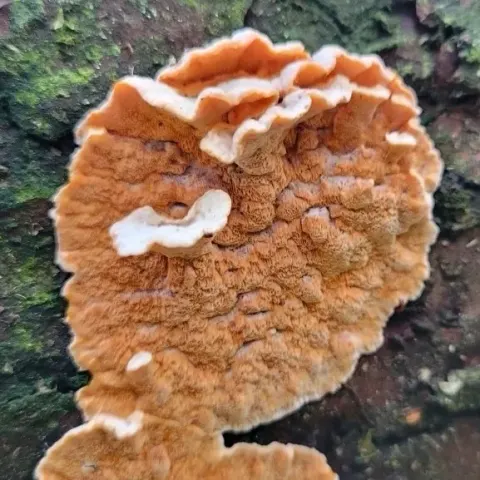
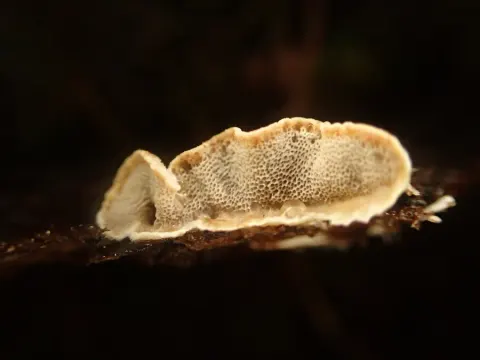
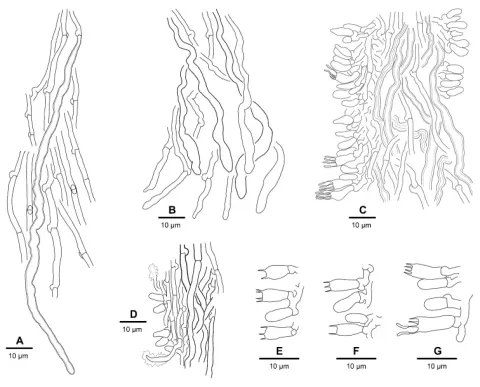
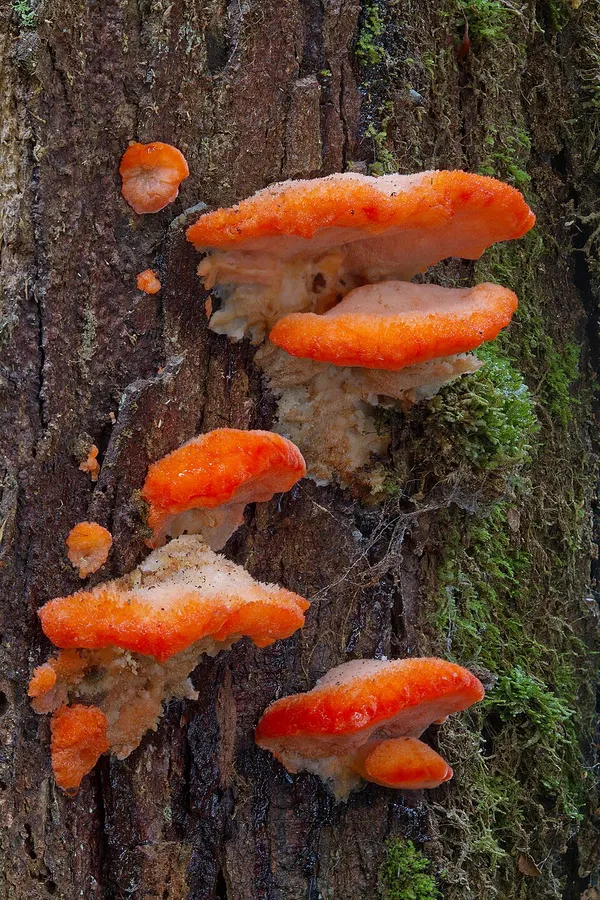
The fruit bodies of Tyromyces pulcherrimus are bracket-shaped caps that measure 3 – 8 cm in diameter. They are sessile, lacking a stipe, and are instead attached directly to the substrate. The cap colour when fresh is cherry red or salmon, but it dries to become brownish. The cap surface can be hairy, particularly near the point of attachment. Pores on the cap underside are red, and number about 1–3 per millimetre. The flesh is soft and thick, red, and watery. It does not have any distinct odour. Tyromyces pulcherrimus is inedible. With a monomitic hyphal system, Tyromyces pulcherrimus contains only generative hyphae. These hyphae are clamped, and are sometime covered with granules, or an orange substance that appears oily. The hyphae in the context are arranged in a parallel fashion, and strongly agglutinated to form a densely packed tissue. Cystidia are absent from the hymenium. The basidia are club shaped with typically four sterigmata, and measure 15–23 by 6.5–7.5 μm. Spores are ellipsoid to more or less spherical, hyaline, and measure 5–7 by 3.5–4.5 μm.

Sebagian uraian ditampilkan dalam bahasa sumber; terjemahannya belum tersedia atau belum lolos pemeriksaan.

Rujukan: [1]

Pengukuran mengikuti objek, spesimen atau kultur, dan metode yang disebutkan sumber. Baca uraian asli untuk konteks lengkap.

02 / Kehidupan

Habitat dan peran ekologis

Tyromyces pulcherrimus is a white rot fungus that grows on the exposed heartwood of several tree species. It has been recorded on southern beech (Nothofagus cunninghamii) in Victoria and Tasmania and on Antarctic beech (Nothofagus moorei) in Queensland and New South Wales. In Tasmania, evidence suggests that it prefers wet forests, including rainforest and wet sclerophyll forest. In Brazil, it is an introduced species that has been recorded on imported eucalypts. It has been found there in Rio Grande do Sul State. In New Zealand, the fungus has been recorded on red beech (Fuscospora fusca) and silver beech (Lophozonia menziesii).

Sebagian uraian ditampilkan dalam bahasa sumber; terjemahannya belum tersedia atau belum lolos pemeriksaan.

Rujukan: [1]

Habitat atau konteks temuan
hutan
Substrat
Informasi belum tersedia pada sumber rilis ini.
Peran atau konteks
Belum dikategorikan pada rilis ini.
Temukan hubungan serupa
03 / Siklus hidup

Reproduksi

With a monomitic hyphal system, Tyromyces pulcherrimus contains only generative hyphae. These hyphae are clamped, and are sometime covered with granules, or an orange substance that appears oily. The hyphae in the context are arranged in a parallel fashion, and strongly agglutinated to form a densely packed tissue. Cystidia are absent from the hymenium. The basidia are club shaped with typically four sterigmata, and measure 15–23 by 6.5–7.5 μm. Spores are ellipsoid to more or less spherical, hyaline, and measure 5–7 by 3.5–4.5 μm.

Sebagian uraian ditampilkan dalam bahasa sumber; terjemahannya belum tersedia atau belum lolos pemeriksaan.

Rujukan: [1]

Sinonim menurut acuan taksonomi rilis: Aurantiporus pulcherrimus; Polyporus pulcherrimus
04 / Batas informasi

Catatan identitas dan cakupan

  • Nama diterima mengikuti Catalogue of Life Base2026-09-11; uraian mempertahankan konsep dan nama sumber aslinya.
  • Original geographic, specimen and life-cycle scope retained; source import awaits individual editorial review.
  • Impor dan terjemahan otomatis belum diperiksa editorial per profil. Struktur reproduktif yang disebutkan tidak membuktikan seluruh siklus hidup diketahui.
  • Pengukuran pada uraian mengikuti spesimen, kultur, dan metode sumber; angka tidak diperluas ke semua populasi.

Catatan distribusi dalam narasi mengikuti sumbernya. Dokumentasi spesimen atau foto mengikuti catatan sumber. Bukti wilayah Indonesia dan penilaian konservasi tidak disimpulkan dari gambar.

05 / Dokumentasi

Melihat dengan konteks

Dokumentasi Tyromyces pulcherrimus dari Wikimedia Commons. The polypore fungus Tyromyces pulcherrimus ; photographed in Upper Florentine, Tasmania, Australia. Identifikasi mengikuti record berkas sumber.

Jenis
Fotografi
Kredit
This image was created by user noodle_snacks at Mushroom Observer , a source for mycological images. You can contact this user here .
Sumber media
Buka entri sumber

Gambar menunjukkan objek menurut identifikasi sumber, bukan verifikasi independen spesimen oleh Fungi. Tidak ada skala baru yang ditambahkan.

06 / Rujukan

Sumber profil

  1. [1] Tyromyces pulcherrimus — Wikipedia (en)Bagian sumber: Frozen revision 1376992854
    Tanggal penghimpunan sumber: 2026-10-12
    Teks sumber: CC BY-SA4.0 · Wikipedia contributors
  2. [2] Catalogue of Life Base2026-09-11 — Tyromyces pulcherrimusBagian sumber: ColDP NameUsage.tsv ID 59ZFB; accepted species; source 2073
    Tanggal penghimpunan sumber: 2026-10-12
  3. [3] Dokumentasi visual — Tyromyces pulcherrimusBagian sumber: Individual media record; identification follows the source, not independent determination
    Tanggal penghimpunan sumber: 2026-10-12
    Media sumber: CC BY-SA 3.0 · This image was created by user noodle_snacks at Mushroom Observer , a source for mycological images. You can contact this user here .

Adaptasi teks: CC BY-SA 4.0. Wikipedia contributors — Tyromyces pulcherrimus — Wikipedia (en)

Uraian asli dan riwayat sumber

Riwayat atau halaman sumber

Ringkasan sumber

Tyromyces pulcherrimus, commonly known as the strawberry bracket, is a species of poroid fungus in the family Polyporaceae. It is readily recognisable by its reddish fruit bodies with pores on the cap underside. The fungus is found natively in Australia and New Zealand, where it causes a white rot in living and dead logs of southern beech and eucalyptus. In southern Brazil, it is an introduced species that is associated with imported eucalypts.

Revisi sumber

Morfologi sumber

The fruit bodies of Tyromyces pulcherrimus are bracket-shaped caps that measure 3 – 8 cm in diameter. They are sessile, lacking a stipe, and are instead attached directly to the substrate. The cap colour when fresh is cherry red or salmon, but it dries to become brownish. The cap surface can be hairy, particularly near the point of attachment. Pores on the cap underside are red, and number about 1–3 per millimetre. The flesh is soft and thick, red, and watery. It does not have any distinct odour. Tyromyces pulcherrimus is inedible. With a monomitic hyphal system, Tyromyces pulcherrimus contains only generative hyphae. These hyphae are clamped, and are sometime covered with granules, or an orange substance that appears oily. The hyphae in the context are arranged in a parallel fashion, and strongly agglutinated to form a densely packed tissue. Cystidia are absent from the hymenium. The basidia are club shaped with typically four sterigmata, and measure 15–23 by 6.5–7.5 μm. Spores are ellipsoid to more or less spherical, hyaline, and measure 5–7 by 3.5–4.5 μm.

Revisi sumber

Ekologi sumber

Tyromyces pulcherrimus is a white rot fungus that grows on the exposed heartwood of several tree species. It has been recorded on southern beech (Nothofagus cunninghamii) in Victoria and Tasmania and on Antarctic beech (Nothofagus moorei) in Queensland and New South Wales. In Tasmania, evidence suggests that it prefers wet forests, including rainforest and wet sclerophyll forest. In Brazil, it is an introduced species that has been recorded on imported eucalypts. It has been found there in Rio Grande do Sul State. In New Zealand, the fungus has been recorded on red beech (Fuscospora fusca) and silver beech (Lophozonia menziesii).

Revisi sumber

Struktur reproduksi sumber

With a monomitic hyphal system, Tyromyces pulcherrimus contains only generative hyphae. These hyphae are clamped, and are sometime covered with granules, or an orange substance that appears oily. The hyphae in the context are arranged in a parallel fashion, and strongly agglutinated to form a densely packed tissue. Cystidia are absent from the hymenium. The basidia are club shaped with typically four sterigmata, and measure 15–23 by 6.5–7.5 μm. Spores are ellipsoid to more or less spherical, hyaline, and measure 5–7 by 3.5–4.5 μm.

Revisi sumber

Rujukan halaman ini

Fungi. Tyromyces pulcherrimus. Rilis data fungi-2026-10-12-expansion-2. https://fungi-atlas.mgadib.chatgpt.site/jamur/tyromyces-pulcherrimus/.

Status: impor sumber; pemeriksaan editorial per profil belum selesai. Untuk klaim biologis, gunakan rujukan pada bagian terkait dan periksa konteks sumber aslinya.