Ciri dan struktur
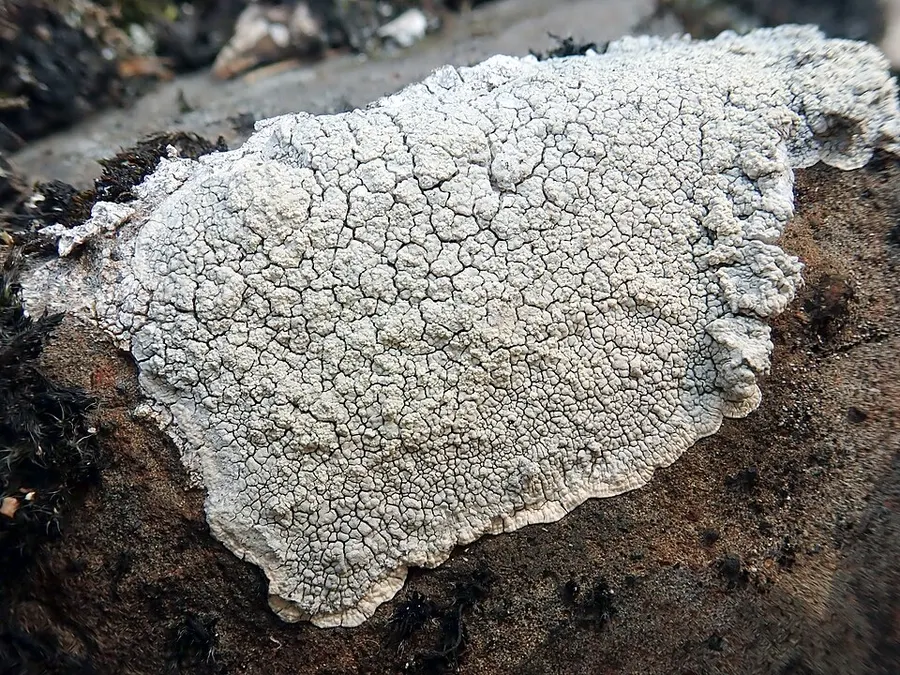
Varicellaria lactea forms a spreading, relatively thick thallus (the main body of the lichen) that appears white to greyish-white. Around the edges, a paler border called the is often visible, sometimes showing faint concentric zoning. The upper surface is typically smooth to slightly roughened and has a dull, appearance. It usually breaks up into a regular pattern of small, tile-like pieces known as , which in this species are fairly coarse, measuring about 0.3–0.8 mm across. These can be flat but are often noticeably convex and vary in shape from rounded to angular. The lichen reproduces mainly by means of soralia, which are small, powdery patches that produce dispersal granules called soredia. The soralia are white, slightly raised, and usually 0.5–1.5 mm in diameter; they may be surrounded by a fragile collar of thallus tissue and sometimes appear floury or efflorescent. They are mostly scattered evenly across the thallus but can occasionally grow close together. The soredia themselves are tiny, about 100–160 micrometres (μm) wide, although they can cluster into larger aggregations. Sexual reproductive structures are very uncommon in this species. When present, they occur as wart-like swellings that resemble soralia but are a little wider (0.4–0.7 mm). Each of these swellings usually contains one -shaped apothecium, rarely two. The discs are pale brown and at first covered by a frosty coating of white ; they are often surrounded by a ragged collar of thallus tissue that also produces soredia. Within these apothecia, the spore-bearing sacs (asci) contain only a single ascospore each.
Habitat dan peran ekologis
Varicellaria lactea is chiefly saxicolous (rock-dwelling), occurring on hard, lime-free, siliceous rocks in humid, shaded to semi‑shaded positions, often on steep faces; it is also recorded on volcanic substrates such as basalt. Field and phylogenetic work shows that the species is overwhelmingly rock‑dwelling, with the few reports from bark now understood to reflect confusion with the related corticolous V. hemisphaerica; substrate rather than chemistry is the main separator between the two. The species is widespread across Europe and locally frequent from lowlands into montane belts, and it also occurs in Macaronesia (Azores) on basaltic rock. Beyond Europe, modern revisions confirm it from East Asia (South Korea) and from North America, where it was first documented for the United States in Alaska and has since been recorded in Alaskan national parks on overhanging and vertical rock walls.
- Habitat atau konteks temuan
- Informasi belum tersedia pada sumber rilis ini.
- Substrat
- Informasi belum tersedia pada sumber rilis ini.
- Peran atau konteks
- Pembentuk liken
Reproduksi
The lichen reproduces mainly by means of soralia, which are small, powdery patches that produce dispersal granules called soredia. The soralia are white, slightly raised, and usually 0.5–1.5 mm in diameter; they may be surrounded by a fragile collar of thallus tissue and sometimes appear floury or efflorescent. They are mostly scattered evenly across the thallus but can occasionally grow close together. The soredia themselves are tiny, about 100–160 micrometres (μm) wide, although they can cluster into larger aggregations. Sexual reproductive structures are very uncommon in this species. When present, they occur as wart-like swellings that resemble soralia but are a little wider (0.4–0.7 mm).
Catatan identitas dan cakupan
- Nama diterima mengikuti Catalogue of Life Base2026-09-11; uraian mempertahankan konsep dan nama sumber aslinya.
- Original geographic, specimen and life-cycle scope retained; source import awaits individual editorial review.
- Impor dan terjemahan otomatis belum diperiksa editorial per profil. Struktur reproduktif yang disebutkan tidak membuktikan seluruh siklus hidup diketahui.
- Pengukuran pada uraian mengikuti spesimen, kultur, dan metode sumber; angka tidak diperluas ke semua populasi.
Catatan distribusi dalam narasi mengikuti sumbernya. Dokumentasi spesimen atau foto mengikuti catatan sumber. Bukti wilayah Indonesia dan penilaian konservasi tidak disimpulkan dari gambar.
Melihat dengan konteks
Dokumentasi Varicellaria lactea dari Wikimedia Commons. The rock-dwelling crustose lichen Varicellaria lactea , photographed in Armesberg (Bavaria) Germany Identifikasi mengikuti record berkas sumber.
- Jenis
- Fotografi
- Kredit
- Wolfgang von Brackel
- Lisensi
- CC BY-SA 4.0
- Sumber media
- Buka entri sumber
Sumber profil
- [1] Varicellaria lactea — Wikipedia (en)
- [2] Catalogue of Life Base2026-09-11 — Varicellaria lactea
- [3] Dokumentasi visual — Varicellaria lactea
Rujukan halaman ini
Fungi. Varicellaria lactea. Rilis data fungi-2026-10-12-expansion-2. https://fungi-atlas.mgadib.chatgpt.site/jamur/varicellaria-lactea/.
Status: impor sumber; pemeriksaan editorial per profil belum selesai. Untuk klaim biologis, gunakan rujukan pada bagian terkait dan periksa konteks sumber aslinya.